
- 74 languages supported by the Voice-Guided Experience
- HITRUST r2, SOC 2, and HIPAA compliance for secure handling of sensitive data
- Projected AI market growth from $10B in 2023 to $70B by 2032
Experts would likely conclude that Ushur’s synchronized voice and visual CX technology addresses a critical gap in omnichannel customer service, particularly in regulated industries, by reducing friction and improving completion rates for complex transactions.
Ushur's AI Ends Clunky Handoffs with Synchronized Voice and Visual CX
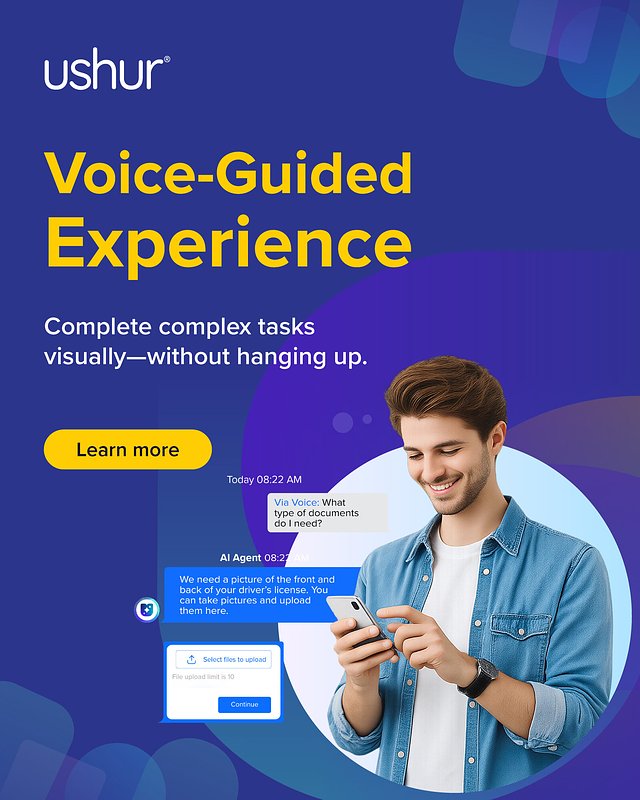
SANTA CLARA, CA – March 19, 2026 – In a move aimed at eliminating the friction of modern customer service, agentic CX platform Ushur today announced the launch of its Voice-Guided Experience. The new capability synchronizes a live AI-driven voice conversation with a secure visual interface on a customer’s mobile device, promising to transform how complex tasks are handled in highly regulated industries like healthcare, insurance, and financial services.
For years, businesses have pursued the "omnichannel" dream, offering customers a variety of contact methods from phone calls to web chats and mobile apps. However, the reality has often been a series of disjointed handoffs. Customers are frequently forced to repeat information, re-authenticate their identity, or abandon a digital process to make a phone call, leading to frustration and high drop-off rates. Ushur’s new technology aims to end this fragmentation by creating a single, continuous, and guided interaction.
Beyond the Broken Omnichannel
The core challenge in customer service for complex transactions—like filing an insurance claim, enrolling in a health plan, or updating financial account details—is that no single channel is ideal. Voice-only systems struggle with the precision needed for filling out forms or uploading documents, while digital-only journeys can feel isolating and demanding, requiring constant typing and visual attention. The moment a customer switches channels, the journey often breaks.
Ushur’s Voice-Guided Experience tackles this problem head-on by merging the two. A customer can initiate a voice call with an AI agent and, while the call remains active, receive a link to a secure mobile web experience. From there, the AI voice guide and the on-screen visuals work in tandem. The AI agent can ask the customer to select an option on their screen, upload a document, or confirm details, with each action on the screen being acknowledged by the voice agent and vice-versa. This creates a fluid, conversational process that feels less like navigating a complex system and more like having an expert guide you step-by-step.
“For years, the industry has chased 'omnichannel' support, but in reality, moving between voice and digital has stayed clunky and fragmented,” said Simha Sadasiva, CEO and Co-founder at Ushur, in the company's announcement. “At Ushur, we’re ending the era of the 'blind handoff.' Our Voice-Guided Experience ensures that when a customer needs help with a complex claim or enrollment, they aren't just left to navigate a screen alone—they have a real-time, synchronized guide.”
The company claims this synchronized approach leads to significantly higher completion rates for these critical journeys, providing meaningful deflection for costly live agent call centers and improving overall customer satisfaction.
A 'Trust-Native' Architecture for High-Stakes Industries
While improving the user experience is a key goal, Ushur’s primary focus is on the regulated sectors where trust and security are non-negotiable. The platform is built on what the company calls a "trust-native architecture," designed to meet the stringent governance, privacy, and security requirements of industries handling sensitive personal health information (PHI) or personally identifiable information (PII).
This architecture is underpinned by certifications and compliance with major industry standards, including HITRUST r2, SOC 2, and HIPAA. These are not just acronyms; they represent rigorous, third-party-validated frameworks for data protection and risk management.
* HITRUST r2 is a gold standard in healthcare, demonstrating a mature and comprehensive security posture.
* SOC 2 provides assurance about a company’s controls over security, availability, and confidentiality.
* HIPAA compliance is a legal necessity for any technology partner handling patient data in the United States.
By embedding governance, real-time observability, and regulator-ready audit trails directly into the AI platform, Ushur aims to give enterprises the confidence to deploy automation for their most critical customer interactions. Every conversation can be replayed, and built-in guardrails ensure the AI agents operate within predefined policies, mitigating compliance risks.
Competing in a Crowded AI Field
Ushur’s launch enters a fiercely competitive conversational AI market, projected to grow from around $10 billion in 2023 to over $70 billion by 2032. Established giants and nimble startups are all vying to redefine customer interactions with AI.
Major players like Genesys, a longtime leader in contact center solutions, recently introduced its own "Agentic Virtual Agent" powered by specialized Large Action Models (LAMs) designed to execute complex tasks across systems. LivePerson, another conversational AI leader, offers a "Conversation Orchestration" platform to integrate and manage AI across enterprise systems for clients like HSBC. Meanwhile, CRM behemoth Salesforce continues to deepen AI capabilities within its Service Cloud, offering industry-specific solutions with built-in compliance features.
In this landscape, Ushur is differentiating itself not by trying to be a general-purpose AI, but by solving a very specific and painful problem: the multimodal breakdown in complex, regulated workflows. While competitors offer powerful AI and omnichannel routing, Ushur’s tight synchronization of a live voice channel with a guided visual experience appears to be a unique approach tailored for high-stakes, high-friction customer journeys. The success of this strategy will depend on its ability to prove that this specialized function delivers a superior return on investment compared to more generalized platforms.
Improving Accessibility and Impact
Beyond operational efficiency, the Voice-Guided Experience is positioned to have a significant impact on accessibility and inclusivity. The platform supports 74 languages and can automatically detect the caller's language to personalize the interaction, removing a common barrier for diverse populations. Furthermore, the design is intended to comply with ADA accessibility standards.
For customers, especially during stressful situations like a medical emergency or a financial hardship application, this approach can dramatically reduce cognitive burden. Instead of trying to remember instructions or navigate a confusing website alone, the combination of auditory guidance and visual confirmation provides a clearer, less stressful path to resolution.
Leading organizations, including Inland Empire Health Plan (IEHP), Cigna, Aflac, and Unum, are already using the Ushur platform to streamline their customer experiences. With the general availability of the Voice-Guided Experience, these organizations and others can now tackle some of their most challenging customer workflows, from member support and coverage education to payment setup and claims processing. While enterprise-level adoption of such technology involves hurdles—including integration with legacy systems, cost, and internal change management—the promise of resolving complex customer needs on the first attempt, without human intervention, presents a compelling business case that many will find difficult to ignore.