
- 255,000 acres: The size of U.S. Sugar's domain where autonomous tractors are deployed.
- 30%: Potential boost in farm productivity from continuous operation of autonomous tractors.
- $500,000: Cost of a single fully autonomous tractor.
Experts view this deployment as a practical, scalable tool that enhances productivity, improves field safety, and strengthens the domestic food supply, while transforming the agricultural workforce through upskilling.
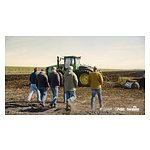
U.S. Sugar Deploys Robotic Fleet in Florida's Fields
CLEWISTON, FL – May 11, 2026 – In the vast, flat expanses of South Florida's sugar country, a new kind of farmhand is working the fields around the clock. U.S. Sugar, one of the nation's largest agricultural producers, has officially launched a fleet of autonomous John Deere tractors, marking the single largest commercial deployment of such technology in the American sugar industry. These unmanned machines are now tilling and preparing land across the company's 255,000-acre domain, signaling a pivotal shift in modern agriculture.
The initiative, a collaboration with Utah-based Autonomous Solutions, Inc. (ASI) and regional dealer Everglades Equipment Group, involves an initial fleet of five high-horsepower John Deere tractors retrofitted with ASI's advanced automation technology. Operating 24 hours a day, seven days a week, the driverless tractors are poised to redefine productivity in the demanding world of sugarcane cultivation.
"U.S. Sugar has always believed that combining innovation with hard work is the best way to keep feeding American families," said Ken McDuffie, president and CEO of U.S. Sugar, in a statement announcing the launch. "By leveraging American technology to increase efficiency and maximize productivity, we are also increasing reliability in our domestic food supply while creating new, higher-skilled opportunities for our employees."
The Dawn of Automated Agriculture
At the heart of the operation is ASI's Vehicle Automation Kit (VAK), a sophisticated system of hardware and software that integrates with the tractors' native drive-by-wire controls. This turns the familiar green-and-yellow machines into fully autonomous workhorses. Overseeing the fleet is a single human operator stationed in a central command center, using ASI's Mobius fleet management platform to monitor and direct multiple vehicles at once.
This deployment moves beyond the concept stage, representing a practical, large-scale application of technology that has been maturing for years. John Deere, a dominant force in the sector, has already deployed over 11,500 autonomous and semi-autonomous tractors globally. However, U.S. Sugar's commitment to an entire fleet for a specific commercial purpose sets a new precedent.
“This deployment demonstrates that autonomy is not a futuristic concept. It is a practical, scalable tool that helps American farmers do more with less, improve safety in the field and keep pace with global demand,” stated ASI CEO Mel Torrie.
The tractors, a mix of John Deere's powerful 8R and 9R Series, are equipped with an array of sensors, high-precision GPS, and advanced AI processing capabilities, allowing them to navigate fields with centimeter-level accuracy. This precision was honed during an 18-month pilot program on U.S. Sugar's own farmlands, ensuring the system was customized for the unique demands of sugarcane land preparation.
The Economic Equation of Autonomy
The move toward automation is a calculated investment driven by a complex economic equation. The initial capital outlay is substantial. A single fully autonomous tractor can cost upwards of $500,000, and retrofitting existing machinery with advanced kits also requires significant investment. The global market for autonomous farm equipment, valued at over $7 billion in 2024, is projected to surge to nearly $19 billion by 2030, underscoring the massive capital flowing into this sector.
For a large-scale operation like U.S. Sugar, the potential return on investment lies in long-term efficiency gains that offset the upfront cost. The most immediate benefit is the ability to operate continuously, maximizing the use of expensive equipment and compressing operational timelines. This can boost overall farm productivity by as much as 30%.
Furthermore, precision technology promises significant reductions in input costs. By optimizing every pass across a field, the autonomous system reduces fuel consumption and minimizes waste of seeds, fertilizers, and other resources. However, the economic case isn't universally proven for all farm sizes. A Purdue University study noted that for automation to be clearly more cost-effective than conventional methods, labor wages would need to be exceptionally high to offset the technology's price tag, suggesting that large industrial farms are best positioned to reap the financial rewards.
"By pairing John Deere’s trusted equipment with cutting-edge autonomous systems, we are helping growers boost productivity, improve accuracy and reduce resource use, all while keeping American agriculture at the forefront of innovation,” said Mike Schlechter, president at Everglades Equipment Group.
Reshaping the Rural Workforce
While the image of driverless tractors raises questions about the future of farm labor, U.S. Sugar has been proactive in addressing the human impact. The company has publicly committed to retaining its current employees, focusing on retraining and upskilling them for new, technology-focused roles. Instead of driving tractors, employees will become autonomous vehicle operators, system technicians, and data analysts—positions that require what the company calls "knowledge-based skills."
This strategy directly confronts the agricultural sector's persistent labor shortages while charting a path for workforce evolution. The shift is from manual, often grueling, field labor to overseeing complex robotic systems from a control room. This transition reflects a broader trend where automation is not just replacing labor but transforming the nature of the work itself.
The success of this model at U.S. Sugar could provide a blueprint for other industries grappling with similar challenges. The focus on creating new, higher-skilled opportunities aims to ensure that the benefits of technological advancement are shared with the existing workforce, mitigating the disruptive impact of automation.
A Greener Furrow? Sustainability in the Digital Age
Beyond economics and labor, U.S. Sugar touts "enhanced sustainability" as a key benefit of its autonomous fleet. This claim is rooted in the core principles of precision agriculture. The tractors' hyper-accurate navigation and execution can lead to tangible environmental gains.
Studies in precision agriculture have shown that optimized routing and consistent speed can reduce fuel consumption by over 6%. The precise application of fertilizers and pesticides—only where they are needed and in the exact amount required—can cut their use by nearly 10%, reducing chemical runoff into surrounding ecosystems. In a region as ecologically sensitive as South Florida, which sits adjacent to the Everglades, such reductions are particularly significant.
The technology is currently focused on land preparation for sugarcane, but the company has announced its intention to expand its use to other crops, including sweet corn and green beans. As the autonomous fleet expands across the company's vast 400-square-mile territory over the next decade, the cumulative impact of these resource efficiencies could be substantial, strengthening the reliability and sustainability of the domestic food supply chain. This deployment is not just a test; it is the new reality of farming at an industrial scale.