
- $135 million ARPA-E investment over 18 months to tackle fusion barriers
- $1.5 billion in private follow-on funding catalyzed by ARPA-E
- DIII-D National Fusion Facility: Largest magnetic fusion research site in the U.S.
Experts agree that the U.S. is strategically positioning itself to lead the global fusion race through strong public-private partnerships, significant federal investment, and a clear decadal vision for commercial deployment by the 2040s.
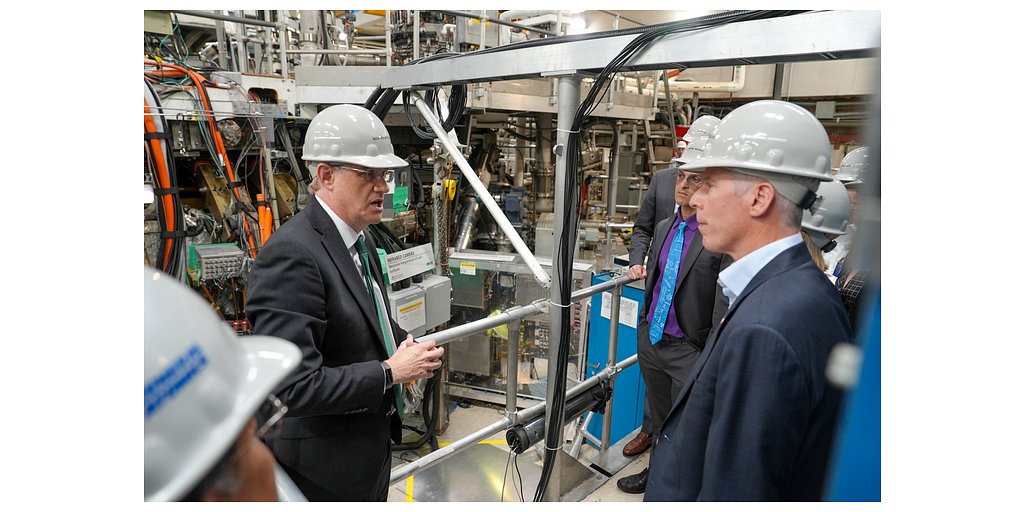
US Backs Fusion Future: Energy Secretary Touts Public-Private Power
SAN DIEGO, CA – April 10, 2026 – A high-level delegation from the U.S. Department of Energy (DOE), led by Energy Secretary Chris Wright, toured the sprawling fusion research facilities at General Atomics this week, signaling a forceful federal commitment to accelerating the promise of clean, limitless energy. The visit underscores a national strategy that increasingly relies on a powerful synergy between government funding and private sector innovation to win the global race for commercial fusion power.
Joined by Under Secretary for Science Darío Gil and ARPA-E Director Conner Prochaska, Secretary Wright inspected the DIII-D National Fusion Facility, the largest magnetic fusion research site in the United States, and General Atomics’ advanced inertial confinement fusion manufacturing spaces. The tour provided a firsthand look at the dual-pronged approach shaping America's fusion ambitions: developing a future power source while simultaneously supporting critical national security missions.
"Fusion, my original dream... represents one of the most promising energy breakthroughs of our time," Secretary Wright stated during the visit. "The work underway at General Atomics is a strong example of how you drive fusion forward, bringing together world-class science and engineering to move long-standing scientific ambition to something we can realistically deliver, and it’s happening here in the United States."
A Bold Vision for a Fusion-Powered Future
The Secretary's visit is more than a ceremonial stop; it's a visible endorsement of the DOE's "Bold Decadal Vision for Commercial Fusion Energy." Launched in 2022 and detailed in a 2024 strategy document, this national plan aims to shift fusion from a purely scientific endeavor to a commercially viable industry. The central goal is to support the private sector in demonstrating a fusion pilot plant in the 2030s, with commercial deployment scaling up through the 2040s.
This ambitious timeline is backed by significant federal investment designed to de-risk the technology for private companies. The Advanced Research Projects Agency–Energy (ARPA-E), which Director Prochaska leads, recently announced a record $135 million investment over 18 months to tackle key technical barriers. These funds are part of a larger strategy that has seen ARPA-E catalyze over $1.5 billion in private follow-on funding, seeding a vibrant ecosystem of fusion startups.
Further bolstering this effort are programs like the Fusion Innovation Research Engine (FIRE) Collaboratives and the Innovation Network for Fusion Energy (INFUSE), which received a combined $134 million in 2025 to bridge the gap between fundamental research and industry needs. These initiatives foster collaboration between national labs, universities, and the growing number of private companies vying to build the world's first fusion power plant.
"Achieving commercial fusion energy is one of the most important scientific and engineering challenges of our time," said Anantha Krishnan, senior vice president of General Atomics Energy Group, acknowledging the critical role of federal support.
The DIII-D: America's Fusion Workhorse
At the heart of this public-private strategy is the DIII-D National Fusion Facility. Operated by General Atomics on behalf of the DOE, the doughnut-shaped tokamak is a cornerstone of the nation’s fusion program. It doesn't aim to be a power plant itself; rather, it's an indispensable scientific instrument for understanding and taming the superheated plasma—the fourth state of matter—required for fusion.
For decades, DIII-D has been the site of landmark discoveries, from validating theories on plasma turbulence to pioneering methods for controlling instabilities that could otherwise halt a fusion reaction. Today, its mission is focused on solving critical science and technology gaps for future reactors, particularly for the tokamak design, which is the most mature fusion concept globally.
The facility serves as a unique collaborative hub where scientists from national labs, universities, and private companies work side-by-side. This model is crucial for training the next generation of fusion scientists and engineers.
“DIII-D plays a critical role in bringing together scientists and engineers to solve some of fusion energy’s most complex challenges and stands as a strong example of public-private partnership,” explained Wayne Solomon, vice president of magnetic fusion energy for General Atomics. He noted the facility's essential work in pioneering machine learning for plasma control, strengthening the domestic supply chain, and training a specialized workforce.
Fusion's Dual Promise: Energy and National Security
While the long-term goal is generating electricity, the tour also highlighted a more immediate and often overlooked aspect of General Atomics' work: its contribution to U.S. national security. The delegation visited the company's inertial fusion technology labs, where technicians fabricate and manufacture microscopic, precision-engineered targets used in inertial confinement fusion (ICF) experiments.
This work is a vital component of the National Nuclear Security Administration’s (NNSA) Stockpile Stewardship Program, which ensures the safety and reliability of the U.S. nuclear deterrent without resorting to explosive testing. By firing powerful lasers at these tiny targets at facilities like the National Ignition Facility, scientists can recreate the extreme conditions inside a nuclear weapon, gathering data that is crucial for maintaining the stockpile.
“Inertial fusion depends on precision at every step, and that is where General Atomics has built deep expertise over many years,” said Mike Farrell, vice president of inertial fusion technologies. This dual-use nature of fusion research means that advancements in materials and physics can simultaneously push the country closer to a clean energy future and reinforce its strategic defense posture.
The Global Race and The Hurdles Ahead
The intensified U.S. focus comes amid a heated global race to commercialize fusion. The international ITER project in France, a massive multi-decade collaboration, aims to demonstrate the scientific feasibility of fusion at a grand scale. Meanwhile, a constellation of private companies, many in the U.S., are pursuing nimbler, more varied approaches. Competitors like Commonwealth Fusion Systems, with its high-temperature superconducting magnets, and Helion Energy, with its pulsed fusion concept, have raised billions in private capital and are pursuing aggressive timelines.
Despite the optimism and investment, formidable challenges remain. No fusion project has yet achieved sustained net energy gain in a way that could be practically harnessed for a power grid. Scientists and engineers must still solve monumental materials science problems, as any reactor must withstand temperatures hotter than the sun's core and intense neutron bombardment for decades.
Furthermore, the most common fusion fuel cycle involves tritium, a rare and radioactive isotope of hydrogen. Future power plants will need to breed their own tritium fuel in a complex "breeding blanket" surrounding the plasma—a technology that is still in the early stages of development. These technical hurdles, combined with the need to establish a clear regulatory framework, mean that while the 2030s may see pilot plants, widespread commercial deployment remains a monumental undertaking.
The visit by Secretary Wright and his team serves as a clear signal that the U.S. intends to meet these challenges head-on, leveraging the collaborative power of its national labs and the dynamism of its private industry. “The United States has the talent, innovation and capability to lead this effort globally,” Krishnan affirmed, framing the quest for fusion as an opportunity to secure a powerful source of carbon-free energy for generations to come.