
- $33 billion: The AI-powered industrial robot market is projected to grow to this value by 2035, up from nearly $18 billion in 2026.
- 100,000+: Universal Robots has over 100,000 cobots deployed globally, providing a scalable platform for data capture.
- Multimodal Data Capture: The UR AI Trainer synchronizes robot motion, force feedback, and visual data to train advanced Vision-Language-Action (VLA) models.
Experts view the UR AI Trainer as a breakthrough in bridging the 'lab-to-factory gap,' enabling robots to learn complex tasks directly on the production floor through high-fidelity, multimodal data capture.
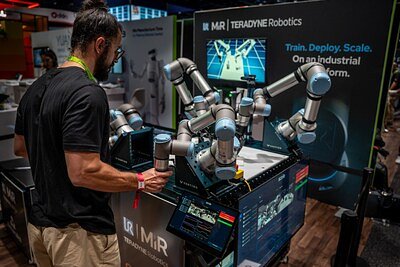
Universal Robots and Scale AI Unveil System to Train Robots on the Job
SAN JOSÉ, Calif. – March 19, 2026 – A landmark collaboration between collaborative robot (cobot) leader Universal Robots and data-centric AI firm Scale AI is set to redefine how industrial machines learn. Unveiled this week at the GTC 2026 conference, the new UR AI Trainer is an imitation learning system designed to bridge the persistent and costly gap between AI development in the lab and its practical application on the factory floor.
This new system marks a significant shift away from the rigid, pre-programmed automation that has long defined industrial robotics. Instead, it ushers in an era where robots can be taught complex, contact-rich tasks through human demonstration, capturing the nuanced data needed to train sophisticated AI models directly on production-grade hardware.
"Our customers, ranging from large enterprises to AI research labs, are no longer just asking for AI features," said Anders Beck, VP of AI Robotics Products at Universal Robots, in the announcement. "They need a way to collect high-fidelity, synchronized robot and vision data to train AI models on the same robots they intend to deploy. Our AI Trainer is the industry's first direct lab-to-factory solution for AI model training."
The Challenge of Teaching Industrial Robots
For years, the promise of intelligent, adaptable robots in manufacturing has been hindered by a fundamental data problem. AI models, particularly for robotics, are notoriously data-hungry, but collecting the right kind of data has been a major bottleneck. Historically, training data has been gathered using research-grade robots in controlled laboratory settings, which often fail to replicate the unpredictable conditions of a real factory.
This discrepancy creates the infamous "lab-to-factory gap," where an AI model that performs flawlessly in a lab struggles or fails completely when deployed into production. Furthermore, many existing systems have relied heavily on visual feedback alone, making it difficult for robots to learn delicate tasks that require a sense of touch, such as assembling small components or inserting parts with tight tolerances. These "contact-rich" applications demand a deeper level of physical understanding that vision alone cannot provide.
"The AI Trainer directly addresses these barriers," Beck noted, emphasizing the system's ability to overcome the limitations of fragmented hardware and low-fidelity data capture that have plagued the industry.
Learning by Imitation: A New Training Paradigm
The UR AI Trainer introduces an intuitive, hands-on approach to robot instruction. Using a "leader-follower" setup, a human operator physically guides a "leader" robot through a task, such as carefully packaging a smartphone. A second "follower" robot mirrors these movements in real-time. The key innovation lies in what happens during this process.
As the human performs the demonstration, the system captures a rich, multimodal stream of synchronized data. This isn't just a recording of the robot's path; it includes precise physical interaction data thanks to Universal Robots' proprietary Direct Torque Control interface. This technology allows for granular control and feedback over the robot's joint torques at a high frequency, effectively giving the AI a sense of touch. By combining this force feedback with motion trajectories and visual data from cameras, the system creates the structured, high-fidelity datasets required to train advanced Vision-Language-Action (VLA) models.
VLAs represent the cutting edge of robotics AI, enabling machines to connect visual observations with natural language commands to execute physical actions. By generating VLA-ready data, the UR AI Trainer paves the way for robots that can understand more abstract instructions and adapt to variations in their tasks and environment.
A Strategic Alliance in a Competitive AI Race
The partnership between Universal Robots and Scale AI is a strategic fusion of hardware and data expertise. Universal Robots brings its massive global footprint, with over 100,000 cobots already deployed across numerous industries, providing a ready-made platform for scalable data capture. Scale AI, a leader in providing high-quality data to power AI models, contributes the software stack and infrastructure to manage and process this data effectively.
"Universal Robots is a leader in industrial robotics, and its global footprint offers the ideal foundation for data capture and AI deployment," said Ben Levin, General Manager of Physical AI at Scale AI. "Together, we've created an integrated robotics data flywheel, allowing customers to train, deploy, and improve their AI models faster than ever before."
This move places the duo at the heart of a rapidly accelerating race to deploy "Physical AI" on an industrial scale. The competitive landscape is heating up, with other major players like ABB also announcing collaborations with tech giants like NVIDIA to enhance simulation and AI training capabilities. Meanwhile, companies such as Boston Dynamics are using a combination of simulation and human demonstration to train their humanoid robots for factory work. The UR and Scale AI collaboration distinguishes itself by focusing on a practical, hardware-first approach that uses the final deployment environment as the primary training ground.
Fueling the Future with Industrial Data
Perhaps one of the most significant outcomes of this partnership will be its contribution to the broader AI community. Universal Robots and Scale AI have announced plans to release a large-scale industrial dataset collected using the UR AI Trainer later this year. The scarcity of high-quality, real-world robotics data has long been a barrier to academic and commercial research.
The release of a comprehensive, multimodal dataset from a real industrial setting could have an impact on robotics analogous to what the ImageNet dataset did for computer vision, providing a benchmark and a foundational resource to fuel innovation across the industry. This initiative addresses a critical need, as the performance of next-generation VLA models is heavily dependent on the quality and diversity of the data they are trained on.
With the AI-powered industrial robot market projected to grow from nearly $18 billion in 2026 to over $33 billion by 2035, the demand for more intelligent and flexible automation is clear. By creating a direct and scalable path for teaching robots on the job, Universal Robots and Scale AI are not just launching a new product; they are building a foundational platform intended to accelerate the entire field of industrial AI.