
- $18 million: Cost of the restoration project for Beit Beirut, supported by Lebanese and French authorities.
- 4.6 meters: Height of the 'SAWA' steel sculpture installed atop the museum.
- 15 years: Duration of Lebanon's civil war (1975–1990), which the museum and sculpture aim to address.
Experts would likely conclude that the 'SAWA' sculpture represents a powerful symbol of unity and reconciliation, effectively transforming a site of historical conflict into a beacon of hope and collective healing.
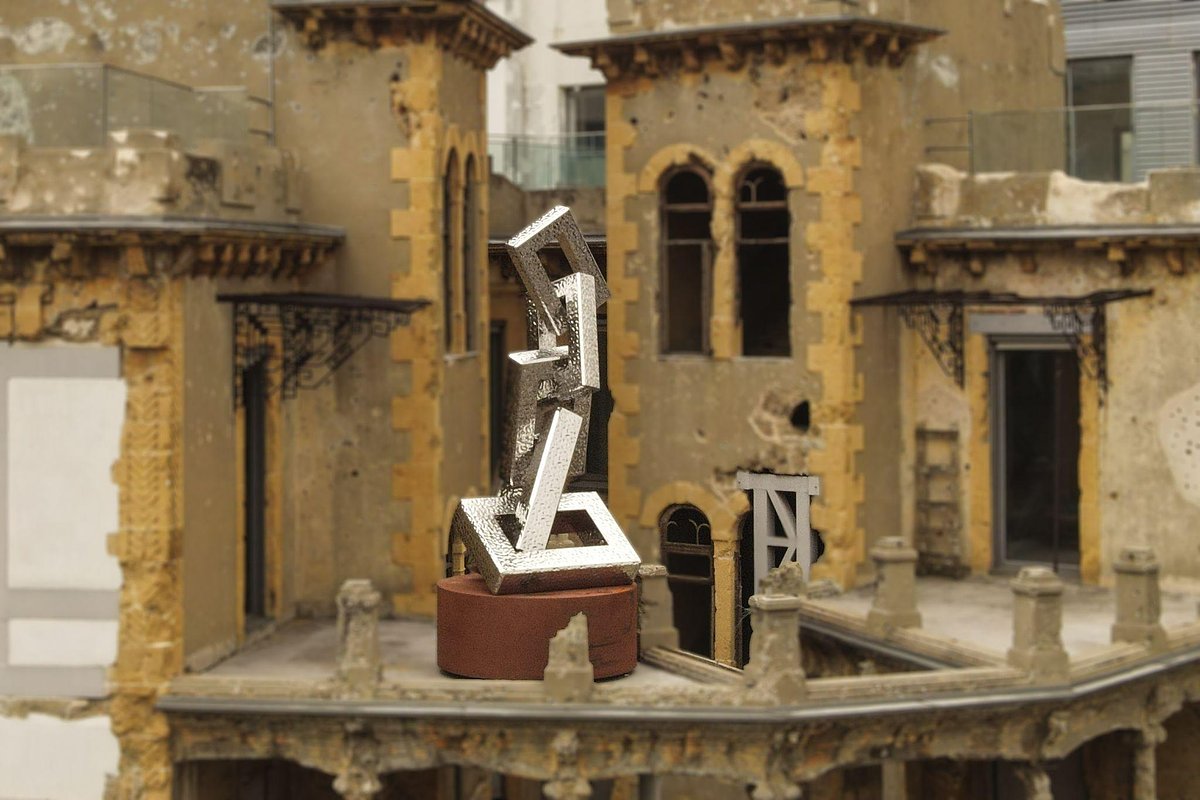
Unity Forged in Steel: 'SAWA' Sculpture Crowns Beit Beirut Museum
BEIRUT, Lebanon – March 12, 2026 – Atop the bullet-scarred façade of Beit Beirut, a building that once served as a frontline sniper's nest, a new symbol of hope now watches over the city. Titled “SAWA,” an Arabic word for “together,” the monumental steel sculpture by Geneva-based artists Pierre and Cedric Koukjian was installed this week, offering a powerful statement of peace and unity on a site synonymous with division.
The installation, an interconnected chain forged from hand-hammered stainless steel, adds a contemporary layer of meaning to the historic museum. It reinforces Beit Beirut's mission as a space for reflection and reconciliation in a city still navigating the complex legacy of its 15-year civil war.
A Monument on a Memory-Laden Site
To understand the significance of “SAWA,” one must first understand the ground on which it stands. Beit Beirut, also known as the Barakat Building, is not merely a museum; it is a preserved wound. Located on the infamous Green Line, the demarcation zone that violently split Beirut into Christian East and Muslim West during the civil war from 1975 to 1990, the building’s strategic position made it a deadly perch for militiamen.
Designed in 1924 by architect Youssef Aftimus, the elegant residential structure was left a hollowed-out shell by the conflict, its walls pockmarked with countless bullet holes and shrapnel scars. After the war, it was slated for demolition, destined to be erased like so many other painful reminders of the past. However, a determined preservation campaign, led by architect and activist Mona Hallak, successfully argued for its immense cultural value. The building was saved and, following an $18 million restoration project supported by Lebanese and French authorities, was reborn as a museum of urban memory.
Unlike traditional museums that display artifacts behind glass, Beit Beirut’s primary exhibit is itself. The restoration deliberately preserved the war damage, transforming the architecture of violence into a tool for education and dialogue. The museum invites visitors to confront the city's traumatic history directly, fostering a collective memory essential for healing and preventing future conflict. The installation of “SAWA” builds directly on this ethos, placing a forward-looking symbol of connection atop a foundation of difficult remembrance.
Forging Unity from Steel and Vision
The artists behind the sculpture, the father-and-son duo Pierre and Cedric Koukjian of SINCE Fine Art, share a deep, personal history with Beirut. Both were born in the city but were forced to leave due to the civil war—Pierre in the late 1970s and Cedric in the mid-1990s. This lived experience of displacement and conflict profoundly informs their artistic practice, which often explores themes of identity, connection, and resilience through a postmodernist lens.
“SAWA” is a quintessential example of their work. The sculpture, which measures 4.6 meters, is designed as a series of massive, interconnected chain links. Crafted from stainless steel and painstakingly hand-hammered, its surface has an undulating, reflective quality that seems to echo the texture of Beit Beirut’s weathered and battle-worn façade. The chain, a recurring motif in Cedric Koukjian’s work, is used here not as a symbol of bondage, but of voluntary and powerful unity—the strength that comes from being linked together.
“This installation embodies the values of connection and hope,” a spokesperson for the designers stated. “Signed by Pierre and Cedric Koukjian, it complements the museum’s mission of preserving history while encouraging reflection and dialogue about the city’s future.” The work physically integrates with the building while offering a profound conceptual counterpoint: where snipers once sought to sever connections, the Koukjians’ art celebrates the unbreakable bonds of a shared humanity.
An Anchor in Beirut's Resilient Art Scene
The arrival of “SAWA” is a significant moment for Beirut's dynamic and fiercely resilient public art scene. In a city where cultural expression often serves as a form of social and political commentary, public art is a vital, if sometimes contentious, part of the urban dialogue. Beirut’s streets are a canvas for artists like Yazan Halwani and the ASHEKMAN collective, who use Arabic calligraphy and murals to reclaim public spaces.
However, the cultural sector faces immense challenges. With minimal state sponsorship, it relies heavily on private patronage and non-profit initiatives. The ongoing economic crisis and the devastating 2020 port explosion have led to an exodus of artists and cultural administrators, further straining the ecosystem. In this context, a major installation like “SAWA” represents a powerful injection of creative energy and a vote of confidence in the city's future.
Public art in Beirut must also navigate a landscape of deep historical and political sensitivities. Past installations have sparked controversy, such as Nadim Karam’s “The Gesture,” a sculpture made from port debris that drew mixed reactions for its timing and symbolism. “SAWA,” with its unambiguous message of peace placed on a site dedicated to reconciliation, appears to have struck a resonant chord, directly addressing the city’s need for unifying symbols that honor memory while inspiring hope.
A Delicate Installation for a Fragile History
Placing a multi-ton steel sculpture atop a historic, war-damaged building was a feat of engineering and conservation. The complex logistics were managed by the firm Blackblues, which was tasked with ensuring the artwork could be securely integrated without compromising the fragile architectural integrity of Beit Beirut. The careful planning and execution reflect a deep respect for the building’s status as a historical artifact.
The sculpture does not sit as an imposition but as a crown, a final piece that completes the building’s narrative arc from a place of division to a beacon of unity. As it catches the Mediterranean light, its polished steel links stand in stark contrast to the dark, hollowed-out windows below, creating a visual dialogue between Beirut's past and its potential future. The artwork serves as a testament that even from the most broken of foundations, something strong, beautiful, and whole can be built.