
- 70,000-square-foot Festival Plaza capable of hosting up to 20,000 people
- 5.5 million visitors annually to Exhibition Place, generating over $500 million in regional economic impact
Experts view the Exhibition Place Vision Plan as a forward-looking initiative to enhance Toronto’s waterfront, though they caution that balancing commercial interests with equitable public access will be critical to its success.
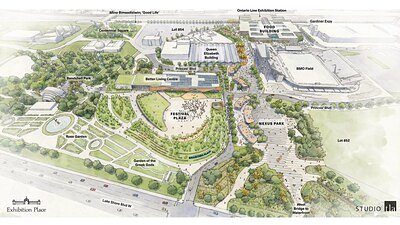
Exhibition Place's Grand Vision for Toronto's Waterfront
TORONTO, ON – April 16, 2026 – The Exhibition Place Board of Governors has endorsed a sweeping vision to reshape one of Toronto’s most iconic sites, approving in principle a long-term plan to transform the 192-acre grounds from a seasonal event space into a vibrant, year-round public destination. The move signals the start of a multi-faceted initiative aimed at better connecting the historic site to the city, the waterfront, and the daily lives of Torontonians.
At a meeting on Thursday, the board endorsed the 'Exhibition Place Vision Plan,' which outlines a future where the sprawling campus evolves from a collection of individual venues into a cohesive, interconnected district. The plan prioritizes a revitalized public realm, seamless transit integration, and new, flexible spaces designed to attract everything from global festivals to local community gatherings.
"This vision builds on the site's rich history while positioning it to better serve Toronto," said Don Boyle, Chief Executive Officer of Exhibition Place, in a statement. He emphasized that the goal is to create an "interconnected campus" that will "reduce pressure on city streets, support Toronto's growing festival and events sector, and strengthen the city's position as a global destination."
A Blueprint for a Year-Round Campus
The core of the vision involves a significant physical reimagining of the grounds. Central to the proposal is the creation of Festival Plaza, a nearly 70,000-square-foot flexible outdoor space capable of hosting up to 20,000 people. This purpose-built plaza is designed to anchor the site as a premier location for large-scale cultural events and concerts throughout the year.
Complementing this will be Nexus Park, a new green space, and a revitalized Food Building and market area, all intended to provide consistent amenities for residents and visitors, even on days without major events. The plan is a direct evolution of earlier master planning efforts that sought to organize the grounds into distinct zones for recreation, entertainment, and exhibition.
Improved connectivity is a cornerstone of the project. A new north-south pedestrian corridor will create a direct, welcoming path from the future Exhibition Station—a key stop on the new Ontario Line—through the heart of the campus and down to the Lake Ontario waterfront. An east-west multi-use pathway will also link disparate parts of the grounds, from The Bentway in the east to Dufferin Street, knitting together venues like BMO Field and Coca-Cola Coliseum into a more intuitive network.
"This Vision Plan is about revealing the full potential of Exhibition Place," said Deputy Mayor Ausma Malik, who also serves as Chair of the Board of Governors. She described the goal as creating a "truly outstanding shared public realm for all residents and visitors to discover and enjoy."
Economic Engine and Community Concerns
Exhibition Place is already a critical economic driver, generating over half a billion dollars in regional economic impact and drawing more than 5.5 million visitors annually. The new vision aims to amplify that role significantly. By enabling year-round programming and enhancing its capacity, the plan is expected to attract further private investment and solidify Toronto’s competitiveness in the international convention and events market.
Long-standing tenants have voiced strong support. Nick Di Donato, President and CEO of Liberty Entertainment Group, which operates the Liberty Grand, called the plan a "thoughtful and forward-looking approach" that aligns with the needs of event organizers and will elevate the visitor experience. These public-facing upgrades will unfold alongside significant private developments, including a planned second tower for Hotel X and a new 5,500-seat performance venue.
However, the ambitious vision is not without its questions. While community partners like The Bentway and the West Side Community Council have expressed optimism about the framework, they have also highlighted the need for careful execution. Ric Amis, Chair of the West Side Community Council, noted the plan's promise but stressed the importance of "equitable access, and genuine community partnership" to ensure the site becomes a "lived, shared civic space."
Concerns have been raised in community consultations about the critical balance between a global event destination and an everyday public park. Stakeholders are questioning whether the new spaces will be accessible and affordable for local, grassroots organizations, or if they will be priced exclusively for large commercial promoters. The challenge, common to major urban renewal projects from London's Olympic Park to Vancouver's False Creek, will be to ensure the public asset delivers value for all residents, not just during ticketed events.
A Political Shadow Looms
Adding a significant layer of complexity to the plan's future is a political development from late 2025. The provincial government's introduction of Bill 68 included a clause that could give the province control over Exhibition Place. While the government has framed it as a "backstop measure" to streamline development coordination with the adjacent Ontario Place revitalization, the move was met with fierce opposition from Toronto city councillors, who assert the site is unequivocally a City of Toronto asset.
This potential shift in governance casts a shadow of uncertainty over the implementation of the newly endorsed Vision Plan. While Exhibition Place management will now proceed with exploring planning and financing options with city and provincial officials, the question of who will ultimately hold the reins remains a critical, unresolved issue.
The success of this transformative vision will depend not only on securing funding and executing complex designs, but also on navigating the delicate balance between commercial ambitions, community needs, and the shifting political landscape between the city and the province.