
- $31M Acquisition: United Energy Corporation acquires Alkane Modus Vis Inc and key assets from Alkane Midstream for $31 million.
- 100,000 gpd LNG Facility: The deal includes a fully operational liquefied natural gas (LNG) production facility in Seminole, Texas, with a capacity of 100,000 gallons per day.
- $15M–$20M Annual Revenue: The combined entity projects annualized 2026 revenues between $15 million and $20 million, with targeted EBITDA margins approaching 30%.
Experts would likely conclude that this acquisition positions United Energy to capitalize on the rapidly growing distributed energy market, leveraging modular, end-to-end solutions to meet rising demand for reliable, localized power sources.
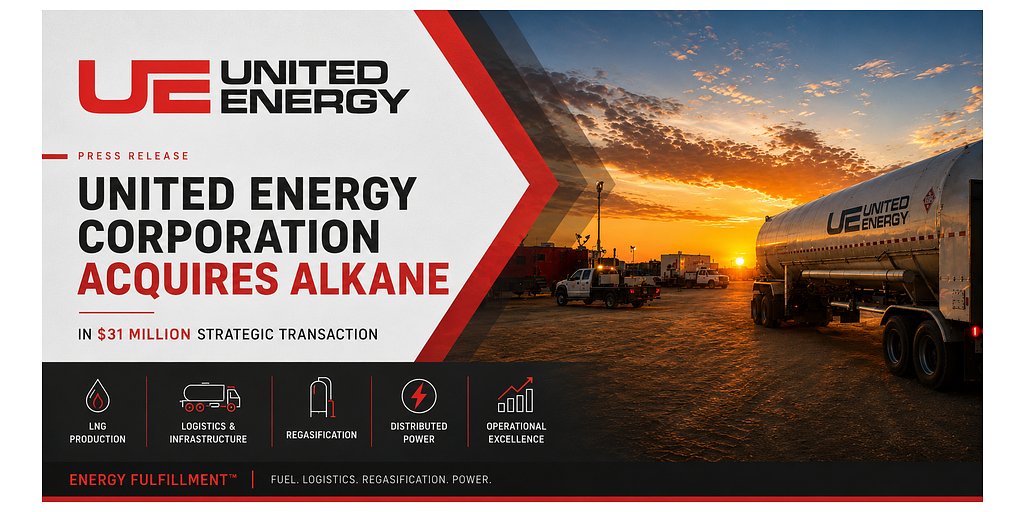
United Energy's $31M Deal for Alkane Fuels Distributed Power Push
PLANO, TX – June 01, 2026 – United Energy Corporation (OTC: UNRG) has finalized a strategic acquisition of Alkane Modus Vis Inc and key assets from Alkane Midstream in a deal valued at approximately $31 million. The transaction, comprising cash, assumed debt, and equity, significantly bolsters United's position in the burgeoning distributed energy sector by integrating a fully operational liquefied natural gas (LNG) production facility and extensive power generation infrastructure.
At the heart of the acquisition is a 100,000 gallon-per-day (gpd) LNG production facility in Seminole, Texas, which, combined with integrated logistics and power generation assets, advances United's mission to become a leading "Energy Fulfillment™" platform. The move positions the company to meet escalating demand from industrial, oilfield, and data infrastructure markets that require reliable power solutions independent of traditional grid constraints.
A Strategic Play in a Booming Market
The acquisition arrives as the North American distributed power generation market is poised for explosive growth, with analysts projecting a compound annual growth rate (CAGR) exceeding 7% over the next five years. Globally, the market is forecast to surge from roughly $510 billion in 2025 to over $1.2 trillion by 2035. This expansion is driven by a confluence of factors, including rising energy demand, the high cost of extending traditional grid infrastructure, and a growing imperative for resilient, localized power sources.
United Energy's strategy directly targets this market gap. "We are building a platform capable of delivering fuel, logistics, regasification, and power generation through one accountable team," said Brian Guinn, Chief Executive Officer of United. "Customers across North America — from industrial operators to data infrastructure developers — cannot afford to wait years for utility infrastructure. We believe demand for reliable distributed energy solutions will continue accelerating, and we can deliver them wherever they may be using clean, abundant natural gas."
The newly combined platform already supports active operations across seven states and projects annualized 2026 revenues between $15 million and $20 million, with targeted EBITDA margins approaching 30%. This positions United to capture a meaningful share of a market shifting decisively toward nimble, on-demand energy solutions.
The 'Energy Fulfillment' Model Takes Center Stage
Unlike traditional large-scale LNG export developers focused on global commodity markets, United is championing a model it calls "Energy Fulfillment™." This approach prioritizes modular deployment, faster execution, and localized, end-to-end service. The Alkane acquisition provides the physical assets and operational backbone to scale this model effectively.
The combined entity boasts a significant track record, having already delivered more than 120 million gallons of LNG and over 750 million kilowatt-hours of distributed energy across some of North America's most demanding operating environments. This history underscores a focus on execution that Alkane's leadership sees as a key differentiator.
"Most companies talk about distributed power. We built a business around fulfilling energy end-to-end — fuel, logistics, regasification, and power," stated Ryan Blazei, President of Alkane, who will continue to lead field operations. "That model is scaling because customers need real execution, not more promises."
This modular approach is proving particularly attractive to industries where speed is paramount. Industry analysis indicates that distributed power solutions can be deployed two to three times faster than large-scale gas turbines, directly addressing the critical "time-to-power" gap that is becoming a primary concern for hyperscale data center developers and other fast-moving industries.
Fueling the Future: Data Centers, Aerospace, and Beyond
The strategic timing of the acquisition aligns with a seismic shift in energy demand, most notably from the rapid expansion of AI-driven data centers. This sector's immense power requirements are creating an urgent need for scalable, dispatchable energy sources that can be deployed quickly. Natural gas, and specifically LNG, is emerging as a critical bridge fuel, offering higher energy density and a cleaner burn than diesel for the continuous power that data centers require.
Anticipating this demand surge, United Energy has already announced plans for an additional 150,000 gpd LNG capacity expansion at its newly acquired Seminole facility. This would more than double its output, bringing total capacity to 250,000 gpd. The expansion explicitly targets growing demand from data centers, as well as oilfield electrification, aggregates, and emerging aerospace infrastructure markets.
"We see major opportunity ahead through additional liquefaction capacity, expanded logistics infrastructure, and future power deployments," Blazei added. "The Seminole platform provides a strong operational foundation for continued growth while also positioning the Company for future opportunities in data center demand and high-purity natural gas fuel applications."
More Than Assets: Integrating Proven Expertise
Both companies have emphasized that the deal's true value extends beyond physical infrastructure. A critical component of the transaction is the retention of Alkane's entire operating team, which brings over a decade of hands-on experience in LNG operations, logistics, and distributed power deployments.
"The biggest part of this deal is the people," Blazei noted. "The Alkane team built this platform in the field — one customer, one project, and one hard lesson at a time. We are not slowing down after this transaction. We are joining United to execute on a much larger opportunity in distributed energy."
This integration of seasoned human capital is crucial. Alkane Midstream, founded in 2014, established itself by developing modular LNG plants and pioneering "Virtual Midstream Solutions." Their proven expertise in managing the complex logistics of small-scale LNG de-risks the acquisition for United Energy and provides an immediate capability to execute on its ambitious growth strategy without the delays associated with building an operational team from scratch.
Financial Realities and A Path to Growth
While the strategic rationale is clear, United Energy, an OTC-listed company with a recent market capitalization fluctuating between $13 million and $28 million, is making a significant bet. The $31 million transaction represents a substantial expansion of its operational and financial footprint. The company's own projections of $15 to $20 million in annualized revenue post-acquisition signal a transformational leap from its previous scale.
Some market analysis tools have flagged United's historical financial strength and profitability as areas requiring improvement, a common characteristic for small-cap companies pursuing aggressive growth-through-acquisition strategies. However, the company is banking on the combination of proven assets, an experienced team, and powerful market tailwinds to drive performance.
By securing a fully operational platform, United Energy has bypassed many of the construction and permitting hurdles that can stall energy projects for years. The success of this acquisition will now hinge on the combined team's ability to execute its expansion plans and convert the immense demand for distributed power into sustainable revenue and profitability.