
- £1.27 million grant from the Office for Students to fund the Anatomage Theater
- Over 20 years of 3D medical content in Anatomage’s library
- £400 million invested by Manchester Met in campus facilities over the past decade
Experts endorse the Anatomage Theater as a transformative tool for medical education, enhancing student engagement, diagnostic skills, and team-based learning, though they note challenges in cost and integration.
UK's First AI-Powered Medical Theater Opens at Manchester Met
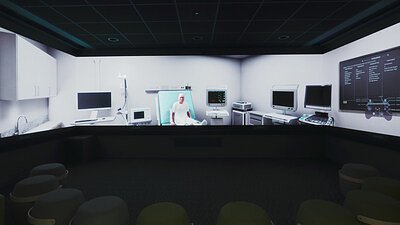
MANCHESTER, UK – April 16, 2026 – A new era in medical and scientific education has dawned in the United Kingdom with the launch of the nation's first Anatomage Theater at Manchester Metropolitan University. This groundbreaking facility, housed within the Faculty of Science and Engineering's Dalton Building, swaps textbooks and traditional lectures for a fully immersive, voice-controlled virtual hospital, signaling a transformative shift in how future healthcare professionals are trained.
Powered by an array of high-resolution LED displays that envelop the room, the Anatomage Theater plunges students into hyper-realistic clinical and scientific environments. The installation, a collaboration with Silicon Valley-based education technology leader Anatomage Inc., represents a significant leap beyond current simulation methods. It moves training from individual VR headsets or plastic mannequins to a shared, interactive space where teams of students can collaborate on complex medical cases without putting a single real patient at risk.
A Virtual Hospital Comes to Life
At the heart of the Anatomage Theater is a sophisticated system that brings medical training to life in unprecedented detail. Unlike traditional simulation centers that often rely on human actors to portray patients, this facility uses advanced, voice-interactive AI. Students can converse directly with virtual patients, asking questions about their symptoms and history as they would in a real clinical setting. These AI-driven patients respond dynamically, presenting with clinically accurate vital signs, comprehensive lab reports, and real medical imaging data drawn from Anatomage’s extensive library of over 20 years of 3D medical content.
This allows students studying nursing, life sciences, and other health professions to practice assessment, diagnosis, and intervention in a high-fidelity, low-risk environment. They can analyze a patient's vitals on a massive screen, explore 3D anatomical structures derived from real human bodies, and simulate treatment protocols for hundreds of common clinical scenarios. The system eliminates the need for keyboards or touchscreens, fostering a more natural and intuitive learning experience that hones both diagnostic skills and patient communication.
Manchester Metropolitan University secured a £1.27 million grant from the Office for Students to fund the new theater as the centerpiece of an expanded suite of Anatomage products. "We are extremely proud to be the first institution to install this exciting technology," shared Dr. G. H. Evans, Head of Department of Life Sciences at the university. "This will provide our students with access to cutting edge technology that will enhance their learning, experience and graduate prospects. We also look forward to continuing our partnership with Anatomage by contributing to development of content on the Anatomage Theater."
A Strategic Leap in Digital Education
The multi-million-pound investment is a cornerstone of Manchester Met's wider strategic vision. The installation is a key component of the university's new Digital Education Nexus (DEN), an initiative designed specifically to address critical skills shortages in the health and social care sectors by producing highly competent, tech-savvy graduates ready for the future NHS.
This move aligns perfectly with the university's "Road to 2030" strategy, which prioritizes digitally-enhanced learning and investment in sector-leading facilities. Over the past decade, Manchester Met has invested over £400 million in creating a world-class campus, including the state-of-the-art School of Digital Arts (SODA) and the Institute of Sport. The Anatomage Theater continues this trend, positioning the university at the forefront of educational innovation in the UK.
The £1.27 million grant from the Office for Students (OfS) underscores the national significance of this project. The funding comes from the OfS's Strategic Priorities Grant program, which targets investment in high-cost but strategically vital subjects like healthcare and STEM. By awarding this grant, the OfS signals a clear endorsement of using advanced technology to enhance graduate employability and meet the evolving skills needs of the UK's economy.
The New Frontier of Immersive Learning
The Anatomage Theater enters a competitive and rapidly evolving market for immersive medical education. While many institutions have adopted virtual reality (VR) platforms like SimX or Osso VR, which use headsets to train individuals on procedural skills, the Anatomage Theater offers a different paradigm. Its full-room, headset-free experience promotes team-based learning and communication, mirroring the collaborative nature of modern healthcare environments.
Experts in educational psychology have long praised the benefits of immersive learning. Academic research consistently shows that such technologies enhance student engagement, improve comprehension of complex subjects, and allow for safe, repeatable practice of critical skills. By allowing students to make mistakes and learn from them in a simulated setting, these platforms build confidence and competence before they ever interact with a live patient. Studies have demonstrated that this type of training can lead to faster, more accurate decision-making in real-world critical scenarios.
However, the field is not without its challenges. The high initial cost of facilities like the Anatomage Theater can be a significant barrier for institutions. Furthermore, ensuring effective integration into existing curricula and providing adequate training for educators are crucial for success. While the Anatomage Theater excels at cognitive and diagnostic training, some experts note that purely virtual environments can lack the haptic, or touch-based, feedback essential for certain psychomotor skills, an area where high-fidelity mannequins still hold an advantage.
From Virtual Dissection to Global Expansion
For Anatomage Inc., the Manchester installation is a landmark achievement and a powerful proof of concept. The company first revolutionized anatomy education with the Anatomage Table, the world's first life-size virtual dissection table, which is now a staple in many leading medical schools and universities. The Anatomage Theater represents the next evolution of its mission to transform scientific learning through technology.
With this successful UK launch, Anatomage is poised to expand the platform's reach. The company's stated goal is to integrate virtual hospital training and science simulation into academic and professional settings globally. The target market extends beyond universities to include hospitals for residency and continuing education programs, as well as specialized professional training centers.
The installation at Manchester Metropolitan University serves as a blueprint for this global strategy, demonstrating how a partnership between a technology innovator and a forward-thinking academic institution can create an unparalleled educational experience. As healthcare becomes more complex and the demand for highly skilled professionals grows, technologies like the Anatomage Theater are set to play an increasingly vital role in preparing the next generation of caregivers and scientists for the challenges ahead.
Topics & Related
Healthcare & Life Sciences
Software & SaaS
AI & Machine Learning
Artificial Intelligence
Generative AI
ChatGPT
Revenue
Related Company Pulse