
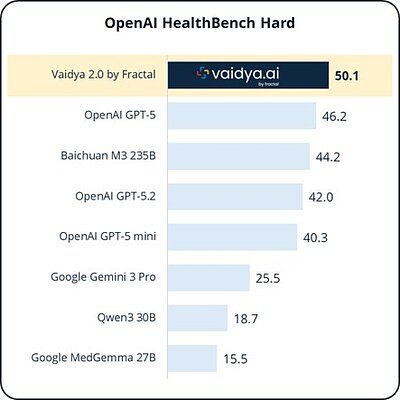
- Vaidya 2.0 scored 50.1 on OpenAI's HealthBench (hard), surpassing GPT-5's reported score of 46.2.
- The benchmark includes 5,000 tasks simulating real-world healthcare conversations.
- Fractal is a key partner in India's ₹10,300+ crore AI Mission.
Experts view Vaidya 2.0's benchmark victory as a significant milestone in healthcare AI, demonstrating the potential of specialized models to outperform general-purpose AI in clinical reasoning, though real-world adoption will depend on safety, regulatory compliance, and integration into existing healthcare systems.
Fractal’s Vaidya 2.0 AI Bests GPT-5 on Key Healthcare Benchmark
NEW YORK, NY – February 19, 2026 – In a significant development for the global artificial intelligence landscape, enterprise AI provider Fractal has announced that its new healthcare model, Vaidya 2.0, has surpassed leading frontier models from OpenAI and Google on a critical industry benchmark. The announcement, made at the India AI Impact Summit 2026, positions the Indian firm as a formidable competitor in the high-stakes race to develop safe and effective AI for medicine.
Fractal revealed that Vaidya 2.0 is the first AI model to achieve a score over 50 on OpenAI's HealthBench (hard), a rigorous test designed to evaluate AI performance in realistic clinical scenarios. With a score of 50.1, Vaidya 2.0 has edged out reported scores for OpenAI’s own GPT-5 and Google’s Gemini Pro 3, marking a potential turning point in the development of specialized, domain-specific AI systems.
A New Leader in Clinical AI Reasoning
The achievement is more than just a number; it represents a leap in an AI's ability to perform complex clinical reasoning. OpenAI's HealthBench is not a simple multiple-choice exam. Developed with over 260 physicians, it comprises 5,000 tasks that simulate real-world healthcare conversations. The "hard" tier, where Vaidya 2.0 excelled, specifically measures performance on clinical queries where accuracy, context-seeking, and clear risk communication are paramount. For comparison, OpenAI's powerful GPT-5 has been reported to score 46.2% on the same benchmark, highlighting the significance of Fractal's achievement.
This new model is designed to power a "Health Care Operating System," bridging the gap between raw data and actionable medical decisions. According to the company, Vaidya 2.0 has been specifically post-trained to move beyond simple knowledge retrieval towards more advanced reasoning capabilities.
"With Vaidya 2.0, we've moved from the knowledge-based foundation models to more advanced post-trained reasoning and agentic based healthcare models," said Suraj Amonkar, Chief AI Research & Platforms Officer at Fractal. He noted that the model's top ranking on HealthBench, combined with leading performance on the MedExpert benchmark for expert-level medical reasoning, demonstrates a comprehensive and reliable approach for a wide variety of healthcare workflows.
The competitive landscape for healthcare AI is intense. OpenAI has been actively pushing its "OpenAI for Healthcare" initiative, partnering with major U.S. hospitals to test its models in clinical settings. Similarly, Google's DeepMind and Google Health divisions have produced models like Med-PaLM 2, which has achieved expert-level scores on medical licensing exams. Fractal's success with Vaidya 2.0 suggests that highly focused, verticalized models can challenge the dominance of general-purpose AI giants.
Powering India's Public Health Revolution
Vaidya 2.0's launch is not just a technological milestone but a strategic one, deeply intertwined with India's national ambitions. Fractal is a key partner in the ₹10,300+ crore India AI Mission, a government initiative aimed at building the nation's sovereign AI capabilities and establishing it as a global AI leader. Vaidya 2.0 is presented as the first of many verticalized foundation models designed to solve the unique challenges of the Global South—being frugal, scalable, and impact-driven.
Srikanth Velamakanni, Co-founder and Group Chief Executive of Fractal, emphasized the model's role in augmenting India's robust digital health infrastructure. "India has built strong digital health foundations over the past decade - from ABHA health IDs to Ayushman Bharat and e-Sanjeevani. The next step is adding reliable reasoning intelligence to those systems," he stated. "When you combine India's digital health infrastructure with reliable reasoning AI, you unlock a new operating model for public health. At India's population scale, intelligence must be accurate, transparent, and accountable. That is the problem Vaidya 2.0 is built to solve."
The practical applications are aimed at both citizens and medical professionals. Proposed citizen-facing use cases include Emergency Assist for rapid triage, a high-fidelity Symptom Checker, and Patient Journey Assist for end-to-end support. For clinicians, the model offers Doctor Assist capabilities, while its performance on Health Data Tasks is intended to support administrative workflows, demonstrating a holistic approach to the healthcare ecosystem.
From Benchmarks to Bedside: The Practical Hurdles
While outperforming competitors on a benchmark is a celebrated achievement, the journey from a performance metric to a trusted clinical tool is long and fraught with challenges. The real test for Vaidya 2.0 will be its performance, safety, and acceptance in real-world healthcare settings. Integrating such a powerful tool into existing hospital information systems and clinical workflows is a significant technical and logistical hurdle.
Furthermore, the regulatory and ethical landscape for healthcare AI is complex and evolving. In India, the Indian Council of Medical Research (ICMR) has established ethical guidelines that stress accountability, patient autonomy, and data privacy. The framework mandates that AI tools must be proven safe before clinical use and must function to support, not replace, a clinician's judgment. Adherence to data protection laws, such as India's Digital Personal Data Protection Act of 2023, will be critical for gaining the trust of both patients and providers.
The global consensus is clear: AI in medicine must be deployed responsibly. The ultimate success of Vaidya 2.0 will depend not only on its reasoning capabilities but also on its transparency, reliability, and its ability to earn a place as a trusted assistant in the hands of medical professionals. Fractal is currently showcasing the new model at the India AI Impact Summit in New Delhi, where it will face scrutiny and interest from policymakers, healthcare leaders, and the wider technology community, all keen to see if this benchmark victory can translate into a tangible revolution in patient care.
Topics & Related
Artificial Intelligence
Generative AI
Cloud Migration
Regulation & Compliance
ESG
Software & SaaS
AI & Machine Learning
Related Company Pulse