
- Global microlearning market CAGR: 22% through 2035
- AI-powered microlearning market growth: From $2.22 billion in 2025 to $5.2 billion by 2029
- Udemy Content Innovation Fund: $2.5 million to support instructor adoption of AI-enhanced formats
Experts view Udemy's AI-powered microlearning initiative as a strategic response to modern workforce demands, leveraging AI personalization and human expertise to create scalable, adaptive learning solutions that could set new industry standards for upskilling.
Udemy's AI Tutor: Microlearning for the Modern Workforce
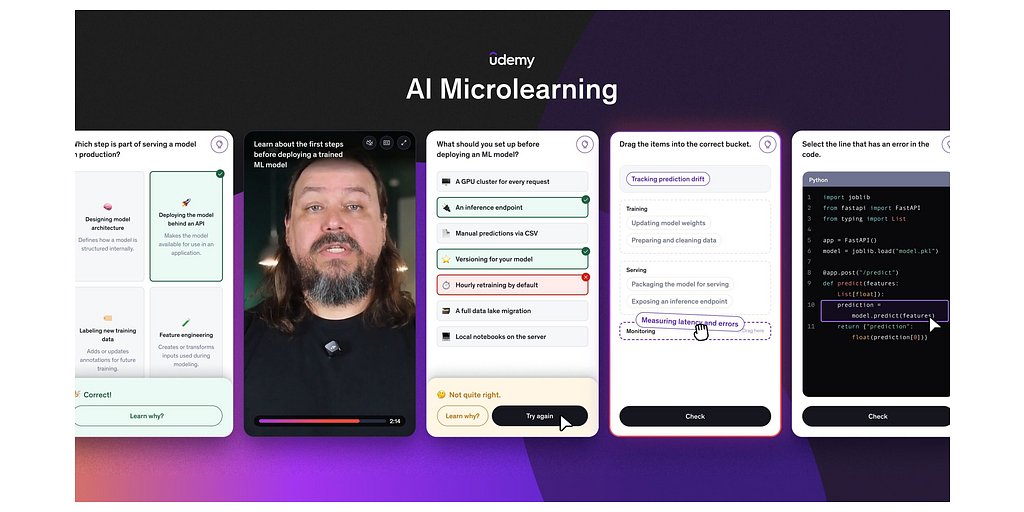
SAN FRANCISCO, CA – December 15, 2025 – Online learning giant Udemy is making a bold move to redefine digital skills acquisition, announcing a phased rollout of an AI-powered microlearning experience set to launch throughout 2026. The initiative aims to transform its vast library of long-form video courses into adaptive, bite-sized learning modules, a direct response to the evolving needs of today’s time-constrained professionals and a significant bet on the future of AI in education.
This strategic pivot isn't just about shortening videos; it's about fundamentally re-architecting the learning process. By leveraging artificial intelligence, Udemy plans to deliver personalized, context-aware content that fits seamlessly into the daily workflows of millions of learners, potentially setting a new industry standard for both consumer and enterprise upskilling.
The Microlearning Mandate: Adapting to the Modern Learner
The shift towards microlearning is not arbitrary; it's a calculated response to seismic shifts in consumer behavior and workplace demands. With the average human attention span dwindling in the digital age, the traditional hour-long lecture format is losing its efficacy. Learners increasingly favor content that is immediate, focused, and easily digestible on the go, a trend that has fueled a booming market.
Industry projections underscore this momentum, with the global microlearning market expected to grow at a compound annual growth rate (CAGR) of over 22% through 2035. More specifically, the AI-powered segment of this market is forecasted to surge from $2.22 billion in 2025 to $5.2 billion by 2029. Udemy is positioning itself to capture a significant share of this growth by addressing the core challenge of modern education: delivering value in a world of constant distraction. The platform's new approach is designed for the professional who needs to learn a new coding function between meetings or a manager who wants to brush up on leadership skills during their commute. By breaking down complex subjects into interactive quizzes, short videos, and active learning exercises, the company aims to make continuous skill development an accessible, everyday habit rather than a daunting commitment.
Inside Udemy's AI Engine: Personalization at Scale
At the heart of this transformation is a sophisticated technology stack, branded as "Udemy AI" and delivered via the company's "Model Context Protocol (MCP) Server." This isn't simply about using AI to recommend courses; it's about creating a dynamic, adaptive learning environment that molds itself to each individual. Udemy AI is designed to analyze a learner's progress, stated goals, and even their professional background to sequence and deliver the most relevant micro-content at precisely the right moment.
The platform's recently launched "Role Play" feature, where learners practice soft skills in AI-generated scenarios, offers a glimpse into this vision. The new microlearning experience will expand on this, creating a feedback loop where the AI learns from user interactions to hyper-personalize skill paths. The MCP Server represents the next frontier of this integration. Originally an open standard developed by Anthropic, Udemy's implementation of an MCP Server acts as a universal adapter, allowing its learning platform to securely connect with the external tools and data sources that businesses use daily.
This technology promises to dissolve the barrier between work and learning. For example, a project manager struggling with team dynamics could search their internal project management software for advice, and the MCP Server would instantly surface a relevant micro-lesson on emotional intelligence from Udemy Business. This "just-in-time" delivery transforms learning from a scheduled event into an integrated, on-demand utility, embedded directly within an employee's workflow.
Empowering the Expert: The Human-in-the-Loop Advantage
While automation is central to the new model, Udemy is taking deliberate steps to ensure human expertise remains the cornerstone of its content. The company is framing its instructors not as passive content providers, but as "creative directors and orchestrators of an AI-enhanced learning experience," according to Zane Vella, Head of Content and Instructor Strategy. This 'human-in-the-loop' approach is critical to maintaining quality and practicality.
Under this model, AI tools will deconstruct an instructor's long-form course into suggested microlearning activities. However, no AI-generated content will reach a learner until the instructor has reviewed, edited, and explicitly approved it. This process ensures that the real-world insights, nuances, and lived experiences that define great teaching are preserved and amplified, not replaced.
To incentivize adoption, Udemy is backing this strategy with significant financial support. The company has announced a $2.5 million Content Innovation Fund to provide grants and resources for instructors experimenting with these new formats. Furthermore, a new revenue-sharing model will ensure instructors are compensated for learner interactions with the AI Assistant within their courses, aligning their financial success with the platform's technological evolution. This hybrid model—combining the scale of AI with the irreplaceable value of human expertise—could become a blueprint for the creator economy in the age of generative AI.
The Enterprise Impact: From Training Days to Daily Skills
For Udemy's thousands of corporate clients, this evolution from long-form courses to integrated microlearning represents a paradigm shift in workforce development. The days of pulling employees away from their work for disruptive, day-long training sessions are numbered. The new model promises to make upskilling a continuous, organic part of the workday, directly addressing the corporate demand for more efficient and effective training solutions.
"At Udemy, instructors are central to how skills are developed on our platform," said Hugo Sarrazin, President and CEO at Udemy. "AI enables us to adapt and scale their expertise, while our platform provides the context needed to personalize each experience and meet learners’ evolving needs." This vision directly translates to tangible benefits for enterprise customers, including faster onboarding, proactive skill gap identification, and higher employee engagement.
By integrating learning directly into business tools via the MCP Server, companies can foster a culture of continuous improvement where skill development is a strategic enabler, not an administrative burden. An analyst working in a business intelligence tool could receive an instant recommendation for an advanced data visualization micro-lesson, applying the new skill moments later. This seamless integration is expected to boost not only knowledge retention but also productivity and employee retention, as workers feel more empowered and invested in their career growth. As the phased rollout begins in 2026, the business world will be watching closely to see if this blend of AI, micro-content, and human oversight can truly deliver on the promise of building the agile, future-ready teams required to compete in the 21st century.