
- AI Home market valued at over $180 billion in 2026, projected to double in 5 years
- AI Robot sector expected to surpass $200 billion by 2031
- Tuya's developer community includes over 1.6 million registered developers
Experts view Tuya Smart's AI-driven strategy as a transformative step toward integrating advanced, proactive AI into everyday hardware, positioning the company as a leader in the intelligent home, robotics, and energy management sectors.
Tuya Smart's AI Blueprint: Rebuilding Hardware for a Smarter World
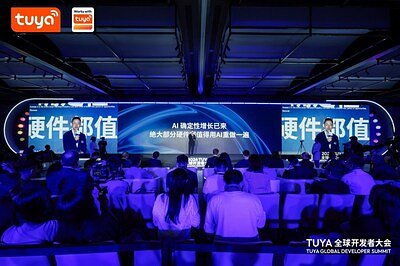
SHENZHEN, China – April 24, 2026 – Global AI cloud platform provider Tuya Smart today unveiled a bold vision for the future of intelligent hardware, centered on a significantly upgraded AI assistant, a suite of new developer tools, and a strategic pivot towards three core ecosystems: AI Home, AI Robot, and AI Energy. The announcements, made at the 2026 TUYA Global Developer Summit, signal a decisive push to move artificial intelligence from the cloud into the very fabric of our physical world.
At the heart of the reveal is the new 'Hey Tuya,' an AI platform that has evolved from a simple conversational tool into what the company describes as a proactive, action-oriented assistant. The summit, attended by thousands of developers and tech experts, laid out a clear roadmap for embedding advanced, intuitive AI into nearly every category of hardware, a move underscored by Tuya Smart's co-chairman and president, Leo Chen, who stated that "almost all hardware is worth rebuilding with AI."
Beyond Commands: The Evolution of Proactive AI
The most significant leap for Hey Tuya is its shift from reactive execution to proactive assistance. Powered by an upgraded AI foundation and a new long-term memory system called OmniMem V2.0, the assistant is designed to learn user habits, preferences, and routines. This enables it to anticipate needs rather than just responding to commands. For example, it can learn a user's daily schedule to proactively adjust the thermostat before they arrive home or suggest a 'Morning Wake-up' routine that dynamically adapts based on calendar events and real-time traffic conditions.
This evolution is supported by a major expansion of Hey Tuya's capabilities. The platform now integrates directly with third-party productivity services like Google Mail, Calendar, and Docs, allowing users to manage their digital life with a single voice command—be it sending an email or scheduling a meeting. This transforms the assistant from a home controller into a comprehensive life management tool.
Addressing one of the smart home industry's most persistent challenges, Tuya has also broadened its hardware compatibility. The new platform offers full support for the Matter protocol and popular open-source platforms like Home Assistant. This focus on interoperability aims to break down the walled gardens that have historically frustrated consumers, enabling seamless coordination between devices from different manufacturers. The AI can orchestrate complex scenarios, such as an "Away from Home Protection" mode that arms security cameras, locks doors, and turns off non-essential lights and appliances in a single, unified action.
Democratizing AI: New Tools for a Million Developers
Underpinning Tuya's vision is a concerted effort to make advanced AI development accessible to a wider audience. The company introduced 'Vibe Coding,' a groundbreaking tool that allows developers to build complex AI, IoT, and mobile solutions using natural language interactions. By significantly lowering the technical barrier, Vibe Coding empowers creators without deep coding expertise to build personalized device dashboards, lightweight applications, and sophisticated automation workflows, potentially unleashing a new wave of hardware innovation.
Tuya also unveiled a key hardware-level innovation with its self-trained Personal Voice Activity Detection (PVAD) model. Designed specifically for real-world hardware, PVAD enables devices to automatically identify and focus on the intended speaker in noisy, multi-person environments without prior voice enrollment. This technology promises to dramatically reduce the frustrating false activations that plague many smart devices, leading to a more reliable and natural user experience.
This is part of a broader enhancement of Tuya's AI infrastructure, which the company packages as a comprehensive "toolkit" for its community of over 1.6 million registered developers. Upgrades to its Physical AI Foundation, Wukong AI platform, and Tuya Real-Time Communication (T-RTC) network provide the foundational power and low-latency communication necessary for next-generation AI applications that interact with the physical world.
A Triple Play Strategy: Targeting Home, Robotics, and Energy
Perhaps the most telling announcement was Tuya's declaration of a focused strategy targeting three high-growth sectors: AI Home, AI Robot, and AI Energy. This move positions the company to capitalize on burgeoning markets and defines its path for the next decade.
The AI Home market, already valued at over $180 billion in 2026, is projected to more than double within the next five years as consumers demand more integrated and intelligent living spaces. Tuya aims to enable whole-home intelligent coordination and proactive services that go far beyond basic automation.
In the AI Robot sector—a market expected to surpass $200 billion by 2031—Tuya plans to provide the AI backbone for devices across companionship, cleaning, wellness, and protection. This focus on embodied robotics highlights a future where physical robots become more capable and integrated into daily life.
Finally, the AI Energy ecosystem addresses a critical global need. By building an AI-driven energy management system, Tuya's platform will enable precise energy monitoring, efficient utilization, and intelligent optimization for homes and businesses. This aligns with the growing consumer and regulatory demand for energy efficiency and sustainability. By framing its future around these three pillars, Tuya Smart is not just providing tools; it is aiming to become the foundational platform upon which the next generation of intelligent hardware is built.