
- 40-50% reduction in natural gas consumption for the site's main industrial dryer
- 20-30% recovery of process water from exhaust
- Coefficient of Performance (CoP) of up to 2.5 for the high-temperature heat pump
Experts view this technology as a critical breakthrough for industrial decarbonization, demonstrating that significant energy savings and operational profitability can be achieved simultaneously.
Turning Waste Heat to Gold: A New Era of Industrial Efficiency
BOLOGNA, Italy – December 04, 2025 – In the world of heavy industry, the plume of steam rising from a factory smokestack has long symbolized productivity. But it also represents a massive loss of energy and a significant source of carbon emissions. Now, a pioneering project at Philip Morris International’s (PMI) Bologna facility is demonstrating how that waste stream can be transformed into a valuable asset, marking a potential turning point for manufacturing worldwide.
A state-of-the-art system, commissioned by PMI and engineered by Dutch integrator JOA Air Solutions, is capturing low-grade waste heat and upgrading it to produce high-temperature steam. The results from the pilot are striking: a 40-50% reduction in natural gas consumption for the site's main industrial dryer, coupled with the recovery of 20-30% of the water from its exhaust. This isn't just an incremental improvement; it's a fundamental shift in industrial energy management, proving that deep decarbonization and operational profitability can go hand-in-hand.
The Technological Leap Forward
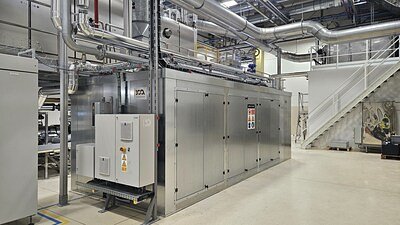
At the heart of the system is a high-temperature heat pump from German start-up SPH (Sustainable Process Heat). Unlike conventional heat pumps designed for residential heating, this industrial-grade machine achieves what was once considered impractical: it produces steam at 139°C and 3.5 bar of pressure. The system captures residual heat from the factory's exhaust, which sits at a tepid 36°C, and elevates it in a highly efficient two-stage process.
The ability to generate steam at this temperature is a critical breakthrough. Many industrial processes—from food pasteurization and chemical distillation to paper and textile drying—rely on steam as their primary heating medium. Historically, this has meant burning fossil fuels. This new technology provides a direct, electrified alternative.
Despite the unusually large temperature lift required, the system maintains a remarkable Coefficient of Performance (CoP) of up to 2.5. In simple terms, for every one unit of electricity consumed by the pump, it delivers 2.5 units of useful heat. This efficiency is what makes the technology economically viable.
"This is a breakthrough for the industry," said Martin Tukker, Director of JOA Air Solutions. "A heat pump capable of delivering this volume of steam, and so seamlessly integrated into the drying process, sets a new benchmark in the processing industry."
The technology's potential has not gone unnoticed. SPH, whose innovative piston compressor technology enables these high temperatures, was recently part of an acquisition agreement with Copeland, a global giant in sustainable climate solutions. This move signals a major consolidation in the rapidly growing high-temperature heat pump market, valued at over $1 billion in 2024, and validates the technology's readiness for widespread adoption.
The Unmistakable Business Case
While the environmental benefits are clear, the project in Bologna makes an equally compelling economic argument. A 50% reduction in gas consumption translates directly into substantial operational cost savings, providing a powerful buffer against volatile energy markets. The added benefit of recovering nearly a third of the process water reduces both intake needs and wastewater treatment costs, further strengthening the return on investment.
This project is not an isolated experiment but a reflection of a much larger market shift. The global industrial heat pump market is projected to grow significantly, with some estimates suggesting it could nearly double to over $18 billion by the early 2030s. This growth is fueled by a perfect storm of factors: rising energy costs, stringent regulations like the EU's Emissions Trading System (ETS) that penalize carbon output, and a growing corporate mandate to operate sustainably.
Of course, challenges remain. The initial investment for such advanced systems is higher than for traditional boilers. However, as demonstrated by the PMI project, the payback period is shrinking, especially when factoring in government incentives and the rising cost of carbon. The success of this pilot serves as a crucial reference installation, de-risking the technology for other manufacturers who have been hesitant to be first-movers. It provides a tangible blueprint for how to overcome the financial and technical hurdles of industrial decarbonization.
A Blueprint for Collaborative Innovation
The project's success is as much a story of strategic partnership as it is of technological prowess. It exemplifies a highly effective model for accelerating innovation: a large multinational corporation (PMI) leveraging its scale and investment capability to partner with a specialized system integrator (JOA) and a cutting-edge technology provider (SPH).
PMI, with its public commitment to achieve Net-Zero emissions across its value chain by 2040, provided the real-world industrial testbed. JOA Air Solutions brought its expertise in creating tailor-made integrations, using advanced modeling to ensure the heat pump worked seamlessly within the existing factory infrastructure. SPH delivered the core technological breakthrough. This synergistic relationship allowed for the rapid deployment and validation of a next-generation solution.
"At PMI we believe in leveraging innovation to address challenges and seeking solutions through strategic collaboration," noted Arjun Arya, Manager of Environmental Sustainability at PMI. "This project is a great example of collaboration to deliver on a challenge that not only accelerates our path to Net-Zero, but the industry as a whole."
This isn't PMI's first foray into large-scale heat recovery. The company previously tasked JOA with a project at its Bergen op Zoom facility to convert waste heat into hot water, a project projected to save 13 GWh of heat and over 2,500 tons of CO2 annually. The Bologna initiative represents the next evolution of this strategy, targeting the much more difficult challenge of steam production.
As industries face mounting pressure to decarbonize, this model of collaboration between established giants and nimble innovators will become increasingly vital. It allows for the sharing of risk, expertise, and resources needed to bring complex, capital-intensive technologies from the lab to the factory floor. The wider industry is taking note, with EU-funded initiatives like the Push2Heat project—of which SPH is a member—testing similar high-temperature heat pumps in sectors like paper manufacturing. These efforts are building a critical mass of evidence and expertise, paving the way for a systemic industrial energy transition.