
- $218 billion: Annual cost to the apparel industry from returns due to poor fit
- 25%+: Return rates for fashion items, with some estimates at 70%
- $616 billion: Transaction data analyzed by True Fit's AI over nearly 20 years
Experts agree that True Fit's AI-driven approach to solving the fit problem in online fashion retail represents a significant step forward, with the potential to reduce costly returns and improve consumer confidence in sizing accuracy.
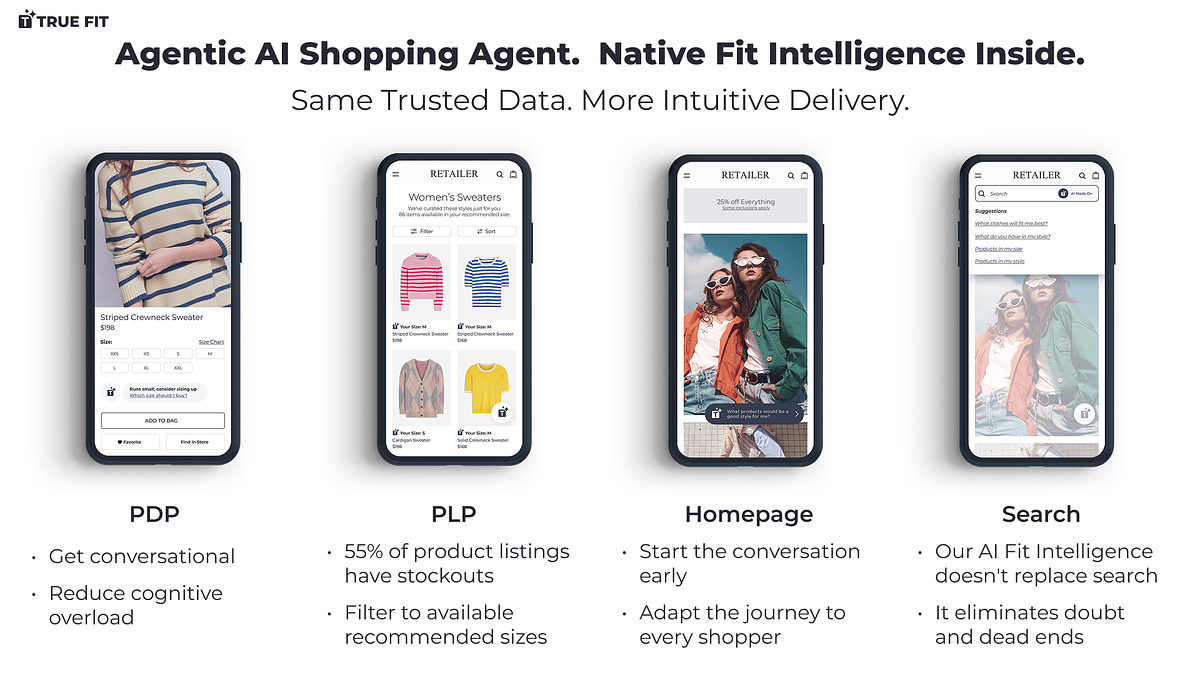
True Fit's AI Aims to Solve Fashion's Billion-Dollar Return Crisis
BOSTON, MA – February 17, 2026 – In a bold move to combat the most persistent plague of online fashion retail, intelligence provider True Fit has announced the launch of its agentic AI shopping experience. The new technology aims to eliminate the costly guesswork of finding the right size, a problem that frustrates shoppers and erodes retailer profits. By leveraging a massive dataset spanning nearly two decades, the company's AI agent promises to proactively guide consumers to clothes and shoes they will not only love but also keep.
This launch enters a market at a critical juncture. Fashion represents a global e-commerce sector projected to surpass $1.5 trillion by 2029, yet it is crippled by staggering inefficiency. The core issue remains the digital disconnect between a shopper and a garment—the simple, unanswered question: "Will this fit me?" True Fit's answer is not just another recommendation engine but a dynamic, learning agent designed to intervene at the precise moment of doubt, potentially transforming the landscape of digital commerce.
The Billion-Dollar Problem of Fit
The scale of the challenge True Fit aims to solve is immense. While total U.S. retail returns were projected to hit $850 billion in 2025, the apparel industry bears a disproportionate share of that burden. Industry reports consistently show that fashion items are returned at rates exceeding 25%, with some estimates suggesting that up to 70% of all clothing bought online is sent back primarily due to poor fit. This logistical nightmare costs the apparel industry over $218 billion annually in shipping, processing, and lost sales.
This financial drain is rooted in consumer behavior driven by uncertainty. According to market research firm Mintel, the fear of an item not fitting is the number one reason for purchase hesitancy among online shoppers. This doubt forces consumers into compensatory behaviors like 'bracketing'—ordering the same item in multiple sizes with the intention of returning those that don't fit. While this strategy provides a temporary solution for the shopper, it inflates shipping costs, increases the carbon footprint of e-commerce, and creates a logistical nightmare for retailers who must process, inspect, and restock a flood of returned goods.
"For fashion, the answer has to start with fit and sizing," said Jessica Murphy, Co-Founder and Chief Executive Officer at True Fit, in the company's announcement. She highlighted the urgency, noting that with nearly one in five online purchases coming back, "retailers need an agent built on structured fit data to solve the problem at its source."
A Data-Driven Answer to 'Will This Fit Me?'
What sets True Fit’s new agent apart in a growing field of AI-powered sizing tools is the sheer depth and nature of its data. The system is not built on static size charts, user-submitted measurements, or the often-biased opinions found in product reviews. Instead, it is powered by nearly 20 years of real-world purchase and, crucially, return data. This proprietary dataset encompasses over $616 billion in transactions from hundreds of millions of shoppers and more than 91,000 brands.
The AI agent works by analyzing patterns of what shoppers with similar profiles and preferences have purchased and kept over time. When a user hesitates on a product page—a signal the AI is trained to detect—the agent can intervene with plain-language guidance. It moves beyond generic advice to offer a personalized recommendation based on a shopper's past behavior and the outcomes of millions of others. This approach aims to instill enough confidence for a consumer to select a single size, directly combating the costly practice of bracketing.
"Fit is deeply personal, and preferences are unique to every shape and body," Murphy stated. "Solutions built on generic data don't help you answer the question everyone has: 'Will this fit me?' Our shopping agent evolves from static to dynamic guidance that answers your size and fit questions, considers your preferences, and learns from past behavior to help you confidently purchase."
The Rise of Agentic Commerce in Fashion
True Fit's launch marks a significant milestone in the evolution toward 'agentic commerce,' a paradigm where AI assistants transition from passive tools to proactive partners in the shopping journey. A year ago, the concept was largely theoretical; today, it is a dominant strategic question for retail leadership. Instead of simply responding to queries, these agents are designed to anticipate needs, interpret complex signals like hesitation, and guide users toward better outcomes.
In fashion, the opportunity for agentic AI is particularly potent. An intelligent agent can do more than just suggest a size; it can understand the nuances of fit preference (e.g., 'slim' vs. 'relaxed'), compare sizing across different brands, and provide a level of personalized consultation previously only available from an in-store expert. By integrating with existing e-commerce platforms like Shopify, True Fit aims to make this advanced capability accessible to a wide range of retailers with minimal engineering overhead.
Furthermore, the company is offering its 'Fit Intelligence' through a Model Context Protocol (MCP), allowing other AI copilots and personalization systems to tap into its rich data. This signals a future where various AI systems can collaborate, using True Fit’s specialized knowledge to handle the complexities of apparel sizing while they manage other aspects of the customer journey.
Navigating Data, Privacy, and Trust
While the promise of a frictionless shopping experience is compelling for both retailers and consumers, the engine driving it—a colossal repository of consumer data—raises important considerations. Operating with information from hundreds of millions of shoppers places a significant ethical responsibility on the company. In an era governed by regulations like GDPR in Europe and CCPA in California, transparency in data collection and usage is not just a best practice but a legal mandate.
Building and maintaining consumer trust will be paramount to the agent's success. Users must feel secure that their purchase history is being used to their benefit without compromising their privacy. Moreover, any AI system trained on historical data runs the risk of perpetuating biases if the training set is not sufficiently diverse. Ensuring the agent provides accurate and equitable recommendations for all body types, shapes, and demographics will be a critical test of its underlying architecture.
The ultimate success of True Fit's agent will hinge on its ability to prove its value proposition. For retailers, that means delivering a clear return on investment through higher conversion and lower return rates. For consumers, it means consistently delivering on the promise of a perfect fit. The first test will come in March 2026, when select early adopters begin rolling out the technology, offering the first real-world glimpse into whether two decades of data can finally solve online fashion's most intractable problem.