
- 90 times lower latency and 120 times lower energy consumption for AI tasks compared to MCUs without a dedicated accelerator.
- Under US$1 pricing for the MSPM0G5187 MCU in volume quantities, targeting cost-sensitive applications.
- Up to 30% reduction in bill-of-materials costs for industrial automation and robotics systems.
Experts view TI's new AI-enabled microcontrollers as a pivotal step in democratizing edge AI, making intelligent features more accessible and energy-efficient across a wide range of devices, from wearables to industrial robots.
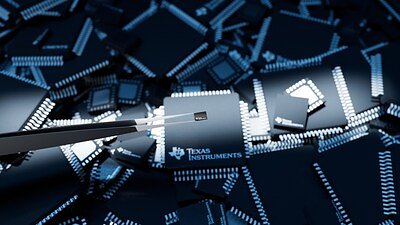
TI's New Chips Aim to Put an AI Brain in Every Electronic Device
DALLAS, TX – March 10, 2026 – Texas Instruments today signaled a pivotal shift in the electronics industry, unveiling a new generation of microcontrollers designed to embed artificial intelligence into virtually any device, from the simplest home appliance to complex industrial robots. The semiconductor giant announced two new microcontroller (MCU) families that integrate a dedicated AI accelerator, a move aimed at democratizing edge AI by making it more affordable, power-efficient, and accessible to developers everywhere.
The announcement, centered around the new MSPM0G5187 and AM13Ex MCU families, introduces TI's TinyEngine™ neural processing unit (NPU). This specialized hardware is engineered to handle deep learning tasks directly on the device, a practice known as edge AI. By offloading these intensive computations from the main processor, TI claims its new chips can run AI models with up to 90 times lower latency and a staggering 120 times lower energy consumption compared to similar MCUs without a dedicated accelerator. This leap in efficiency could fundamentally alter the design of battery-powered and resource-constrained electronics.
"TI invented the digital signal processor almost 50 years ago, laying the groundwork for today's edge AI processing," said Amichai Ron, senior vice president of Embedded Processing and DLP® Products at TI, in a statement. "Now TI is leading the next phase of innovation by integrating the TinyEngine NPU across our entire microcontroller portfolio... we are making edge AI accessible and easy to use for every customer and every application."
Democratizing AI from Wearables to Factories
For years, sophisticated AI has been largely confined to powerful, cloud-connected servers or expensive, high-end processors. TI's new strategy directly challenges this paradigm. The company is positioning its new MCUs to drive an explosion of intelligence in everyday objects.
The MSPM0G5187, built on an Arm® Cortex®-M0+ core, is the flag-bearer for this democratization effort. With pricing under US$1 in volume quantities, it targets a wide array of simpler, cost-sensitive applications. This opens the door for developers to add intelligent features like keyword spotting, gesture recognition, or anomaly detection to products like fitness wearables, smart home circuit breakers, and small appliances without breaking the bank or requiring a constant power source. The dramatic reduction in energy use means battery-powered devices can run AI tasks for far longer, a critical factor for portable electronics.
On the other end of the spectrum, the new AM13Ex MCUs target the demanding world of industrial automation and robotics. These chips are the industry's first to combine a high-performance Arm Cortex-M33 core, the TinyEngine NPU, and an advanced real-time control architecture onto a single piece of silicon. This integration is particularly significant for multimotor systems, where it can enable features like adaptive control based on load sensing or predictive maintenance by analyzing motor vibrations. By consolidating these functions, TI estimates designers can reduce their bill-of-materials costs by up to 30%.
This push into smaller, more ubiquitous chips is seen by industry watchers as a critical next step for AI. "While much of the world has been focused on AI acceleration and NPUs in bigger SoCs, it turns out some of the more interesting and far-reaching applications of AI can be enabled inside smaller chips like microcontrollers," noted Bob O'Donnell, President and Chief Analyst at TECHnalysis Research. "Edge-based applications of AI acceleration can make consumer devices more intelligent and industrial devices more efficient."
Lowering the Barrier for Developers
Hardware is only half the battle. A significant hurdle to widespread AI adoption has been the complexity of software development. Recognizing this, Texas Instruments has made a substantial investment in its developer ecosystem.
The new MCU families are supported by TI's CCStudio™ Edge AI Studio, a free toolchain designed to simplify the entire AI workflow. It provides engineers with more than 60 pre-trained models and application examples, giving them a running start on tasks ranging from sensor data analysis to motor control optimization. The environment provides the flexibility to run AI models using either the dedicated TinyEngine NPU for maximum efficiency or a software-based implementation on the main CPU.
Perhaps most innovatively, TI is integrating generative AI directly into its main CCStudio™ integrated development environment (IDE). This feature allows engineers to use simple, natural language prompts to generate code, configure systems, and debug their applications. This approach aims to lower the steep learning curve often associated with embedded AI, empowering a much broader audience of engineers to build intelligent products without needing to be machine learning experts.
Navigating a Competitive AI Hardware Landscape
Texas Instruments is not alone in the race to dominate the edge AI market. Other semiconductor giants like NXP, STMicroelectronics, and Renesas are also heavily investing in their own AI-enabled MCU portfolios, each with unique hardware accelerators and software ecosystems. The market is rapidly moving toward a future where AI capability is a standard feature, not a premium add-on.
TI's strategy appears to be one of breadth and accessibility. By committing to integrate the TinyEngine NPU across its entire MCU portfolio—from general-purpose to high-performance—the company is making a powerful statement. Its competitive edge lies not just in the performance of a single chip, but in creating a scalable and unified platform that developers can use for a vast range of products.
The ultra-low power consumption of the TinyEngine also taps into the growing demand for sustainable technology. As billions of connected devices come online, their collective energy footprint becomes a major concern. Hardware that dramatically reduces power per inference contributes to longer battery life and a more environmentally friendly electronics ecosystem.
With production quantities of the MSPM0G5187 MCU available now and the AM13Ex MCUs in preproduction, TI is moving quickly to turn its vision into reality. The new technologies are being demonstrated this week at the embedded world 2026 conference in Nuremberg, Germany, offering the industry a first-hand look at what could be the beginning of a new, more intelligent era for electronics everywhere.