
- 90% failure rate of drugs in clinical trials: The article highlights that improving 3D cell culture reliability could help reduce this high failure rate. - End-to-end workflow: The VitroPrime™ plate enables a 'zero-disruption' process from cell seeding to imaging, minimizing sample loss. - Xeno-free platform: TheWell Bioscience's ecosystem includes animal-component-free materials, enhancing reproducibility.
Experts would likely conclude that the VitroPrime™ plate represents a significant advancement in 3D cell culture technology, addressing critical bottlenecks in reproducibility and reliability for drug discovery and personalized medicine.
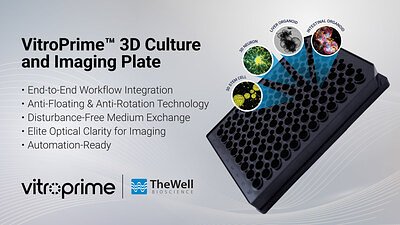
TheWell Bioscience Unveils Plate to End 3D Cell Culture Disruption
MONMOUTH JUNCTION, N.J. – February 09, 2026 – TheWell Bioscience has launched a new product that promises to solve one of the most persistent frustrations for scientists working with advanced 3D cell models. The company today announced the release of the VitroPrime™ 3D Culture and Imaging Plate, a next-generation culture vessel engineered to eliminate physical disruption from the entire 3D cell culture workflow, from initial cell seeding to final high-resolution imaging. This innovation could significantly improve the reproducibility and reliability of organoid and spheroid research, critical fields for advancing drug discovery and personalized medicine.
A Solution to a Persistent Scientific Bottleneck
For years, the promise of 3D cell cultures—miniature, lab-grown tissues and organs that more accurately mimic human biology than traditional flat cell layers—has been hampered by a fundamental technical challenge: the tools used to grow them were not designed for the task. Researchers have often relied on standard culture plates, originally created for 2D monolayer cultures, to grow delicate, gel-based 3D structures like organoids and spheroids.
This mismatch has created a cascade of problems. Routine procedures like changing the nutrient media can cause the fragile hydrogel constructs to become dislodged, float, or even rotate within the well, making consistent tracking of specific structures impossible. The process of moving these delicate samples between different vessels for staining, fixation, and imaging frequently leads to structural damage or complete sample loss. This is an especially costly problem in organoid research, where samples are often rare, derived from patients, and can take weeks or months to cultivate. The resulting experimental variability makes it difficult to generate consistent data, compare results across experiments, and perform the reliable longitudinal studies necessary for tracking disease progression or drug response over time. These limitations have slowed the adoption of 3D models in high-throughput screening and created a significant bottleneck in preclinical research.
Engineering a 'Zero-Disruption' Workflow
The VitroPrime™ 3D Culture and Imaging Plate was conceived to solve these challenges from the ground up. Instead of adapting an old design, TheWell Bioscience engineered a vessel specifically for the needs of modern 3D biology. The plate's design enables an end-to-end workflow where fragile samples are never moved, minimizing manual manipulation and preserving the integrity of the 3D architecture.
At the heart of the design is a dedicated lateral media-exchange channel. This feature allows for the passive diffusion of fresh media, fixatives, and staining reagents into the well without disturbing the sample itself. This eliminates the need for pipetting directly onto the delicate hydrogel, a common source of sample disruption. Furthermore, the plate incorporates a unique sample-locking architecture with an anti-floating and anti-rotation design. This ensures that the 3D construct remains in a stable, fixed position throughout long-term culture and analysis, which is critical for live-cell imaging and developmental studies. To complete the workflow, the plate features an ultra-clear, premium cover-glass bottom optimized for high-resolution confocal microscopy, allowing researchers to capture detailed images of the intact 3D structures directly within the culture vessel.
"For years, we've spoken with researchers around the world who struggle to find the right culture vessel for 3D organoid workflows—one that can prevent hydrogel floating, allow live-cell tracking, enable easy media exchange and sample fixation without sample loss, and support high-resolution imaging," said John Huang, CEO of TheWell Bioscience, in the company's announcement. "It took several years of rational design and iterative development to translate these unmet needs into a practical, scalable solution."
Beyond the Plate: The Power of an Integrated Ecosystem
The launch of VitroPrime™ is more than just a new piece of labware; it represents a key component in TheWell Bioscience's larger strategy to provide a comprehensive, integrated platform for 3D cell culture. The company is positioning itself against established competitors like Corning and Thermo Fisher Scientific by offering an "end-to-end" solution where every component is designed to work together seamlessly.
This ecosystem includes the company's VitroGel® hydrogels, which are xeno-free (animal-component-free) and tunable matrices for cell growth; RocketCell™ media and CytoGrow™ growth factors optimized for 3D environments; and Cyto3D® reagents for downstream analysis. By designing the VitroPrime™ plate to integrate perfectly with these products, TheWell Bioscience aims to provide researchers with a defined, standardized, and automation-ready workflow. This approach tackles a major source of experimental inconsistency: the variability introduced by using components from different manufacturers and animal-derived materials. A fully xeno-free platform not only enhances reproducibility but also aligns with the growing push for New Approach Methodologies (NAMs) that reduce reliance on animal products and provide more human-relevant data.
Accelerating the Future of Medicine
By removing fundamental technical barriers, innovations like the VitroPrime™ plate have the potential to significantly accelerate progress in critical areas of biomedical research. The ability to generate more consistent and reproducible data from 3D cell models could have a profound impact on the drug development pipeline. Pharmaceutical research increasingly relies on 3D tumoroids and organoids to test the efficacy and toxicity of new drug candidates, as these models are far more predictive of human response than 2D cultures. Improving the reliability of these assays could help researchers identify promising compounds earlier and, conversely, fail unsuitable candidates faster, potentially reducing the staggering 90% failure rate of drugs in clinical trials.
In the realm of disease modeling, robust and stable 3D culture systems allow for more accurate studies of complex biological processes, from viral infection to tumor metastasis. For personalized medicine, the stakes are even higher. Patient-derived organoids—miniature versions of a patient's own tissue grown in a lab—are being used to create "avatars" for testing different treatment regimens. A workflow that minimizes sample loss and variability is essential for ensuring that these tests provide clinically relevant information to guide patient care. By providing a tool that makes these advanced techniques more reliable and scalable, TheWell Bioscience is helping to bridge the gap between the potential of 3D biology and its practical application in labs everywhere. The new plate, available in multiple formats to support both small-scale research and high-throughput screening, represents a critical step toward making complex, human-relevant in vitro models a standard part of the modern research toolkit.