
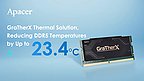
- Temperature Reduction: GraTherX reduces DDR5 module temperature from 82.7°C to 59.3°C in fanless environments. - Reliability Boost: Mean Time Between Failures (MTBF) increases by approximately 2.7 times. - Thin Design: 0.17mm-thick composite layer integrates seamlessly with existing DDR5 platforms.
Experts would likely conclude that Apacer's GraTherX represents a significant advancement in thermal management for edge AI systems, addressing critical heat dissipation challenges and enhancing long-term reliability.
The Unseen Engine of Resilience: Cooling the AI Edge
TAIPEI – June 12, 2026 – In the relentless pursuit of performance, we often overlook the quiet forces of permanence. As industries pivot toward intelligent automation and AI at the edge, the conversation is dominated by processing speeds and algorithmic efficiency. Yet, a fundamental physical constraint threatens to throttle this progress: heat. In the compact, often fanless environments where the next generation of computing must operate, a thermal crisis is brewing. Today, a development from Apacer Technology Inc. suggests that the most profound innovations may not be in how fast our systems run, but in how long they can endure.
The Taiwanese memory specialist has unveiled GraTherX, an industrial-grade cooling technology for high-speed DDR5 memory modules. While the announcement of a new thermal solution may seem incremental, its claimed capabilities point to a step-change in system resilience. By addressing a critical heat-dissipation bottleneck, this technology is a powerful reminder that in the 21st-century industrial landscape, durability is not just a feature—it is the bedrock of value.
The Unseen Drag on Performance
The transition to DDR5 memory, while offering significant bandwidth and performance gains, has come with a thermal cost. Higher frequencies and increased power density generate more heat than ever before. In a standard data center with ample airflow, this is a manageable engineering challenge. But at the edge—inside a factory-floor industrial PC, an autonomous vehicle's control unit, or a smart surveillance camera—the rules are different.
These systems are frequently housed in sealed, fanless enclosures to protect against dust, moisture, and vibration. This design choice, crucial for reliability, creates a thermal trap. As the DDR5 modules work under heavy computational loads demanded by AI applications, temperatures soar. The system's self-preservation mechanism, thermal throttling, kicks in, reducing clock speeds to prevent damage. The result is a direct hit to performance, consistency, and, ultimately, operational effectiveness. More critically, sustained high temperatures degrade components over time, shortening their lifespan and leading to premature failure.
Conventional cooling solutions, often involving small heatsinks, offer marginal relief, typically reducing temperatures by a mere 3–5°C. This is insufficient for the demands of modern edge hardware. The problem is particularly acute on the rear side of a memory module, which sits close to the motherboard with almost no airflow, creating a localized hotspot that undermines the entire component's stability.
Engineering Elegance in a 0.17mm Solution
Apacer's GraTherX technology is a masterclass in addressing a complex problem with an elegantly simple, yet scientifically advanced, solution. Instead of a bulky, bolted-on heatsink, GraTherX is an ultra-thin composite layer, just 0.17 millimeters thick, that integrates directly onto the memory module. Its design brilliance lies in both its material composition and its structure.
The solution employs a multilayer design that combines two of the most effective thermal conductors known: copper and graphene. Copper, the standard-bearer for thermal management in electronics, provides a robust pathway for heat to travel. It is paired with graphene, a single-atom-thick layer of carbon renowned for its extraordinary thermal conductivity, which is instrumental in spreading the heat rapidly across a surface. This composite structure doesn't just move heat; it manages it with exceptional efficiency.
Most critically, GraTherX incorporates a dual-sided heat conduction structure. It effectively creates a thermal bridge, pulling heat away from the trapped, vulnerable rear-side components and transferring it to the front side, where it can be more effectively dissipated into the surrounding environment. This simple act of thermal balancing eliminates the dangerous hotspots that plague traditional designs, leading to a dramatic improvement in thermal uniformity across the entire module.
The slim profile is not a trivial detail. At 0.17mm, it allows GraTherX to be integrated into existing DDR5 platforms without requiring costly and time-consuming system redesigns. This makes it a near-frictionless upgrade for system integrators, accelerating its potential adoption across the industry.
From Lab Bench to Factory Floor: The Impact on Resilience
The performance metrics released by Apacer are striking. In validation tests under natural convection—simulating a fanless environment—a DDR5 module's temperature was reduced from a critical 82.7°C down to a stable 59.3°C. This 23.4°C reduction is not an incremental improvement; it is a fundamental shift in the thermal operating window for high-performance memory.
However, for strategists and operators focused on long-term value, the most compelling figure is the impact on component lifespan. Based on its reliability modeling, Apacer estimates that the reduced thermal stress can increase the Mean Time Between Failures (MTBF) by approximately 2.7 times. This is where performance intersects with permanence. A nearly threefold increase in reliability for a critical component like memory has profound implications for the total cost of ownership and the viability of mission-critical systems.
For an industrial PC running a 24/7 manufacturing line, this means less downtime and reduced maintenance. For an Advanced Driver-Assistance System (ADAS) in a vehicle, it means greater stability and safety under sustained computational loads. For a network of smart surveillance cameras, it means consistent, reliable operation without performance degradation on a hot day. The technology will be rolled out across the company's industrial DDR5 portfolio, covering both ECC and non-ECC modules, signaling a broad commitment to this new standard of resilience.
Redefining the Economics of the Edge
By tackling the thermal bottleneck head-on, innovations like GraTherX do more than just improve a single component's performance. They reshape the economic and strategic calculations for deploying advanced technology in the physical world. The ability to run hotter, more powerful processors in compact, ruggedized form factors without compromising reliability unlocks new possibilities for AI and automation.
As businesses increasingly rely on intelligent systems operating in unpredictable environments, the identifying marks of a winner are found in resilience and consistency. Apacer's focus on solving a fundamental physical constraint with advanced material science demonstrates a deep understanding of this principle. While the industry chases ever-higher benchmarks, true, lasting value is being built in the silent, unseen layers that ensure those benchmarks can be sustained not just for a moment, but for the entire operational life of the system.