
- 26 countries invited to participate in Toshiba's GridDB Startup Program.
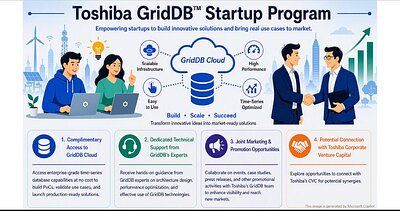
- Complimentary access to GridDB Cloud offered, along with dedicated technical support and potential venture capital investment.
- Target sectors: Smart infrastructure, healthcare, AI, and finance.
Experts would likely conclude that Toshiba's GridDB Startup Program is a strategic move to dominate the industrial data frontier by leveraging startup innovation, creating a robust ecosystem around its proprietary technology.
Toshiba’s Gambit: Courting Startups to Conquer the Industrial Data Frontier
KAWASAKI, JAPAN – June 25, 2026 – Toshiba Corporation, a titan of industry, made a calculated move this week that has less to do with manufacturing hardware and more to do with architecting the future of industrial intelligence. The launch of its GridDB Startup Program is far more than a standard corporate outreach initiative; it's a strategic deployment designed to embed its proprietary data technology at the heart of the next industrial revolution.
Announced on June 24, the program invites startups from 26 countries to build their solutions on GridDB Cloud, Toshiba's high-performance time-series database. By offering complimentary access, dedicated technical support, and a potential line to its corporate venture capital arm, Toshiba is laying a path of least resistance for innovators. But make no mistake, this is not corporate altruism. It’s a shrewd play to win the foundational layer of the emerging cyber-physical economy, where the ability to process massive, real-time data streams determines market leaders and losers.
The Strategic Calculus Behind Open Arms
For a legacy conglomerate like Toshiba, embracing the unpredictable world of startups may seem counterintuitive. Yet, this program is a masterclass in modern ecosystem building. The core strategy is not to sell a product, but to make a technology indispensable. This initiative is a direct reflection of Toshiba's long-stated vision for Cyber-Physical Systems (CPS)—a world where a constant feedback loop exists between the physical world of sensors and machines and the digital world of AI-driven analysis.
A company executive familiar with the strategy noted that GridDB is the linchpin of this vision, designed to be the “open database that enables real-time processing of vast amounts of time-series data.” By giving startups the keys to this powerful engine, Toshiba is effectively outsourcing the most challenging part of innovation: discovering novel use cases. Instead of trying to predict every future application for its technology, the company is creating a sandbox for hundreds of agile, creative teams to do it for them. The most successful of these startups won't just be customers; they will become powerful case studies and evangelists, cementing GridDB's relevance in sectors from smart infrastructure to finance.
This open innovation model allows Toshiba to accelerate its market penetration at a fraction of the cost of internal R&D, turning its powerful but specialized database into the foundational layer for a new generation of industrial applications.
A Launchpad in the Data Deluge
From the startup's perspective, the GridDB program represents a significant reduction in friction. The primary challenge for any company working with IoT, AI, or real-time analytics is the immense cost and complexity of the underlying data infrastructure. Building a scalable, reliable, and low-latency data platform can consume millions in capital and thousands of developer hours before a single line of application code is written.
Toshiba's GridDB is engineered to solve this exact problem. It's not a general-purpose database; it's a specialist tool optimized for the tsunami of data generated by IoT sensors. Its unique Key-Container data model and in-memory-first architecture are built for petabyte-scale performance, allowing it to ingest and analyze high-frequency data with minimal delay. In a competitive landscape that includes formidable players like InfluxDB and TimescaleDB, GridDB differentiates itself with a focus on mission-critical reliability, leveraging an Autonomous Data Distribution Algorithm to prevent single points of failure—a crucial feature when managing a smart grid or a factory floor.
The program effectively removes this infrastructure burden. By providing complimentary access to GridDB Cloud on the Azure Marketplace, startups can bypass the setup and management overhead and focus their limited resources on what they do best: building innovative products. The inclusion of dedicated technical support and a potential on-ramp to Toshiba's Corporate Venture Capital transforms the offer from a simple free trial into a genuine accelerator, providing the technical and financial runway needed to achieve escape velocity.
Forging the Cyber-Physical Future, One Startup at a Time
The ultimate goal of this initiative is to bring Toshiba's abstract vision of Cyber-Physical Systems into concrete reality. The program's target sectors—smart infrastructure, healthcare, AI, and finance—are the primary battlegrounds where real-time data will create trillions in value over the next decade.
Consider the practical applications. A startup in the program could develop an AI-driven predictive maintenance solution for wind farms, using GridDB to process real-time vibration data from thousands of turbines to predict failures before they happen. Another could build a platform for smart cities to manage traffic flow and energy consumption by analyzing sensor data from across the urban environment. In healthcare, a participating company might create a system that uses data from wearable sensors to provide real-time health monitoring for chronically ill patients, with AI algorithms in the background flagging anomalies for medical professionals.
These are not hypothetical scenarios; they are the tangible outcomes Toshiba is betting on. Each successful startup that builds on GridDB becomes another node in Toshiba's expanding network, demonstrating the platform's power and creating a virtuous cycle. As more solutions are built on the database, it becomes a more attractive choice for the next wave of innovators, creating a powerful network effect that is difficult for competitors to dismantle.
The Story Behind the Numbers
For market watchers and investors, the GridDB Startup Program should be seen as a leading indicator of Toshiba's long-term strategy. The immediate revenue from this program will be negligible. The real value lies in the strategic positioning and the creation of a deep technological moat. By fostering an ecosystem, Toshiba is playing a long game, aiming for market share and platform dominance over short-term licensing fees.
The connection to Toshiba Corporate Venture Capital is perhaps the most telling piece of the puzzle. It provides the company with an early look at, and preferred access to, the most promising technologies being built on its own platform. This creates a powerful synergy: Toshiba can nurture, and then invest in or acquire, the very companies that are making its core technology more valuable. It’s a self-reinforcing loop of innovation and investment.
In a world where industrial giants are racing to reinvent themselves as technology companies, this is what a focused digital transformation strategy looks like. It acknowledges that no single company can innovate fast enough on its own. By strategically opening its most advanced technology to the world's most agile minds, Toshiba is not just launching a program; it is making a bold bid to write the operating system for the next industrial age.