
- 40-point gap in employee happiness between highest and lowest-ranking states
- $1.9 trillion in lost productivity due to declining U.S. employee engagement
- Hidden Risk category includes major labor markets like New York and California, where low turnover masks employee dissatisfaction
Experts argue that low employee turnover may indicate a 'hidden risk' of disengagement and burnout, challenging the traditional view of turnover as a sole indicator of workforce health.
The Silent Crisis: Why Low Employee Turnover Could Be a Red Flag
DRAPER, UT – January 27, 2026 – For decades, HR leaders have viewed low employee turnover as a key indicator of a healthy, stable workforce. A new report, however, suggests this long-held belief may be a dangerous illusion. New data reveals that in many parts of the United States, including major economic hubs like New York and California, low turnover may be masking a silent crisis of employee disengagement, burnout, and quiet quitting.
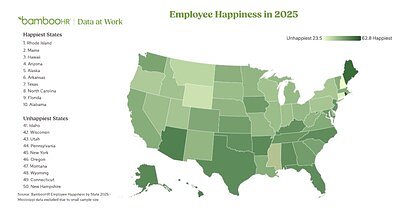
BambooHR, a leading people intelligence platform, today released its "America's Morale Map," a comprehensive analysis of employee sentiment based on data collected throughout 2025. The findings paint a startling picture of a nation deeply divided by morale, uncovering a nearly 40-point gap in employee happiness between the highest and lowest-ranking states. The report challenges conventional wisdom by arguing that labor market dynamics—specifically, the opportunity for mobility—are a far greater predictor of happiness than income, politics, or geography.
"Low turnover can look like stability on the surface, but in many states it may be masking disengagement," said Jonathan Vaas, Chief Legal Officer and Head of HR of BambooHR, in the report's press release. "Our data shows that when employees stay because they feel stuck versus fulfilled, organizations face a hidden risk of quiet quitting and burnout."
A Nation Divided by Morale
The report's findings, derived from employee Net Promoter Score® (eNPS) data, show a vast chasm in worker sentiment. While the national average eNPS in 2025 stood at 43—a score considered favorable—state-level scores ranged dramatically from an excellent 63 in Rhode Island to a dismal 24 in neighboring New Hampshire. This stark contrast between adjacent states underscores the report's central argument: place-based factors are not the primary drivers of employee satisfaction.
Contrary to common assumptions, the analysis found no consistent correlation between employee happiness and state income levels, political leanings, or dominant industries. High- and low-performing states were found on both sides of the political and economic spectrum. This suggests that the underlying reasons for employee contentment or misery are more complex than previously thought and are rooted in the structure of the labor market itself.
This data aligns with broader trends of workforce malaise. Recent Gallup studies have chronicled a decline in U.S. employee engagement to a 10-year low, costing the national economy an estimated $1.9 trillion in lost productivity. BambooHR's report adds a crucial new layer to this narrative, suggesting that a significant portion of this disengagement is hidden in plain sight, camouflaged by employees who are too economically insecure or lack the opportunities to leave their current roles.
The Four Faces of the American Workforce
By cross-referencing eNPS data with employee turnover rates, BambooHR identified four distinct labor-market typologies that define the American work experience:
- Ideal Stability: States with high satisfaction and low turnover, representing the best-case scenario where employees are happy and choose to stay.
- Healthy Dynamism: States with high satisfaction and high turnover, where employees feel positive but frequently move to seize new opportunities in a vibrant job market.
- Acute Attrition: A small group of states where low satisfaction is paired with high turnover, as unhappy workers vote with their feet.
- Hidden Risk: The largest and most consequential group. These states exhibit low satisfaction but also low turnover, indicating a workforce that is unhappy but feels trapped.
It is this "Hidden Risk" category that poses the most significant threat to employers. The report identifies several of the nation's largest and wealthiest labor markets, including New York, California, and Connecticut, as falling into this group. In these states, factors such as extremely high costs of living, specialized industries with limited transferability of skills, and intense competition may create a form of "golden handcuffs," where employees feel financially or logistically unable to leave a job, even if it leaves them profoundly dissatisfied.
The True Cost of a 'Stuck' Workforce
The implications for businesses operating in these "hidden risk" environments are profound. An organization filled with disengaged employees who are merely punching the clock is suffering from a slow-moving but corrosive ailment. This phenomenon of "quiet quitting" erodes productivity, stifles innovation, and degrades customer service over time.
"The unhappy employee who stays often becomes a drag on performance and a signal to others that problems are being tolerated," Vaas warned. "When the underlying causes of disengagement are not addressed, that dynamic weakens culture, slows productivity, and creates longer-term, systemic costs that are difficult to recover from."
Leaders who rely solely on turnover metrics may get a false sense of security, celebrating retention wins while a deeper cultural decay sets in. The report serves as a critical reminder that the absence of resignations does not equal the presence of engagement.
Beyond Turnover: The Shift to 'People Intelligence'
"America's Morale Map" ultimately calls for a more sophisticated approach to understanding the workforce, moving from simple metrics to a holistic "people intelligence" strategy. The report's methodology—combining sentiment data (eNPS) with behavioral data (turnover)—provides a blueprint for how organizations can gain a more accurate and actionable view of their workforce's health.
For employers, especially those in "hidden risk" states, the path forward involves looking beyond retention numbers. It requires proactively creating an environment where employees want to stay, not just feel they have to. This includes investing in internal mobility programs, offering clear pathways for career growth, fostering skill development, and genuinely listening to and acting on employee feedback. Modern HR technology, including AI-powered analysis of qualitative feedback, is becoming essential for leaders to process this complex data at scale.
The final takeaway is clear: employee silence is not golden. In an economic climate where mobility may be constrained, it is more important than ever for leaders to actively measure and cultivate genuine satisfaction. The true measure of a healthy organization is not just that its people are staying, but that they are staying for all the right reasons.