
- Liner Scholar’s database includes 460 million academic papers, more than double the industry benchmark.
- Liner’s AI scores 95.3% on OpenAI’s SimpleQA benchmark for factual accuracy.
- Major publishers like Cell Press and Elsevier now require AI tool disclosure in manuscripts.
Experts agree that Liner’s Figure Generator represents a significant advancement in academic research workflows, but emphasize the need for rigorous human oversight to ensure scientific integrity and prevent misinformation.
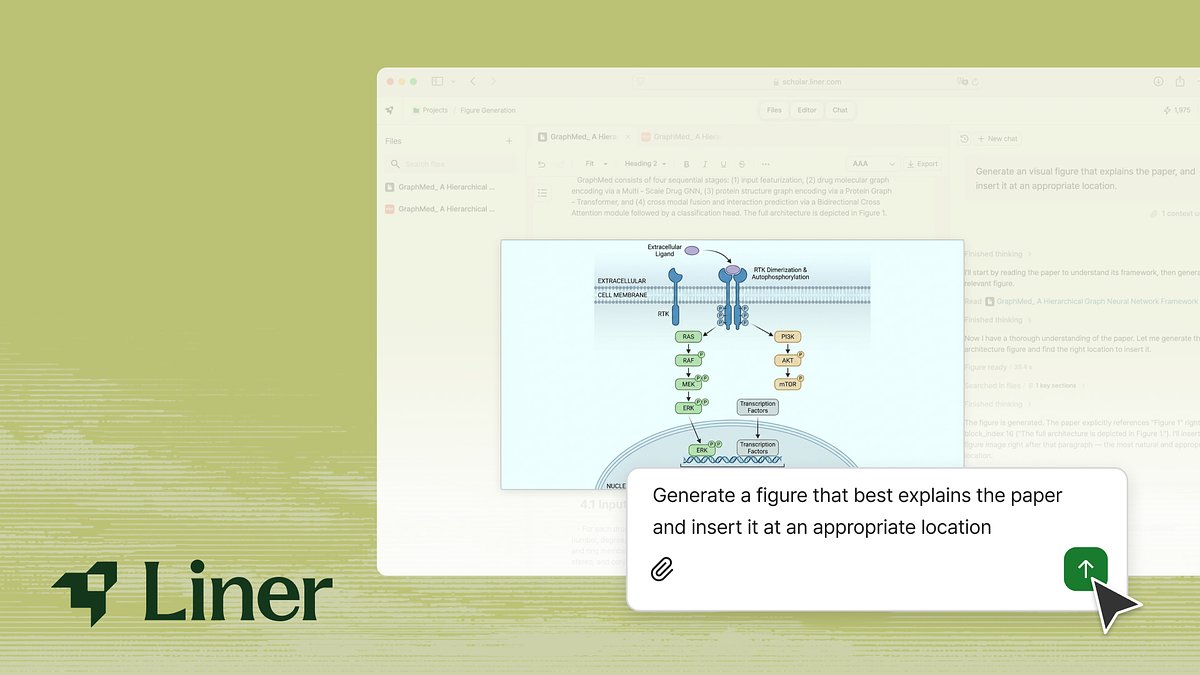
Liner AI Tool Automates Figures, Reshaping Academic Research
SAN FRANCISCO, CA – April 09, 2026 – Liner, an AI research platform known for its “evidence-first” approach, today launched Figure Generator, a new capability designed to transform dense academic writing into publication-ready visuals. The tool, now part of the company's Liner Scholar platform, aims to automate one of the most time-consuming aspects of research, potentially altering workflows for scientists and academics worldwide.
This move extends Liner's functionality beyond its established strengths in text summarization and citation management into the complex realm of visual communication. The company, recently named No. 2 in Education on Fast Company’s 2026 Most Innovative Companies list, is betting that researchers are ready for an AI that not only finds information but helps explain it visually.
A Picture is Worth a Thousand Citations
For researchers in fields like artificial intelligence, computer science, and biology, a clear diagram or figure is often as crucial as a paper's abstract. A well-constructed visual can distill complex system architectures, biological pathways, or data correlations into an easily digestible format, significantly boosting a paper's clarity, impact, and citation potential. However, creating these figures has long been a major bottleneck.
The process is traditionally a manual, resource-intensive endeavor requiring specialized software skills in tools like Adobe Illustrator, or significant time spent wrestling with PowerPoint. For many academics, this adds hours or even days to an already demanding publication schedule, sometimes requiring outside design support at additional cost.
Figure Generator is designed to directly address this pain point. “Researchers are often expected to communicate highly complex ideas with clarity, but the process of creating strong figures has remained unnecessarily slow and resource-intensive,” said Luke Kim, CEO of Liner, in the announcement. The new tool aims to bridge the gap between having the data and effectively communicating it.
From Evidence to Explanation in a Single Workflow
Liner’s new feature operates with straightforward functionality. A researcher can highlight a technically dense passage within a paper and prompt the platform’s AI chat to generate a figure illustrating the concept. The system then analyzes the selected text to produce a visual, whether it's a process flow, a structural diagram, or a system architecture.
Beyond reactive generation, the tool also proactively suggests where a figure might be most effective. By analyzing the entire document, Liner can identify sections where a visual aid would most improve comprehension and propose a custom-tailored figure. This capability is powered by Liner Scholar’s extensive database of 460 million academic papers, which the company describes as a significant “data moat” more than double the size of industry benchmarks.
This integration is key to Liner’s strategy. By embedding figure generation within its existing research ecosystem, the company aims to create a seamless workflow from discovery to explanation. “No more PowerPoint. No more Illustrator,” Kim stated. “Researchers should be able to go from evidence to explanation in one workflow.” This positions the tool not as a standalone design app, but as an integral part of a comprehensive AI research assistant.
The Crowded Field of AI Co-Pilots
Liner’s Figure Generator enters a rapidly growing and competitive market for AI-powered academic tools. Several platforms, such as ConceptViz and Illustrae, are already focused on generating scientific illustrations from text prompts. Established tools like BioRender are also integrating AI to automate figure creation, while platforms like Eraser.io focus on generating technical diagrams from text.
Liner seeks to differentiate itself with its “evidence-first” philosophy. The platform has earned praise for its high factual accuracy—reportedly scoring 95.3% on OpenAI’s SimpleQA benchmark—and its relentless focus on source traceability, where every AI-generated claim is linked back to a specific, verifiable source. This commitment to rigor is particularly appealing in an academic environment wary of AI “hallucinations.”
The company’s broader platform, Liner Scholar, already competes with AI-powered literature review tools like Elicit and Scite.ai. By adding a sophisticated visualization component built on its massive proprietary database, Liner is making a strong play to become an all-in-one “agentic research” system—an AI co-researcher that can handle complex, multi-step tasks across the entire research lifecycle.
Drawing the Line on Academic Integrity
The rise of AI-generated visuals, while promising, also introduces a host of complex ethical questions that the academic community is just beginning to navigate. The primary concern is the potential for visual misinformation, where an AI could inadvertently—or intentionally, if misused—create figures that misrepresent data or fabricate results, compromising scientific reproducibility.
Publishers are scrambling to establish clear policies, which remain fragmented and are evolving rapidly. Major publishers like Cell Press and Elsevier now require authors to explicitly disclose the use of any AI tools in their manuscripts. A crucial distinction is emerging: while AI may be used to generate schematic diagrams or conceptual illustrations (with disclosure), its use for generating figures that represent primary experimental data is widely prohibited due to the high risks to research integrity.
Liner’s own usage policy acknowledges that AI-generated content “may contain inaccuracies or biases” and places the responsibility on the user to “conduct a thorough assessment of the potential risks.” This aligns with an industry-wide trend where human oversight is positioned as the final, indispensable safeguard.
As tools like Figure Generator become more sophisticated and widespread, researchers, journal editors, and peer reviewers will face the new challenge of verifying the authenticity and accuracy of AI-generated visuals. The future of scientific communication will likely depend on how well this new partnership is managed, with transparency and rigorous human oversight serving as the ultimate guide.