
- 55,000+ people have already joined the waitlist for the oral Wegovy pill in the UK.
- 61% of non-users would prefer a daily pill over injectables.
- 120,000–130,000 UK patients could adopt oral GLP-1s within the first three months.
Experts agree that while the oral Wegovy pill represents a significant advancement in obesity treatment accessibility, its long-term success hinges on overcoming execution challenges, including strict administration protocols, supply chain resilience, and equitable patient access.
The Pill Paradox: UK's Oral Wegovy Sparks a Gold Rush, But Execution is the Real Test
GLASGOW, Scotland – June 11, 2026 – The starting gun for the next phase of the UK’s war on obesity has been fired. With the Medicines and Healthcare products Regulatory Agency (MHRA) today approving the country's first oral GLP-1 medication for weight management, the landscape of obesity care is poised for a seismic shift. The drug, a tablet form of Novo Nordisk's blockbuster Wegovy, moves a blockbuster treatment from a weekly injection to a daily pill, and the market has responded with explosive force. Digital provider Simple Online Healthcare reported that over 55,000 people have already joined its waitlist, a stark indicator of the immense pent-up demand for a less invasive option.
This isn't just another drug approval; it's a potential paradigm shift in patient access and preference. But as we've learned in the world of advanced manufacturing and technology rollout, the gap between an innovative breakthrough and successful mass-market execution is fraught with challenges. The story of the Wegovy pill will not be defined by the initial hype, but by the practical realities of its administration, the performance of its supply chain, and the architecture of the digital health ecosystem now tasked with its delivery.
A Revolution in a Bottle
The case for an oral GLP-1 is, on its face, overwhelmingly compelling. In a market where needle-aversion is a significant barrier to entry, a pill feels familiar and far less daunting. Research from Simple Online Healthcare quantifies this sentiment, suggesting 61% of people not currently using GLP-1 medications would prefer a daily pill. Even nearly half of existing users, already accustomed to injectables, say they would favor a tablet.
These preferences are fueling aggressive market projections. The digital healthcare company estimates that oral GLP-1s could reach 120,000-130,000 UK patients within the first three months alone, with a staggering 100,000 of them expected to be entirely new to obesity medication. This isn't just about converting existing patients; it's about fundamentally expanding the market. Looking further, the company suggests up to half a million current injectable users are open to switching if the price and real-world outcomes meet expectations.
"We welcome the MHRA's approval of the Wegovy pill," said Abdal Alvi, Chief Clinical Officer at Simple Online Healthcare, in a statement accompanying the news. "For many people, a tablet may feel more familiar and less daunting than an injection, and oral GLP-1s have the potential to widen access to effective obesity treatment."
This move by Novo Nordisk also heats up a fiercely competitive market, projected to exceed $100 billion globally by 2030. It puts the company in a stronger position against rivals like Eli Lilly, whose injectable Mounjaro has shown superior weight-loss results in trials and who is also developing its own oral options. The race is on, and the delivery mechanism is now a key battleground.
The Execution Challenge: Reading the Fine Print
While the promise of a simple pill is powerful, the reality of its use is far from simple. This is where the rhetoric of revolution meets the hard reality of execution. As Alvi cautioned, "it is important that patients understand these are still powerful prescription medicines."
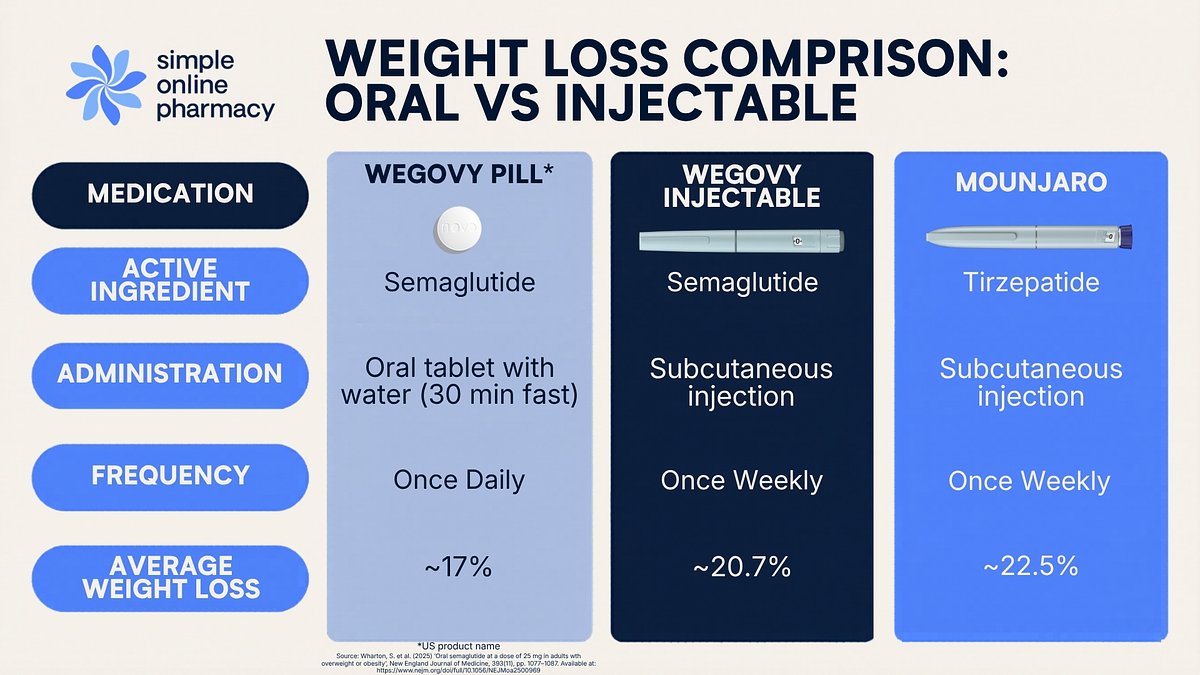
He's not just referring to the potential side effects—primarily gastrointestinal issues like nausea and diarrhea, which are common to the GLP-1 class. The true challenge lies in the pill's stringent administration protocol. To be effective, the tablet must be taken on an empty stomach after an overnight fast, with no more than a small sip of water, and patients must then wait at least 30 minutes before eating, drinking, or taking other oral medications. Even small deviations, Alvi notes, "will considerably affect how well the medication works."
This isn't a 'pop-and-go' pill; it's a daily ritual requiring significant discipline. The operational complexity for patients is a critical factor that is easily lost in the excitement. Furthermore, while clinical trials showed an average weight loss of around 16.6% over 64 weeks—a fantastic result—it is slightly below the 20.7% seen with injectable Wegovy and the 22.5% achieved with Mounjaro. For the 88% of current users who say they would only switch for equal or higher results, this small but significant efficacy gap could be a major deterrent.
The Digital Gatekeepers
The initial rollout of the Wegovy pill will not happen through the NHS. Until it is assessed for cost-effectiveness by the National Institute for Health and Care Excellence (NICE), it will be available only through private prescription. This places digital health companies like Simple Online Healthcare at the very center of the rollout, acting as the primary interface between the drug and a tidal wave of patient demand.
This model raises critical questions about oversight and equity. While these platforms offer unprecedented access and convenience, they are under increasing scrutiny from regulators like the Care Quality Commission (CQC) to ensure that remote prescribing is safe, appropriate, and supported by robust clinical care. The concern is that the ease of online access could lead to medication being used for cosmetic purposes rather than for clinically-defined obesity, a use the MHRA explicitly warns against.
Moreover, the private-pay model creates an immediate two-tiered system where access is determined by the ability to pay, with monthly costs likely to run from £80 to over £300. It also puts immense pressure on a supply chain that has already buckled under the demand for injectable GLP-1s. The National Pharmacy Association has voiced serious concerns about a burgeoning black market for counterfeit treatments, a risk that could be amplified by a highly sought-after pill format.
The approval of an oral GLP-1 is a landmark moment for obesity care in the UK. It represents a triumph of pharmaceutical innovation that directly addresses a core patient desire. Yet, the path from approval to effective, equitable, and safe nationwide adoption is a narrow one. Success will depend less on the initial demand and more on the meticulous management of patient expectations, the rigour of clinical oversight, and the resilience of a supply chain bracing for impact.