
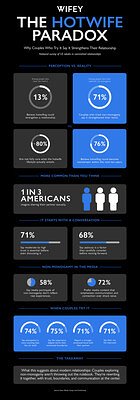
- 71% of couples in consensual non-monogamy (hotwife dynamic) report a stronger emotional bond.
- Only 13% of the general population believes such practices could have a positive effect.
- 74% of these couples find anticipation and planning more exciting than the sexual act itself.
Experts emphasize that successful consensual non-monogamy hinges on intense communication, emotional literacy, and negotiated boundaries, which can strengthen relationships beyond traditional monogamous models.
The Hotwife Paradox: Redefining Intimacy Through Radical Honesty
LOS ANGELES, CA – March 10, 2026 – A striking new survey suggests a profound disconnect between how Americans imagine non-traditional relationships and how they are experienced by those who practice them. According to new research, a vast majority of couples who engage in consensual non-monogamy—specifically the “hotwife” dynamic—report that it actually strengthens their relationship, a finding that flies in the face of conventional wisdom.
The national survey, commissioned by WIFEY, a relationship platform from adult content producer Vixen Media Group, reveals what it calls the “hotwife paradox.” While 71% of couples who have explored the lifestyle say it fortified their emotional bond, a mere 13% of the general population believes such a practice could have a positive effect. This chasm highlights a quiet but significant shift in how some modern couples are approaching desire, honesty, and the very definition of commitment.
Beyond the Taboo: Communication as the Core
At the heart of the paradox lies a fundamental misunderstanding of the practice. The term “hotwifing” refers to a form of consensual non-monogamy where a woman in a committed relationship engages in sexual activity with other partners with the full knowledge and encouragement of her primary partner. Far from the secrecy and betrayal of infidelity, the practice is predicated on a foundation of intense communication, mutual respect, and meticulously negotiated boundaries.
Nearly 80% of survey respondents admitted they were not fully sure what the term entails, often conflating it with cheating. Yet the data from those practicing it paints a different picture. Among couples who have explored non-monogamy:
- 71% reported a stronger emotional bond.
- 71% said their sex life improved.
- 75% stated the experience helped them clarify emotional boundaries.
Perhaps most tellingly, 74% of these couples said the anticipation and planning were more exciting than the sexual act itself. This suggests the power of the dynamic lies less in sexual novelty and more in the shared fantasy, trust, and radical transparency required to navigate it.
“What stands out in this data is not risk-taking, but intention,” said Dr. Tara, a Certified Sexologist with the American Board of Sexology, in the original press release. “Couples who explore consensual non-monogamy successfully tend to over communicate. They spend more time discussing boundaries, emotions, and expectations than many traditionally monogamous couples do. That level of emotional literacy is often what strengthens the relationship, not the sexual dynamic itself.”
A Generational Shift in Defining Love
The survey data indicates this renegotiation of relationship norms is being led by younger generations, particularly Millennials. Among respondents aged 31 to 40, half believe that couples who explore hotwifing are more committed, a stark contrast to just 20% of adults over 60 who feel the same.
This isn’t necessarily a rejection of commitment, but a redefinition of it. For these generations, the future of love appears to be increasingly tied to freedom and transparency. The survey found that 49% of adults aged 31 to 40 strongly agree that the future of love is about freedom, compared to just 20% of those aged 61 to 70. Millennials also reported finding the process of defining boundaries the most challenging (37%), suggesting they are the ones doing the heaviest emotional lifting to build these new relational frameworks.
This shift occurs against a backdrop of rising curiosity. Nearly one in three Americans (31%) say they have fantasized about sharing their partner, and 40% believe it could be a way to reclaim excitement in a long-term relationship. The conversation, however, remains largely private. A significant 62% of respondents prefer to keep discussions about non-monogamy behind closed doors, signaling a “quiet shift” happening within marriages rather than a loud cultural rebellion.
The Nuanced Reality of Consensual Non-Monogamy
While the survey from Vixen Media Group presents a compelling narrative of relationship enhancement, academic research and clinical practice offer a more complex picture. For years, sexologists and relationship therapists have studied Consensual Non-Monogamy (CNM), finding that while it can indeed foster personal growth and deeper connection for some, it is not without significant challenges.
Studies in the field often corroborate the survey’s emphasis on communication as the cornerstone of successful CNM. The process demands a high degree of emotional intelligence and a willingness to confront difficult emotions like jealousy, which 68% of the survey’s respondents cited as a key factor they carefully consider. However, the social landscape remains a major hurdle. Individuals in CNM relationships frequently face intense stigma, judgment, and discrimination, which can cause psychological distress and force them to conceal their relationship structures from family, friends, and even healthcare providers.
Furthermore, while the survey was conducted by an independent agency, its commission by a commercial entity in the adult entertainment space highlights a growing trend of marketing alternative sexualities. Vixen Media Group, with its WIFEY brand, is strategically positioning itself within a niche but expanding market by framing its content as a tool for authentic exploration and relationship strengthening. This commercial interest intersects with a genuine cultural movement, blurring the lines between entertainment, lifestyle, and a re-evaluation of modern intimacy.
As dissatisfaction with one-size-fits-all relationship models grows, more couples appear to be asking difficult questions about what monogamy can and cannot provide. The survey found that 76% of those who have already explored non-monogamy believe dynamics like hotwifing could become mainstream within the next decade. Whether that prediction holds true, the conversation itself is pushing trust, communication, and emotional honesty to the forefront as the universal pillars of a committed, modern partnership, regardless of its specific form.