
- 92% of Pakistan's land is classified as arid or semi-arid, creating severe agricultural challenges.
- Wheat yields could fall by as much as 50% by 2050 if current trends persist.
- Over $1.3 billion in potential investment has been pledged to modernize Pakistan's agricultural sector through joint initiatives.
Experts view this China-Pakistan agricultural collaboration as a strategic shift toward sustainable food security, leveraging scientific innovation to address climate vulnerabilities and strengthen long-term economic ties.
The Green Bridge: How Science Cements China-Pakistan's All-Weather Pact
LANZHOU, China – March 31, 2026 – In the sun-scorched, water-stressed farmlands of Pakistan, a quiet revolution is taking root, nurtured by expertise cultivated over 1,500 miles away on China's Loess Plateau. This is not a story of grand infrastructure, but of seeds, soil, and science—a collaboration that is becoming a crucial, living pillar of the China-Pakistan Economic Corridor (CPEC) and the broader Belt and Road Initiative (BRI).
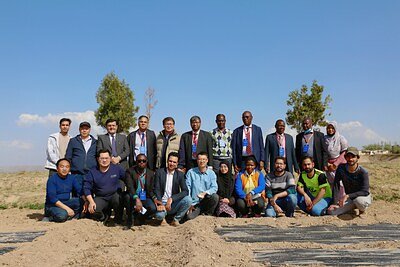
At the heart of this initiative is Professor Youcai Xiong and his Dryland Agricultural Ecology Research Team at Lanzhou University. Since 2012, this group has been building a 'green bridge' between the two nations, translating decades of research in arid agriculture into practical solutions for one of the world's most climate-vulnerable regions. Their work exemplifies a strategic shift in the China-Pakistan partnership, moving beyond concrete and steel to address the fundamental challenge of food security.
The Arid Challenge: A Race Against Time for Pakistan's Food Security
Pakistan's agricultural sector, the backbone of its economy employing nearly half the population, is facing an existential crisis. The nation is rapidly moving from water-stressed to water-scarce, with per capita water availability plummeting to crisis levels. With approximately 92% of its land classified as arid or semi-arid, the country's reliance on an increasingly strained Indus River system is a critical vulnerability.
Inefficient irrigation contributes to staggering water loss, while the escalating impacts of climate change—erratic rainfall, punishing heatwaves, and creeping desertification—threaten to decimate crop yields. Projections from international food policy institutes warn that wheat yields, a staple crop, could fall by as much as 50% by 2050 if current trends persist. This dire forecast underscores the urgent need for a paradigm shift in farming practices.
It is within this high-stakes environment that the technologies and methods championed by Professor Xiong's team find their profound relevance. The challenge is not merely to increase yields, but to do so sustainably, conserving precious water resources and building resilience against a volatile climate.
A Blueprint from the Loess Plateau: Lanzhou's Answer to Dry-land Farming
Professor Xiong, a recognized expert whose work has earned him the distinction of being a Foreign Member of the Pakistan Academy of Sciences, has dedicated his career to mastering the science of farming in harsh environments. His team's research at Lanzhou University has produced a suite of systemic solutions tailored for arid regions.
These innovations are not abstract theories; they are field-tested strategies. Key among them is the advanced application and recovery of plastic mulch films, a technique that dramatically reduces water evaporation from the soil, suppresses weeds, and regulates soil temperature, allowing crops to thrive with less water. This is coupled with research into water-saving, high-yield crop varieties and cultivation patterns, such as cereal-legume intercropping, which enhance soil health and yield stability.
Furthermore, the team's work addresses the dual goals of productivity and ecological protection. Their research into the synergy between ecosystem management and sustainable agriculture provides a scientific basis for achieving both "stable yields" and "carbon sequestration." By improving soil health and organic matter, these farming techniques help turn agricultural lands into carbon sinks, actively contributing to climate change mitigation. With a publication record of over 160 papers and book chapters, including 12 highly cited papers in prestigious journals like Journal of Advanced Research and Field Crops Research, the team's scientific credibility is firmly established. Their work in Northwest China has created a scalable blueprint now being adapted for their counterparts in Pakistan.
More Than Seeds: Cultivating a Generation of Scientific Diplomats
Perhaps the most enduring impact of this collaboration is its investment in people. The partnership extends far beyond technology transfer; it is about building human capital and fostering deep, lasting connections. Lanzhou University has become a vital hub for Pakistani scholars, having trained 348 students in recent years, with an overwhelming 96% receiving Chinese government scholarships.
Professor Xiong's team is a microcosm of this exchange. It currently hosts a vibrant community of four Pakistani postdoctoral fellows, four Ph.D. candidates, and five master's students. These are not just students; they are future leaders in Pakistan's agricultural sector. The success stories are compelling. Dr. Asfa Batool, who enrolled in 2012, has since been appointed as an Associate Professor at a Chinese university. Postdoctoral fellow Dr. Muhammad Maqsood Ur Rehman achieved a significant milestone by securing a National Natural Science Foundation project for Excellent Young Foreign Scholars—the only foreign recipient in Gansu province.
This success is fostered by a nurturing environment that goes beyond academics. The university provides comprehensive support, from housing and language assistance to daily logistics, ensuring the scholars can focus on their research and smoothly integrate into life in China. By working on the front lines with Chinese researchers and local farmers, these Pakistani scientists gain invaluable hands-on experience, preparing them to return home as key agents of change and innovation.
The Geopolitical Harvest: Agriculture as a Pillar of the Belt and Road
While the initial phase of the China-Pakistan Economic Corridor (CPEC) focused on energy and transportation infrastructure, its second phase has placed agriculture at the forefront. Professor Xiong's initiative is a prime example of this strategic evolution, demonstrating how the Belt and Road Initiative can deliver tangible benefits at the grassroots level.
This agricultural cooperation is a powerful tool of soft power, solidifying the "All-Weather Strategic Cooperative Partnership" with shared goals of sustainability and prosperity. It moves the relationship beyond government-to-government agreements into the realm of university labs and rural farming communities. The establishment of joint working groups and a recent flurry of MOUs, representing over $1.3 billion in potential investment from a 2026 conference, signal a long-term, coordinated effort to modernize Pakistan's agricultural sector.
By embedding Chinese technology and expertise within Pakistani institutions and training the next generation of local experts, the program ensures its own sustainability. This collaborative model, focused on solving critical shared challenges like food security and climate change, provides a compelling narrative for the BRI, showcasing it as a vehicle for mutual development and green growth. As these seeds of scientific cooperation continue to be sown, they promise a harvest of not only improved crop yields but also a more resilient and interconnected future for the entire region.