
- 70% of consumers reassess their mobile plan at least once a year
- 37% of Gen Z reviews their options every 3-6 months
- 85% of consumers describe eSIM experience as positive
Experts agree that the mobile market is undergoing a fundamental shift driven by Gen Z's demand for autonomy, transparent pricing, and seamless switching enabled by eSIM technology, forcing carriers to compete on service and value.
The Great Mobile Unbundling: Gen Z and eSIMs Upend the Wireless Market
NEW YORK, NY – March 02, 2026 – The long-standing loyalty that once defined the U.S. mobile market is rapidly eroding, replaced by a new era of consumer empowerment and intense competition. A landmark survey reveals a profound shift in consumer behavior, where static, long-term contracts are giving way to continuous evaluation, driven by a generation that demands autonomy and technology that makes switching carriers as simple as tapping a screen. This transformation is not only challenging the dominance of legacy carriers but also paving the way for non-traditional players, like retailers, to stake their claim in the multi-billion dollar industry.
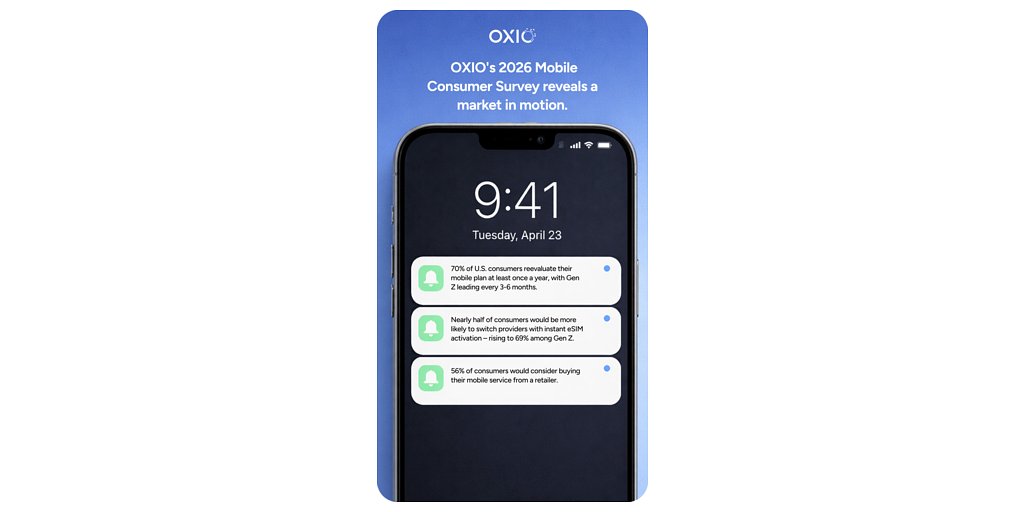
New data from the OXIO 2026 Mobile Consumer Survey, which polled over 1,000 U.S. consumers, paints a clear picture of a market in flux. Seven in ten consumers now reassess their mobile plan at least once a year, actively hunting for better value. For the industry’s most disruptive demographic, Gen Z, this evaluation cycle is even shorter, with 37% reviewing their options as often as every three to six months.
“Consumers are not passively renewing mobile plans. They are actively evaluating them, comparing value, scrutinizing pricing, and reassessing providers more frequently,” said Nicolas Girard, CEO of OXIO, in the report’s release. “Mobile is evolving from a static utility into a dynamic service relationship, and the next era will belong to those who reduce complexity, communicate transparently, and activate seamlessly.”
The New Value Equation: Price, Transparency, and Control
The primary catalyst for this constant re-evaluation is price. The survey found that a bill increase is the single largest trigger for 58% of consumers to start shopping for a new provider. In this environment, the opaque billing and complex fee structures of the past have become a significant liability. Consumers are demanding straightforward, predictable pricing.
This focus on core value has also diminished the appeal of once-popular perks. Despite years of heavy investment by carriers in entertainment partnerships, just 22% of consumers cite bundled services like streaming subscriptions as a key value driver. For Gen Z, that figure drops to a mere 20%. In a world saturated with subscriptions, these add-ons are losing their power to lock in customers, who are increasingly prioritizing network performance, transparent pricing, and direct control over their service.
This desire for control is a defining characteristic of younger consumers. The survey reveals that Millennials and Gen Z are declaring their mobile independence far earlier than previous generations, leaving family plans between the ages of 19 and 22—nearly 15 years sooner than Boomers and Gen X. The motivation is not financial, but a fundamental desire for autonomy. Nearly half of Gen Z consumers (45%) report wanting their own plan, while 44% cite a desire for more control over features and usage. This behavior aligns with broader generational trends that show Gen Z values personalization, authenticity, and direct management of their digital lives.
The eSIM Revolution: Tearing Down the Walls of Switching
Fueling this consumer-led revolution is the rapid adoption of eSIM technology. The embedded SIM card, which allows users to activate and switch mobile plans digitally without a physical card, is fundamentally dismantling one of the biggest barriers to competition: switching friction.
According to the OXIO report, 44% of consumers have already used eSIM, and an overwhelming 85% describe the experience as positive. Adoption is highest among younger, tech-savvy generations, with 57% of Millennials and 60% of Gen Z having used the technology. More importantly, eSIM is directly influencing consumer behavior. Nearly half of all consumers say the ability to activate a plan instantly via eSIM would make them more likely to switch providers. For Millennials and Gen Z, the figures are even more dramatic, at 64% and 69% respectively.
This trend is supported by the broader market. North America is leading global eSIM adoption, and with device manufacturers like Apple making their latest U.S. iPhones eSIM-only, the technology's dominance is inevitable. Industry analysts, including the GSMA, project that eSIM connections will account for the majority of smartphones by the end of the decade. This shift empowers consumers to “carrier-hop” with unprecedented ease, forcing providers to compete on merit, service, and price every single day, not just at the end of a two-year contract.
Retail's New Frontier: The Enduring Power of the Physical Store
While technology like eSIM pushes the industry toward a digital-first model, the survey uncovers a crucial, and perhaps counterintuitive, insight: physical stores remain vital. A staggering 81% of all consumers—and 90% of Gen Z—say that access to a physical store is an important factor when selecting a mobile provider. This highlights a potential disconnect with the strategies of some major carriers, who have been streamlining their retail footprints in favor of digital channels.
This preference for an in-person touchpoint creates a massive opportunity for a new category of mobile provider: trusted retailers. The survey found that 56% of consumers are open to buying mobile service from a retailer, the highest of any non-traditional provider category. Retailers possess a unique combination of assets: a widespread physical footprint, established brand trust, and existing customer relationships. By leveraging Telecom-as-a-Service (TaaS) platforms, which handle the complex backend network infrastructure, retailers can launch branded mobile services with relative ease, creating new recurring revenue streams and deepening customer loyalty.
We are already seeing this play out. Major brands like Walmart have established MVNOs (Mobile Virtual Network Operators) such as Walmart Family Mobile, and reports suggest Amazon has explored offering low-cost plans to its Prime members. While the path is not without its challenges—as evidenced by Target's recent decision to end its third-party mobile partnership—the strategic logic is compelling. For retailers, mobile service is no longer just a product to be sold, but a powerful tool for customer engagement in an increasingly competitive landscape. This convergence of retail and telecom signals a new front in the battle for the American mobile consumer, one where convenience, trust, and value are the ultimate currencies.