
- 30x energy efficiency: Q.ANT's photonic hardware targets a 30x increase in energy efficiency compared to classical processors.
- 900 terawatt-hours by 2030: Industry projections estimate data centers could consume over 900 terawatt-hours annually by 2030.
- First production-relevant models: Q.ANT successfully ran complex AI workloads on photonic hardware for the first time.
Experts would likely conclude that Q.ANT's light-based AI processing represents a transformative leap in energy efficiency, potentially solving one of AI's most critical sustainability challenges.
The Dawn of Light-Based AI: How Photonics Is Solving the Energy Crisis
STUTTGART, Germany – June 23, 2026 – In a Hamburg convention hall, a German technology firm, Q.ANT, quietly demonstrated what could be the solution to artificial intelligence's most pressing problem. The company successfully ran complex, modern AI models on a processor that computes not with electrons, but with light. This breakthrough isn't just a technical achievement; it's a direct challenge to the unsustainable energy trajectory of an AI-powered world.
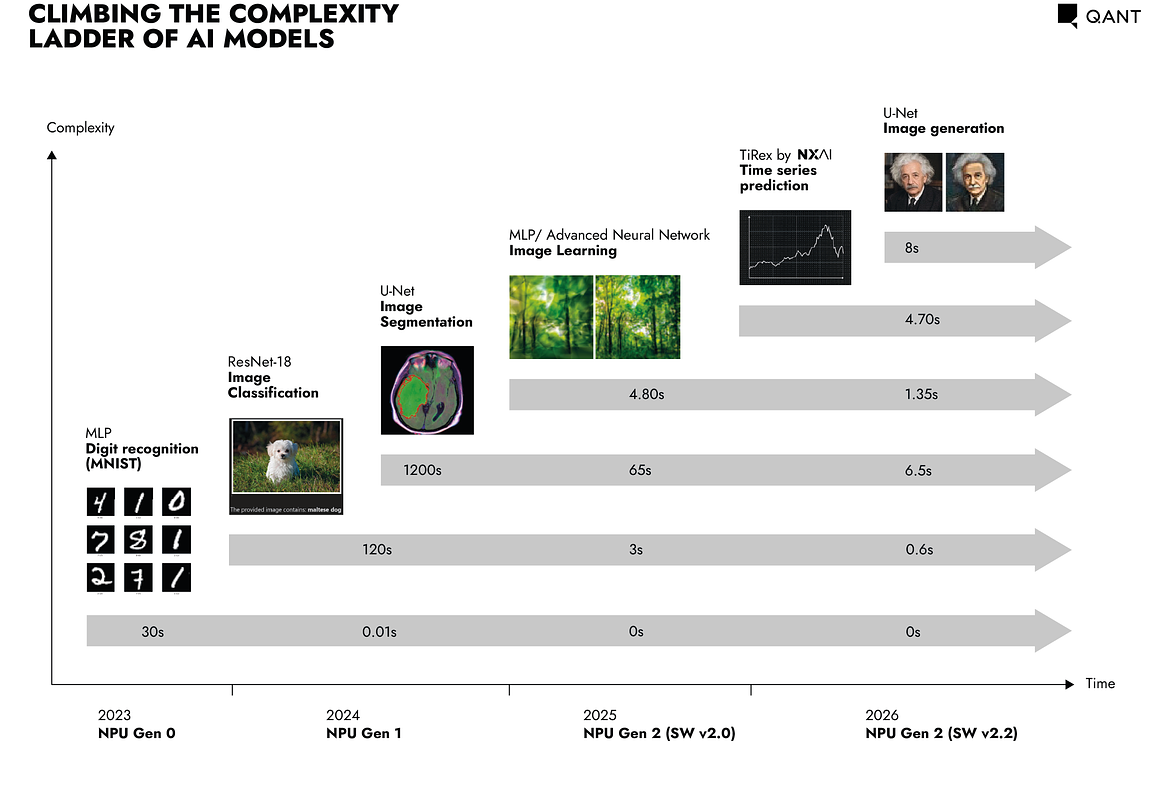
At ISC High Performance 2026, Q.ANT showcased its second-generation Native Processing Unit (NPU) executing two of the most demanding classes of AI workloads: a diffusion model for generating images and a recurrent neural network for predicting future trends. This marks the first time such production-relevant models have run on photonic hardware, signaling a critical maturation of the technology from academic curiosity to a commercially viable tool that could fundamentally alter the economics of AI infrastructure.
The New Energy Calculus
The relentless growth of AI has come with a voracious appetite for power. Industry projections estimate that by 2030, data centers could consume over 900 terawatt-hours annually, a staggering figure that casts a long shadow over the technology's future. As one analyst noted, we are approaching a "computational cost singularity," where progress is throttled not by our ingenuity, but by our ability to power it.
Q.ANT's approach tackles this problem at its source. “When you perform computation with light instead of transistors, you reduce energy consumption at the source,” says Dr. Michael Förtsch, Q.ANT's founder and CEO. The company claims its hardware targets a 30x increase in energy efficiency for equivalent mathematical operations compared to classical processors. This isn't an incremental improvement; it's a paradigm shift. The efficiency stems from the physics of photons, which generate negligible heat, allowing one optical element to perform the work of what Q.ANT estimates to be over a thousand transistors in certain multiplication tasks. The result is a dramatic reduction in both computational power and the secondary energy cost of cooling.
“Every serious conversation about the future of AI acknowledges that energy is the bottleneck the industry must break through,” Förtsch adds. “Our recent demonstrations of generative AI show that photonic hardware can carry the mathematical load of the most demanding modern AI workloads.”
A Leap Beyond the Transistor
Proving the potential of a new computing architecture requires more than just running simple algorithms. It must prove its mettle on the complex, messy, and computationally brutal models that define modern AI. Q.ANT did just that, demonstrating both breadth and depth in its hardware's capabilities.
First, it ran a diffusion model, the same class of architecture behind popular image generators. These models are notoriously intensive, relying on repeated, large-scale matrix operations. “If photonic hardware could execute such workloads efficiently and reliably, it would be an exciting indication that alternative computing substrates may play an important role in the future of generative AI,” commented Professor Dr. Björn Ommer, a leading researcher behind the stable diffusion model.
Second, to prove its versatility, the company executed the TiRex time series prediction model, which is built on the advanced xLSTM architecture developed by the Austrian AI lab NXAI. This model is designed for complex sequential tasks like financial market analysis and supply chain optimization. “Seeing it run on Q.ANT's photonic hardware is amazing and opens a new chapter,” says Lukas Fischer, Head of Applied Research at NXAI. “xLSTM architecture on photonic systems could redefine what energy-efficient AI even means.”
Perhaps most critically for long-term adoption, the ecosystem is beginning to coalesce. Independent developers at Daisytuner recently compiled an AI model directly from PyTorch—a standard software framework—to run on Q.ANT's processor. This crucial step removes a significant barrier to entry, allowing AI developers to work with familiar tools without needing to become experts in optical physics.
From Lab to Live Production
For any deep-tech innovation, the journey from a laboratory proof-of-concept to a commercially relevant product is fraught with peril. Q.ANT appears to be navigating this path with strategic precision, building a foundation of institutional confidence and commercial partnerships.
The German cloud provider IONOS has already placed the first commercial orders for Q.ANT’s hardware, signaling a clear enterprise demand for this new class of accelerator. This partnership aims to make photonic computing accessible to business users, providing a real-world testbed for the technology's performance and efficiency claims.
Furthermore, Q.ANT’s systems are not just being tested; they are in live production. Two of Europe’s most powerful high-performance computing facilities, the Leibniz Supercomputing Centre Munich (LRZ) and Jülich Supercomputing Centre (JSC), are already running the hardware as operational co-processors. This level of early adoption from world-class institutions provides powerful validation and a crucial feedback loop for future development.
Backed by a significant Series A funding round and a U.S. expansion into Austin, Texas, the company is scaling its manufacturing from 4-inch research wafers to 8-inch production wafers. This move is essential for achieving the economies of scale needed to compete with the silicon behemoths and integrate into data centers globally. The development of a “Photonic Abstraction Layer” to ensure seamless software integration further underscores a mature strategy focused on real-world deployment, not just theoretical performance.