
- Consumer complaints rose from 2.1 million in 2024 to 2.6 million in 2025 (FTC data).
- 79% of B2B tech buyers face change management issues (Gartner).
- 43% scale back tech ambitions due to implementation challenges (Gartner).
Experts would likely conclude that AI-driven compliance frameworks, like Gryphon AI's Contact Governance Maturity Model, are transforming regulatory constraints into strategic growth opportunities by enabling scalable, compliant customer engagement.
The Compliance Paradox: How AI and Regulation Forge a New Engine for Growth
BOSTON, MA – June 02, 2026 – A fundamental friction is building at the heart of the global economy. On one side, enterprises are deploying ever-more-sophisticated tools—from automated dialers to AI agents—to reach customers. On the other, a rising tide of consumer frustration and regulatory scrutiny threatens to grind that outreach to a halt. Data from the Federal Trade Commission underscores this tension, with consumer complaints steadily climbing, jumping from 2.1 million in fiscal year 2024 to 2.6 million in 2025. This isn't just background noise; it's a systemic risk.
In this environment, contact governance—the rules dictating who you can contact, when, and how—is rapidly shifting from a back-office legal function into a critical component of corporate strategy. Responding to this structural shift, contact governance leader Gryphon AI has launched its Contact Governance Maturity Model™, an industry-first framework designed not just to mitigate risk, but to transform the entire compliance function into an engine for revenue growth. The move signals a broader market realization: in the modern enterprise, the ability to safely and effectively communicate with customers is no longer a given, but a core competency that must be systematically cultivated.
From Reactive Checkbox to Strategic Engine
For decades, compliance has been viewed through the lens of cost-avoidance. It was a necessary burden, a complex set of rules to be navigated to stay out of trouble with regulators. This defensive posture, however, often leads to overly conservative strategies, where entire segments of potential customers are suppressed from outreach lists out of an abundance of caution. The result is lost revenue and wasted market potential, hidden costs that rarely appear on a balance sheet.
"For years, compliance was seen as a burden; something you had to do to stay out of trouble," said Clay McNaught, CEO of Gryphon AI, in a recent announcement. "What we've shown is that compliance can also help you grow your business by unlocking reach and eliminating the over-suppression of compliant customers." This statement captures the essence of the paradigm shift Gryphon AI is championing. The company’s new maturity model is built on the principle of "Growth through Governance," suggesting that a sophisticated, data-driven compliance framework can become a durable competitive advantage.
By systematically evaluating an organization's governance capabilities across eight dimensions—including Regulatory Intelligence, Operational Compliance Execution, and Data Integrity—the model provides a roadmap to move beyond simple DNC list scrubbing. It pushes organizations toward a state where they can confidently engage the maximum number of permissible contacts, turning a defensive necessity into an offensive tool for market expansion. This is the compliance paradox: the very constraints that seem to inhibit growth can, when managed with precision and intelligence, become the foundation for more effective and profitable customer engagement.
Operationalizing Governance in the Age of AI
The most significant structural change proposed by the model is the extension of high-level Governance, Risk, and Compliance (GRC) policies into the operational trenches of customer interaction. While traditional GRC programs excel at setting enterprise-wide policies and generating reports for leadership, they often lack an "operational execution layer." This creates a gap where rules exist on paper but are not consistently enforced in the real-time chaos of a sales or service floor.
This is where Gryphon AI's model makes its most compelling case. It focuses on embedding compliance logic directly into workflows across voice, SMS, email, and emerging AI-driven channels. The goal is to reach what the model defines as "Stage 3: Operational Governance," an inflection point where compliance shifts from a task that agents must remember to an automated, operating condition of the system itself. At this stage, a non-compliant call or text is not just flagged after the fact; it is prevented before it ever happens.
"Partial governance introduces subtle friction that becomes measurable over time through rising complaints and declining trust," noted Neal Keene, Gryphon AI's CTO. The maturity model is designed to eliminate that friction by creating a single source of truth for contact eligibility. This foundation is becoming increasingly critical as enterprises rush to adopt AI agents for customer outreach. Without a robust governance layer, AI can amplify compliance failures at an unprecedented scale and speed, turning minor risks into catastrophic ones. By ensuring governance precedes automation, the framework provides the necessary guardrails to leverage AI safely, transforming it from a potential liability into a powerful asset for scalable, compliant outreach.
Bridging the 'Change Gap' in a Complex Market
The path to advanced technological capability is littered with failed implementations. Citing Gartner research, Gryphon AI highlights that a staggering 79% of B2B technology buyers face significant change management issues during deployment, with 43% ultimately scaling back their ambitions. This "change gap" between a technology's promise and an organization's ability to absorb it is a primary driver of unrealized ROI.
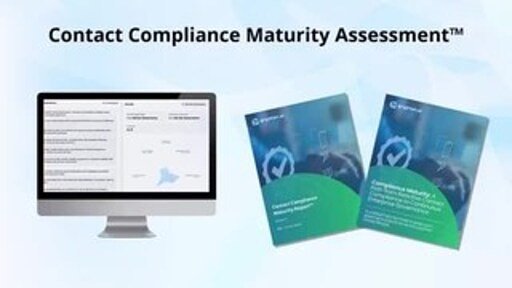
While the market offers a range of solutions, from broad GRC platforms like MetricStream and ServiceNow to specialized call center compliance tools, Gryphon's maturity model differentiates itself by acting as a consultative roadmap. It's not just a piece of software but a structured, phased approach to organizational change. The model provides a diagnostic assessment that helps a company identify its current stage—from "Ad Hoc" to "Enterprise"—and exposes the specific constraints holding it back. The output is a personalized report that functions as a "roadmap, not a scorecard," detailing the concrete steps needed to advance.
This guided approach is designed to de-risk the adoption of advanced governance technology. By breaking the journey into manageable stages and focusing on building capabilities across dimensions like Governance & Accountability and Enterprise Oversight, the model helps organizations build the internal muscle required for success. It provides a clear path through the complexity, ensuring that the investment in technology translates into a tangible and durable improvement in performance, rather than becoming another statistic in the 'change gap' graveyard.
The New Regulatory Minefield and the Path to Agility
The regulatory landscape governing customer contact is a constantly shifting minefield of federal and state laws, from the long-standing Telephone Consumer Protection Act (TCPA) to new rules governing SMS and AI interactions. In this environment, static, manual compliance processes are no longer viable. The key to survival and success is not just adherence, but agility—the ability to absorb regulatory change quickly and without disrupting business operations.
Gryphon AI's model directly addresses this need by emphasizing "Regulatory Agility" and "Data Integrity & Evidence" as core pillars of maturity. The framework is designed to help organizations create a system that can translate complex legal language into executable, machine-enforceable rules. Furthermore, by creating an audit-ready, time-stamped record of every single eligibility decision and contact event, it builds a fortress of evidentiary proof. This 100% audit readiness transforms the high-stakes, reactive process of responding to a lawsuit or regulatory inquiry into a routine, data-driven report.
Ultimately, the model offers a path away from a constant state of reaction. It guides leadership from the chaos of Stage 1, where compliance is an ad-hoc firefighting exercise, toward Stage 5, "Continuous Enterprise Governance," where risk is managed holistically and proactively. By providing a structured path from reactive chaos to proactive governance, the model aims to equip enterprises with the agility needed to not just survive the next wave of regulation and technology, but to master it.