
- 47%: AI use for internal modeling doubled in the past year.
- 44%: AI application in fraud detection.
- 74% vs. 39%: Larger banks ($250B+ assets) lead in AI fraud detection adoption compared to smaller banks (<$1B assets).
Experts agree that banks are prioritizing internal, high-impact AI applications like fraud detection and data modeling to build expertise and demonstrate ROI before expanding to customer-facing AI solutions.
The AI Imperative: How Banks Are Moving from 'If' to 'How' in Fintech
ATLANTA, GA – February 02, 2026 – The banking industry has officially moved past the theoretical era of artificial intelligence. The new focus is no longer on if AI should be integrated into financial services, but how to deploy it responsibly and strategically for maximum impact. This shift from speculative discussion to practical implementation marks a crucial turning point, as institutions grapple with the challenges and opportunities of embedding AI into their core operations.
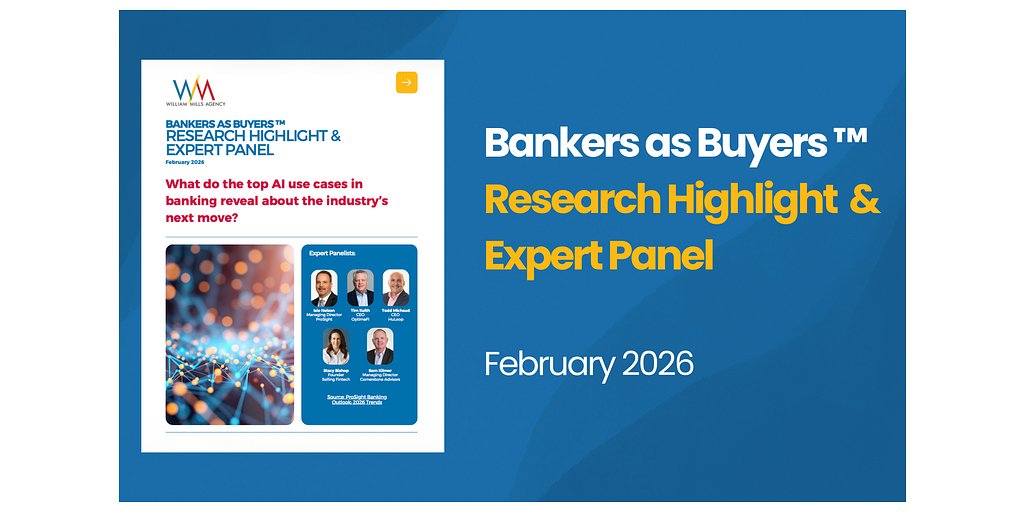
A new report from William Mills Agency, a leading fintech public relations firm, crystallizes this industry-wide pivot. The latest edition of its Bankers as Buyers™ Research Highlight & Expert Panel report examines the most common AI use cases today to decode the industry's next moves. Drawing on data from the ProSight Banking Outlook: 2026 Trends research, the report provides a clear snapshot of a sector in transition.
“This research reinforces that financial institutions are no longer asking if they should use AI, but how to deploy it responsibly and where it delivers the most value,” said Scott Mills, president of William Mills Agency, in a statement accompanying the report's release. “The goal of this research highlight is to advance the conversation by examining how peers are approaching AI today and what these early use cases signal about the direction of banking in the years ahead.”
A Pragmatic Approach: Prioritizing Risk and Efficiency
The report's findings reveal a clear pattern of pragmatism and caution. Rather than pursuing flashy, customer-facing AI novelties, banks are overwhelmingly directing their initial AI investments toward internal, high-impact areas like fraud detection and data modeling. According to the underlying research, the use of AI for internal modeling nearly doubled to 47% in the past year alone, while its application in fraud detection rose to 44%.
This focus on back-office functions is strategic. These use cases are often easier to implement, scale, and audit. Because they are typically supervised by human experts and operate on internal data, they present a lower risk profile than applications that interact directly with customers or handle sensitive personal information. This trend is particularly pronounced in larger institutions, which have the resources and data volumes to pioneer such initiatives. Research shows that 74% of financial institutions with over $250 billion in assets are using AI for fraud detection, compared to just 39% of their smaller counterparts with under $1 billion in assets. Overall, banks are adopting AI at a faster clip (47%) than credit unions (32%), highlighting a gap that could widen as the technology matures.
Industry observers note that this approach allows financial institutions to build internal expertise and demonstrate tangible ROI in a controlled environment. By strengthening their defenses against financial crime and optimizing internal risk models, banks are building a solid foundation of trust and capability before venturing into more complex, external-facing AI deployments.
Decoding the Future: The Slow Rise of Customer-Facing AI
While internal applications dominate, the report indicates that external-facing AI, such as chatbots and automated call center support, is experiencing modest but steady growth. These use cases are now approaching 25% adoption as pilot programs mature and the underlying language models become more sophisticated. However, their slower adoption rate underscores the industry's cautious stance when customer interaction and data privacy are at stake.
The primary hurdle remains the immense risk associated with mishandling Personally Identifiable Information (PII). The report highlights a consensus among experts that the potential liability of inputting sensitive customer data into third-party AI applications often outweighs the immediate value. Consequently, the most significant growth is in AI categories that are less likely to involve PII. This risk-averse strategy is expected to continue until data security, privacy frameworks, and regulatory guidelines are more firmly established.
Looking forward, the rise of Generative AI presents a new frontier. While traditional machine learning has proven its worth in fraud detection, new data suggests that a majority of financial institutions are already planning to use Generative AI for the same purpose. This indicates a rapid evolution where newer, more powerful AI techniques are being applied to solve long-standing problems. The expert panel featured in the William Mills Agency report—comprising leaders from banking strategy, technology consulting, and fintech firms like ProSight, OptimaFI, HuLoop, Selling Fintech, and Cornerstone Advisors—collectively points toward a future where AI becomes a layered, multi-faceted tool integrated across the entire banking ecosystem.
The Human Element: Navigating Ethics and Talent
As AI becomes more embedded in banking, the conversation is expanding beyond technology to include critical discussions around ethics, governance, and talent. The consensus among industry leaders is that successful AI integration is less about algorithms and more about the human-led strategy that guides them. The focus on non-PII use cases is a direct reflection of this, prioritizing ethical responsibility and risk mitigation over rapid, unchecked implementation.
However, this cautious approach creates its own set of challenges. One of the most significant is the growing talent gap. Financial institutions are in a fierce competition to attract and retain professionals with deep expertise in data science, machine learning, and AI ethics. Without the right people to build, manage, and govern these complex systems, even the most advanced technology can fail or introduce unforeseen biases and risks.
Furthermore, regulatory bodies are increasing their scrutiny of AI applications in finance, demanding greater transparency, fairness, and accountability. Banks must therefore not only innovate but also build robust compliance and governance frameworks to ensure their AI models are equitable and explainable. The institutions that successfully navigate this complex terrain will be those that treat AI not as a standalone technology project, but as a core component of their business strategy, deeply intertwined with their commitments to customers, regulators, and society at large. The journey is far from over; for the banking industry, the true test of the AI revolution has only just begun.
Topics & Related
Artificial Intelligence
Generative AI
Machine Learning
Automation
Data Privacy (GDPR/CCPA)
Data Breaches
Revenue
Banking
Fintech
Software & SaaS
AI & Machine Learning
Related Company Pulse