
- $77M total funding across 70+ projects
- Up to $1.25M per project for advanced technologies
- Vermifiltration systems reduce methane emissions by up to 90% and nitrogen in wastewater by over 40%
Experts would likely conclude that the Dairy Plus Program represents a strategic shift in agricultural resilience, successfully transforming environmental liabilities into economic assets through targeted public-private collaboration.
The $77M Bet on Resilient Dairy: A Blueprint for Permanence
DAVIS, CA – June 17, 2026 – The California Dairy Research Foundation (CDRF) announced today what is expected to be the final round of funding for its Dairy Plus Program, making $34 million available to the state's dairy farmers. On the surface, this is a straightforward agricultural grant program. But to see it merely as a subsidy is to miss the profound strategic shift taking place in one of America's most vital industries. This isn't just about managing manure; it's about engineering permanence.
This latest injection of capital brings the program's total incentive funding to over $77 million, spread across more than 70 projects since its inception. Beneath the headline number lies a powerful story of how to navigate 21st-century headwinds. In a landscape defined by resource constraints, regulatory pressure, and market volatility, California's dairy industry is not just playing defense. With the help of this program, it is actively turning its greatest liability into a cornerstone of its future resilience.
Beyond the Balance Sheet: De-Risking the Future
For the individual dairy farmer, the pressures are immense. Navigating fluctuating milk prices is a constant challenge, but the larger, more existential threats come from tightening water quality regulations and the state's ambitious climate goals. The capital expenditure required to meet these new standards can be crippling for family-owned operations. This is where the Dairy Plus Program moves beyond simple financial aid and becomes a powerful de-risking tool.
The program offers up to $1.25 million per project, but it’s not a blank check. It’s supplemental funding, designed to be paired with other private or public investments, such as those from the state's Alternative Manure Management Program (AMMP). This structure encourages a shared-risk, shared-commitment model. Farmers are not passive recipients; they are active partners investing in the long-term viability of their own businesses.
By subsidizing the adoption of advanced technologies—such as vermifiltration systems that use worms to process wastewater, or advanced centrifuges that separate solids with incredible efficiency—the program allows farmers to make decade-defining investments. These are not incremental improvements. They represent a fundamental re-engineering of the farm's operational core, creating a moat against future regulatory shocks and resource scarcity. The result is a more durable business model, one that is less dependent on external inputs and better insulated from the environmental and economic storms on the horizon.
From Environmental Liability to Strategic Asset
The central challenge for any dairy is manure. It's a constant, voluminous output that, if mismanaged, contributes to potent greenhouse gas emissions (methane) and poses a significant threat to groundwater through nitrogen and salt surpluses. For decades, this has been a cost center and an environmental headache. The Dairy Plus Program is a catalyst for reframing this liability as a strategic asset.
"The Dairy Plus Program supports dairy farmers' important efforts to continually innovate and improve the protection of natural resources," said Denise Mullinax, Executive Director of CDRF. Her statement points to the core of this transformation: using innovation to turn a problem into a solution. By adopting state-of-the-art practices, Mullinax notes, farms can "address nitrogen and salt surpluses, prepare for changing water quality regulations, and work toward meeting multiple environmental targets."
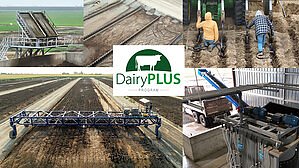
Consider the technologies at play. Vermifiltration systems, like the one pioneered at Alberto Dairy in Stanislaus County, can prevent up to 90% of methane emissions from manure storage and reduce nitrogen in wastewater by over 40%. The solid byproducts become a valuable, nutrient-rich compost, reducing the need for synthetic fertilizers. Advanced separation technologies, meanwhile, create a stream of clean water that can be reused for irrigation—a critical advantage in drought-prone California—often through highly efficient subsurface drip irrigation systems. Suddenly, a single waste stream is transformed into multiple value streams: clean water, organic fertilizer, and a verifiable reduction in carbon footprint that could one day be monetized in carbon markets. This is the essence of building a high-performance, permanent enterprise.
The Collaborative Engine: A Model for 21st Century Progress
Perhaps the most compelling aspect of the Dairy Plus Program is its structure. This is not a top-down government mandate, nor is it a purely market-driven phenomenon. It is a meticulously constructed public-private partnership that serves as a blueprint for tackling complex industrial and environmental challenges.
The collaboration involves three key players, each bringing a unique strength. The U.S. Department of Agriculture (USDA) provides the foundational funding through its Advancing Markets for Producers (AMP) Initiative, giving the program national legitimacy and financial firepower. The California Department of Food and Agriculture (CDFA) administers the program, ensuring it aligns with state-level policy and regulatory goals. Finally, the California Dairy Research Foundation (CDRF), an independent non-profit, acts as the crucial link to the industry itself, providing technical expertise, building trust, and ensuring the program delivers practical, on-farm solutions.
This tripartite structure is a masterclass in strategic alignment. It leverages federal capital, state administrative capacity, and industry-specific knowledge to accelerate the adoption of beneficial technology at a pace that would otherwise be impossible. It demonstrates that the path to a sustainable future is not through antagonism but through collaboration, creating a framework where economic resilience and environmental stewardship are not competing interests but two sides of the same coin. As this final round of funding opens, it marks the culmination of a successful experiment in industrial transformation, offering a powerful model for how other sectors can build their own resilient and permanent future.