
- Carbon Intensity Score: -350.7 gCO₂e/MJ, making the fuel carbon-negative.
- Cost Efficiency: Capital cost of production facility slashed to less than $100,000 per barrel-per-day of installed capacity.
- Methane Capture: Each gallon of fuel produced is equivalent to removing roughly 100 pounds of CO₂ from the atmosphere.
Experts would likely conclude that Circularity Fuels' innovative technology offers a promising, scalable solution for sustainable aviation fuel, addressing both climate change and agricultural waste management challenges.
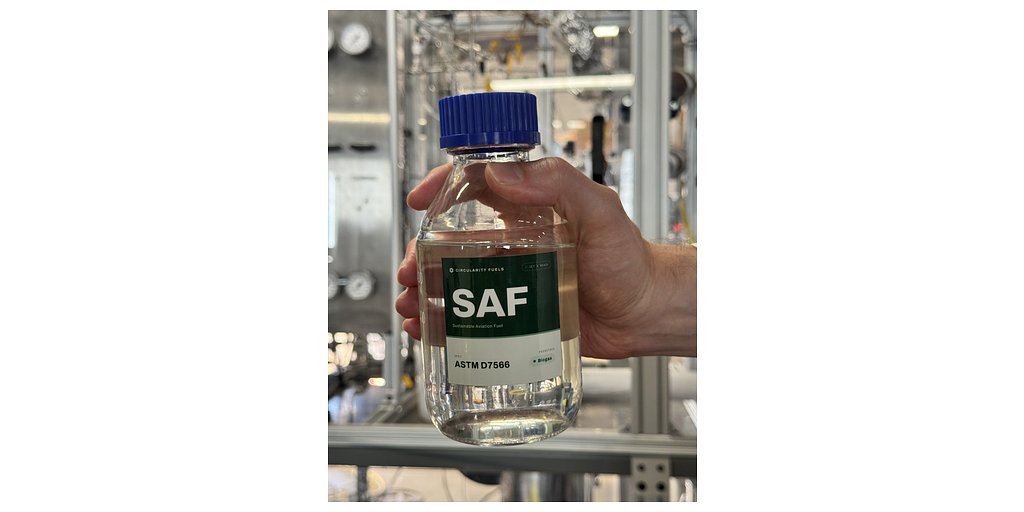
From Manure to Mach Speed: A Startup’s Radical Plan to Fuel Planes
REDWOOD CITY, CA – June 15, 2026
On a sprawling dairy farm near Madera, California, home to more than 5,000 cows, a quiet revolution has been humming away. For six months, two unassuming, skid-mounted reactors have been performing a kind of modern alchemy: transforming the raw, untreated gas from decomposing manure into high-grade, sustainable aviation fuel (SAF).
This is the work of Circularity Fuels, a Redwood City startup that just announced it has completed the world’s first end-to-end conversion of agricultural biogas into drop-in jet fuel. The achievement represents more than just a technical milestone; it’s a potential paradigm shift for two vastly different industries—aviation and agriculture—and a critical new front in the war on climate change. By closing the loop from farm waste to the friendly skies, Circularity Fuels is proposing a solution that is not just green, but profoundly, and perhaps profitably, circular.
A New Flight Path for Aviation Fuel
The aviation industry is desperate for a clean break from its fossil fuel dependency. Airlines, airports, and governments have committed to ambitious net-zero emissions targets by 2050, a goal that feels impossibly distant when today’s global SAF production meets less than 1% of total demand. According to the International Air Transport Association (IATA), while SAF production is expected to triple in 2024, it will still only account for a paltry 0.53% of the industry’s fuel needs.
The problem is twofold: feedstock and cost. The current market is dominated by fuel derived from used cooking oil (UCO), a resource with a limited ceiling for scalability and fraught with energy security risks, given most of it is imported. So-called e-Fuels, made by synthesizing hydrogen and carbon dioxide using renewable electricity, are another long-term hope, but rising power prices make them economically challenging for the foreseeable future. Today, SAF remains anywhere from two to ten times more expensive than its fossil-based counterpart.
This is the challenging landscape into which Circularity Fuels has flown its banner. The company claims its technology can slash the capital cost of a production facility to less than $100,000 per barrel-per-day of installed capacity—about one-fifth the cost of typical SAF plants being built today. “The hard part of this industry was never designing a theoretical plant that could make SAF,” said Dr. Stephen Beaton, Circularity’s Founder and CEO. “It was proving you could do it continuously, from real biogas, at a cost that pencils. We’ve now done that.”
The Alchemy in the Barn
The secret lies in a two-step process housed in modular reactors designed to operate directly on the farm. The system taps directly into the dairy’s anaerobic digester, which captures the biogas—roughly 65% methane and 35% carbon dioxide—from manure. This raw, unpurified gas has historically been a major barrier to economical conversion.
First, the gas enters the electrified Ouro bi-reforming reactor. This unit, which the company claims is one-hundredth the cost of conventional reformers, uses a proprietary process to convert over 98% of the methane and, critically, over 90% of the carbon dioxide into syngas—a mixture of hydrogen and carbon monoxide. This ability to convert the CO₂ in a single step, rather than requiring an expensive pre-treatment removal process, is a core part of the innovation.
From there, the syngas is fed into the compact Aion Fischer-Tropsch synthesis reactor. This technology, a well-established industrial process, rearranges the molecules into long-chain liquid hydrocarbons. The final output is a synthetic crude that is upgraded on-site into a finished jet fuel that meets ASTM D7566 Annex A1 specifications. This means it can be blended up to 50% with conventional Jet-A and used in existing aircraft and airport infrastructure without any modifications.
The Climate-Negative Payoff
The most startling claim made by Circularity Fuels is that its fuel is not just low-carbon, but deeply carbon-negative. According to the company's internal life-cycle modeling, based on California’s rigorous regulatory framework, the fuel has a carbon intensity score of -350.7 gCO₂e/MJ.
This negative score comes from the feedstock itself. Methane, the primary component of biogas, is a greenhouse gas over 80 times more potent than carbon dioxide over a 20-year period. On most of the thousands of dairies across the country, this gas is simply vented or flared into the atmosphere. By capturing methane that would otherwise escape and turning it into fuel, the process avoids a massive amount of greenhouse gas emissions. The climate benefit of this avoided methane is so large that it outweighs all the emissions from producing and ultimately burning the fuel in a jet engine. According to the company, each gallon produced is equivalent to removing roughly 100 pounds of CO₂ from the atmosphere.
This approach not only tackles aviation emissions but also directly addresses a major source of agricultural pollution, turning an environmental liability into a climate solution.
A Green Lifeline for the American Farm
While the aviation industry stands to gain a vital new fuel source, the impact on the agricultural sector could be just as transformative. For decades, farmers have struggled to manage manure waste and its associated biogas. Today, less than 6% of America's large livestock operations, which generate nearly a trillion pounds of manure annually, capture the resulting biogas.
“For two decades, we’ve watched dairies flare or vent biogas because the only off-take options required millions in cleanup equipment and a pipeline next door,” said Craig Hartman of Hartman Engineering, a veteran developer of agricultural biogas projects. Circularity’s modular, on-site system eliminates those barriers. “Circularity is the first team I’ve seen take raw biogas straight from a digester and turn it into finished jet fuel on-site. That changes the conversation for every dairy operator we work with.”
This technology provides farmers with a powerful new revenue stream, monetizing a waste product into a premium commodity. The economic model is further bolstered by powerful federal and state incentives, including the EPA’s Renewable Fuel Standard and California’s Low Carbon Fuel Standard (LCFS), the same programs that helped scale the ethanol and biodiesel industries.
With the technology now validated in the field, Circularity Fuels is looking toward commercialization. The company, which is backed by $8 million in seed funding and awards from ARPA-E and the National Science Foundation, plans to break ground on its first commercial site in 2027. With a vast, untapped feedstock resource waiting in farms, landfills, and wastewater treatment plants across the globe, this small-scale pilot in California’s Central Valley may have just marked the spot where a new, circular economy begins to take flight.