
- 90% of core administrative tasks can be performed via conversational text or voice commands using OpenClaw AI Agent.
- 500+ modular RESTful APIs exposed for AI agents and third-party developers.
- Dual 5GbE LAN ports enabling up to 1010 MB/s combined throughput.
Experts would likely conclude that TerraMaster's 'AI-native' NAS represents a significant usability innovation, though its long-term success hinges on developer adoption and ecosystem growth.
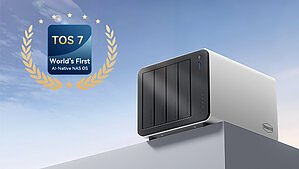
TerraMaster's 'AI-Native' NAS: A Usability Leap or Just Smarter Storage?
SHENZHEN, China – June 23, 2026 – In a market accustomed to incremental hardware upgrades, TerraMaster has made a bold software-centric play with the launch of its F4-425 Pro Network Attached Storage (NAS) device. The hardware itself is formidable, but the real headline is its operating system, TOS 7, which the company is marketing as the "world's first AI-native NAS operating system." This isn't just about adding a few intelligent features; TerraMaster claims a fundamental redesign of the user-to-machine relationship, replacing complex menus with natural language conversation. Timed for a global release on Amazon's Prime Day, the move signals an aggressive push to shift the perception of NAS from a passive data repository to an active, intelligent assistant for homes and small businesses.
Deconstructing 'AI-Native' in a Crowded Field
The term "AI-native" is potent, suggesting an architecture built from the ground up with artificial intelligence at its core. TerraMaster's claim hinges on this distinction. While established competitors like Synology and QNAP have been integrating AI for years, their approach has largely focused on AI-powered applications running on top of a traditional OS framework. Synology's DSM, for example, uses local AI for facial recognition in its Photos app and is building an "AI Admin Console" to integrate with third-party models for productivity tasks. QNAP has long offered its AI Core to accelerate image recognition and even supports dedicated AI accelerator hardware.
TerraMaster argues that TOS 7 is different. The company states that the integration of AI is not an add-on but a foundational element of the system kernel and its interaction logic. The primary evidence is the OpenClaw AI Agent, which allows users to perform over 90% of core administrative tasks—creating storage pools, setting user permissions, configuring backups—using conversational text or voice commands. This moves AI from being a feature within an app to being the primary interface for the entire system. Furthermore, the company has exposed over 500 modular RESTful APIs, opening low-level system functions to AI agents and third-party developers in a way that goes beyond typical application-level SDKs. While competitors have certainly made their devices smarter, TerraMaster is betting that a native conversational interface for system management represents a genuine paradigm shift, one that could finally democratize a product category often seen as intimidating for the non-technical user.
From Command Line to Conversation
For decades, the main barrier to wider NAS adoption has been complexity. Navigating web interfaces filled with technical jargon like iSCSI LUNs, RAID configurations, and network bonding is daunting for the average user. TerraMaster's TOS 7 aims to bulldoze that barrier. The press release offers a compelling example: a user could simply type, "Create a 2TB shared folder for the design team and set up weekly automatic snapshots." The OpenClaw agent is designed to parse this request, execute the necessary steps, and confirm completion.
This approach has profound implications for usability. Small business owners could manage data security with commands like, "Lock all shared folders immediately if ransomware is detected," turning a multi-step emergency procedure into a single, intuitive action. For home users, it promises a future where organizing a lifetime of digital photos or setting up a personal media server is as easy as asking a smart speaker to play a song. Critically, TerraMaster emphasizes that its key AI processes, such as facial recognition and semantic file analysis, run entirely on the local device. In an era of increasing skepticism about data privacy, this commitment to on-device processing is a significant selling point, ensuring that personal or proprietary data never leaves the user's private cloud. This combination of simplified interaction and robust data privacy directly addresses the core anxieties and complexities that have historically limited the appeal of network storage.
Power Under the Hood: More Than Just an Intelligent Assistant
While the software story is compelling, TerraMaster has not neglected the hardware. The F4-425 Pro is a powerhouse designed to support the demanding workloads its new OS enables. At its heart is an Intel 8-core N350 processor, a modern CPU with a remarkably low 7W power draw, making it highly efficient for an always-on device. Paired with 16GB of fast DDR5 RAM (upgradeable to 32GB), the system is specified to handle significant multitasking, from running multiple virtual machines and Docker containers to transcoding 4K and even 8K video streams in real-time.
Connectivity is another area of focus. The inclusion of dual 5GbE LAN ports is a substantial upgrade over the 1GbE standard that still persists on many competing models. Using link aggregation, these ports can deliver a combined theoretical throughput of up to 1010 MB/s. For creative professionals working with massive video files or small businesses with dozens of users accessing data concurrently, this level of bandwidth eliminates critical bottlenecks and enables seamless collaborative workflows. The storage architecture is equally flexible, with four main drive bays complemented by three NVMe M.2 slots. This hybrid design allows users to combine high-capacity hard drives for bulk storage with ultra-fast SSDs for caching or running performance-sensitive applications, providing a sophisticated and scalable foundation for the AI-driven software.
Building an Ecosystem: The Long-Term Vision
The most forward-looking aspect of TerraMaster's strategy may be its plan for a "Developer-First Ecosystem." The robust API access is the first step, but the announcement of a forthcoming "Skill Marketplace" reveals the true ambition. This platform is envisioned as a hub where third-party developers can build, test, and publish their own AI applications and skills for TOS 7. This model, which mirrors the app store ecosystems that define modern smartphones and computing platforms, is a strategic attempt to crowdsource innovation and dramatically expand the device's capabilities over time.
The long-term success of the F4-425 Pro and the "AI-native" vision will likely depend more on the vitality of this marketplace than on any single feature available at launch. If developers embrace the platform, users could one day download skills for advanced home automation, specialized data analytics for specific industries, or new media management tools that TerraMaster itself never envisioned. This open approach is a calculated risk; building a thriving developer community from scratch is a monumental challenge. However, if successful, it could transform the F4-425 Pro from a static product into a dynamic, evolving platform, ensuring its relevance and utility for years to come.