
- 120 kilowatts: Power consumption per AI rack, 2-3x higher than previous-gen hardware.
- 50-minute to 3-minute: Time reduction for onboarding an AI rack with KSManage Ultra.
- PUE < 1.1: Targeted efficiency improvement over air-cooled data centers.
Experts would likely conclude that KAYTUS's KSManage Ultra represents a critical advancement in managing the complexity of modern AI Factories, offering proactive resilience and operational efficiency gains that could redefine industry standards.
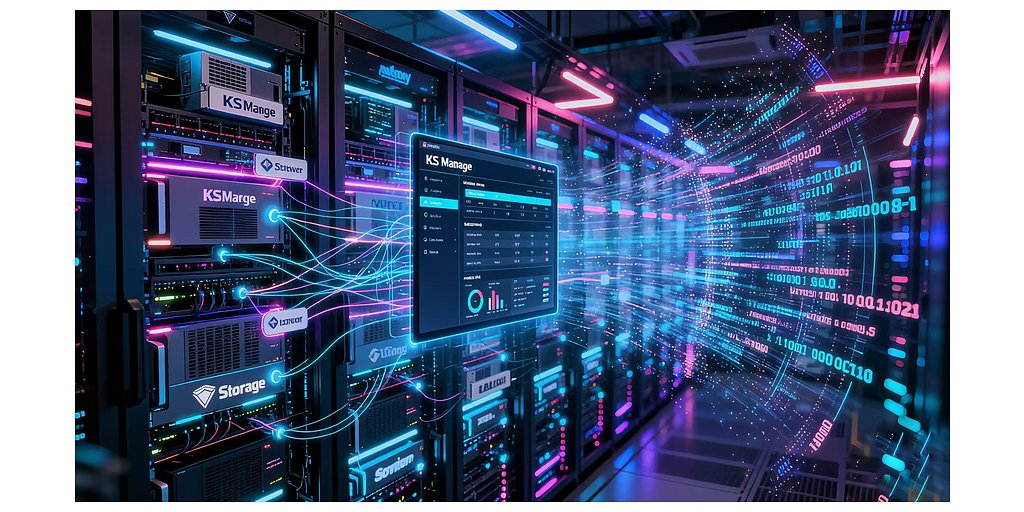
The AI Factory's New Nervous System: KAYTUS Challenges the Status Quo
FRANKFURT, Germany – June 25, 2026 – The term "AI Factory" has officially graduated from a convenient metaphor to a physical reality defined by breathtaking scale and daunting complexity. As organizations race to build and deploy generative AI, they are confronting a new class of operational challenges that legacy tools were never designed to handle. At the ISC 2026 conference here, infrastructure provider KAYTUS made a bold move to address this gap, launching KSManage Ultra, a platform it bills as the intelligent nervous system for the modern AI Factory.
The announcement signals a critical evolution in data center management. For years, operations have centered on the individual server as the primary unit of management. But in the world of AI, where a single rack can house nearly a hundred accelerators and consume over 120 kilowatts of power, that model is broken. KAYTUS's new platform aims to shift the paradigm from fragmented, component-level oversight to integrated, system-level intelligence, a move that could prove essential for any enterprise serious about scaling its AI ambitions.
The Crisis of Complexity in AI Operations
The operational hurdles facing today's AI data centers are immense. The basic building block is no longer a server but a tightly coupled, high-density AI rack integrating computing, networking, power, and liquid cooling into a single, complex ecosystem. Compared to traditional server deployments, the density and interconnectedness have exploded. A rack-scale system like the NVL72 integrates thousands of high-speed interconnects, and its power density can be two to three times higher than previous-generation hardware. This concentration of power generates an enormous amount of heat, making advanced liquid cooling a requirement, not a luxury.
This shift introduces three fundamental challenges. First, management complexity has soared. Operators can no longer think about individual GPUs or CPUs; they must manage the health of the entire rack as a single unit, where a fluctuation in coolant flow can impact the performance of the entire system. Second, fault identification has become notoriously difficult. Unlike a simple hardware failure that causes downtime, many AI performance issues are "silent killers." A subtle degradation in network link quality or a minor thermal anomaly can silently cripple the efficiency of a multi-million-dollar training run, and pinpointing the root cause across disparate software and hardware logs is a Herculean task. Finally, the sheer scale of AI deployments creates an efficiency crisis. Manually onboarding, configuring, and testing these complex racks one by one is slow, error-prone, and unsustainable, leading to configuration inconsistencies that can plague an entire cluster.
A Unified Command Center for the AI Stack
KAYTUS's answer to this crisis is KSManage Ultra, a platform designed to provide a unified command center for the entire AI infrastructure stack. It moves beyond the limitations of traditional Data Center Infrastructure Management (DCIM) tools by creating a single-pane-of-glass view that spans from individual components—GPUs, CPUs, memory, and power shelves—to nodes, racks, clusters, and the entire data center.
The platform's power lies in its ability to correlate data from previously siloed domains. It integrates in-band data from the operating system and applications with out-of-band data from hardware logs, firmware, and sensors (BMC), and combines it all with data from the physical infrastructure, including power distribution units (PDUs) and cooling distribution units (CDUs). This holistic view allows operators to see the complete picture, breaking down the walls between IT and facilities management.
The efficiency gains promised are dramatic. KAYTUS claims the platform can reduce the time for onboarding a single AI rack from a manual 50-minute process to an automated one that takes less than three minutes. By automatically scanning device serial numbers and building topology maps, it eliminates tedious and error-prone manual setup. The platform also supports one-click, batch-based stress testing and configuration, ensuring that every node in a cluster is deployed consistently, which is critical for maintaining stable performance at scale.
From Reactive Firefighting to Proactive Resilience
Perhaps the most significant strategic shift offered by KSManage Ultra is the move from reactive problem-solving to proactive, automated operations. In a traditional model, an operator is alerted only after a failure has occurred. In the high-stakes world of AI, where a single training run can represent a massive investment, that is too late. The platform is designed to get ahead of problems before they impact critical workloads.
By continuously evaluating the health of nodes and racks based on indicators like GPU status, network link quality, and firmware consistency, the system can identify at-risk components. It can then intelligently tag and isolate potentially faulty nodes, preventing them from being assigned to crucial tasks. This allows operators to maintain a stable and healthy pool of computing resources, maximizing business continuity and resource utilization.
Nowhere is this proactive capability more critical than in liquid cooling management. KSManage Ultra features a sophisticated three-level leak detection system at the node, rack, and loop levels. If a risk is detected, the platform can automatically coordinate a series of actions—triggering a safety shutdown, closing solenoid valves to isolate the leak, and generating alerts and work orders for remediation. This automated, closed-loop response transforms a potential catastrophe into a managed incident, a crucial capability for building trust in liquid-cooled environments. This focus on efficiency also has significant sustainability implications; by precisely managing cooling resources, KAYTUS aims for a Power Usage Effectiveness (PUE) below 1.1, a major improvement over air-cooled data centers.
Redrawing the AI Infrastructure Management Map
The launch of KSManage Ultra places KAYTUS in direct competition with a formidable field of players. Tech giants like NVIDIA, HPE, and Dell are all building out their own comprehensive AI Factory solutions, often bundling management software with their hardware. Meanwhile, established DCIM specialists like Schneider Electric and Vertiv are adapting their platforms to address the unique power and cooling demands of AI. KAYTUS, which has a significant global presence as a top AI server provider, is differentiating itself by offering a solution that is purpose-built from the ground up for the specific architectural realities of the modern AI Factory.
Its approach is not to create another walled garden. With an open architecture and APIs, KSManage Ultra is designed to integrate seamlessly with upper-level scheduling platforms and enterprise CMDBs, as well as manage heterogeneous lower-layer devices. This positions the platform as a foundational operational layer that enhances, rather than replaces, existing enterprise systems. By tackling the most complex and painful aspects of rack-scale, liquid-cooled AI operations, KAYTUS is making a strategic play to become an indispensable partner for enterprises navigating the next wave of digital transformation. As AI Factories become the new engines of economic growth, the intelligent systems that manage them will be just as important as the silicon inside.