
- 4.9mm: The astonishingly thin base device of TECNO's Modular Phone, rivaling some of the slimmest non-modular phones on the market.
- 10 modules: The number of high-performance modules demonstrated, catering to creators, professionals, and power users.
- 8 connection zones: The designated areas on the phone's back for attaching modules.
Experts would likely conclude that while TECNO's Modular Phone addresses past failures with elegant engineering and a focus on slim design, its long-term success hinges on creating a thriving ecosystem and offering a compelling value proposition at an accessible price point.
TECNO's Modular Phone: A Slim New Hope for a Failed Tech Dream?
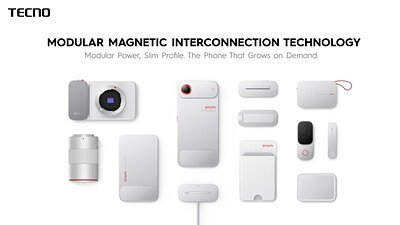
HONG KONG – February 25, 2026 – At Mobile World Congress 2026, technology brand TECNO has resurrected one of the tech industry's most alluring and elusive concepts: the modular smartphone. The company unveiled its Modular Phone, a forward-looking concept built on a new Modular Magnetic Interconnection Technology. It presents a vision where a phone’s capabilities are not fixed at the factory but can be expanded and customized in an instant. Featuring an astonishingly thin 4.9mm base device, the system allows users to magnetically snap on a variety of hardware modules—from extra batteries to professional lenses—without the bulk that doomed its predecessors. While the demonstration is captivating, it also raises a critical question: can TECNO succeed where industry titans like Google have so famously failed?
The Ghosts of Modularity Past
The dream of a truly modular phone is a siren song that has lured and then dashed the hopes of some of technology's biggest names. The path to TECNO's MWC stage is littered with the ambitious wreckage of past attempts. The most notable of these was Google's Project Ara, a moonshot initiative that envisioned a phone with swappable core components like processors, displays, and cameras. The promise was ultimate customization and a reduction in electronic waste. However, the project collapsed under its own weight, succumbing to technical complexity, a clunky user experience, and the immense challenge of fostering a viable third-party developer ecosystem. The resulting prototypes were often thick, aesthetically unappealing, and failed to convince consumers they needed that level of granular control.
Motorola, then under Google's ownership, offered a more pragmatic approach with its Moto Mods. These accessories snapped onto the back of its Moto Z line of phones, adding functions like a Hasselblad camera grip, a projector, or an extra battery. While more commercially successful than Ara, the system was limited by its reliance on a specific phone series and a module ecosystem that, while functional, never achieved the critical mass needed for widespread adoption. Similarly, LG's G5 attempted a slide-out module system for its "Friends," but the clunky implementation, which required a reboot to swap parts, and a sparse accessory lineup led to its swift abandonment.
These past failures have taught the industry harsh lessons. Consumers have consistently shown a preference for the sleek, integrated designs of flagship phones over the compromised aesthetics and potential complexity of modularity. The cost of a base phone plus multiple modules often exceeded that of a high-end, all-in-one device, and the challenge of creating a thriving, open ecosystem of modules proved to be a nearly insurmountable hurdle.
A New Blueprint for Modularity
It is against this backdrop of skepticism that TECNO is making its case, and its primary argument is rooted in elegant engineering. The company appears to have learned directly from the failures of the past, focusing intensely on the single biggest complaint leveled against earlier modular concepts: bulk. The base smartphone is just 4.9mm thick, a measurement that rivals some of the slimmest non-modular phones on the market. Even with an accessory like the ultra-thin 4.5mm POWER BANK module attached, the combined thickness remains well within the bounds of a typical modern smartphone, making the modularity feel like a natural extension rather than a cumbersome attachment.
This is achieved through a sophisticated hybrid connection architecture. A precision-engineered magnetic array allows modules to snap securely and intuitively onto one of eight designated zones on the phone's back. But instead of relying on a single, complex physical connector for all functions, TECNO has split the duties. Power is delivered efficiently and with low heat through physical pogo-pin connectors, while all data transmission is handled wirelessly. The system intelligently switches between Wi-Fi, Bluetooth, and high-bandwidth, low-latency millimeter-wave (mmWave) communication depending on the module's needs. This creates a seamless, "plug-and-play" experience, freeing the user from technical concerns.
"We believe the ultimate goal of technology is not to create a static masterpiece, but to offer an extension of human freedom," said Leo Li, TECNO's Product Head for the project, in the company's official announcement. "This is an experiment in mobile liberation, where the device is no longer defined by its factory form, but by the user's intent in every moment."
An Ecosystem of Possibilities
Beyond the core technology, the success of any modular platform rests on the strength and diversity of its accessory ecosystem. TECNO's concept launched with a demonstration of around ten high-performance modules designed to cater to creators, professionals, and power users. The ultra-thin POWER BANK effectively doubles the device's usable power. An ACTION CAMERA module unlocks new shooting angles and creative workflows, while a dedicated TELEPHOTO LENS module functions as a standalone system, using the phone's screen as a low-latency viewfinder for professional-grade imaging.
This approach positions the modules less as replacement parts and more as specialized tools in a dynamic kit. A photographer can attach the telephoto lens for a shoot, a vlogger can snap on the action camera, and a business traveler can add the power bank for a long flight, carrying only what is needed for the task at hand. TECNO's vision extends to future modules for AI-powered tools, storage expansion, and other lifestyle accessories. The company has also presented two distinct design aesthetics for the phone itself—the clean, silver-aluminum ATOM edition and the bold, geek-inspired MODA edition—to broaden its appeal.
However, the long-term viability of this ecosystem remains a significant question. The interface is currently proprietary, which gives TECNO control but could stifle the third-party innovation that is crucial for a modular platform to thrive. While the company has hinted at the potential for future solutions that extend beyond its own ecosystem, the path from a closed, curated set of accessories to a vibrant, open marketplace is a challenging one that its predecessors failed to navigate.
The Unanswered Question of Price and Place
As a concept presented at MWC 2026, the TECNO Modular Phone has no announced price or release date. This leaves the most critical variable unanswered. TECNO has built its global brand by offering feature-rich, well-designed devices in over 70 markets, with a particular focus on providing value in emerging economies. A highly engineered, multi-part modular system is inherently expensive to design and manufacture, which could place it in a premium price bracket, potentially at odds with the company's core market strategy.
For the modular dream to finally become a reality, it must offer a compelling value proposition not just to tech enthusiasts but to a broader audience. It must prove that the flexibility it offers is worth the potential cost and complexity compared to a traditional, integrated smartphone. TECNO has presented an impressively engineered and thoughtfully designed concept that directly addresses the aesthetic and practical failures of the past. The ultimate success of this ambitious project may hinge not on its innovative design, but on whether it can deliver on its promise of 'mobile liberation' at a price point the world is willing to pay.