
- $11 million: Average cost of a healthcare data breach in 2023, a 53% increase since 2020 (IBM report).
- $4.1 million: Total fines settled by HHS OCR in 2023 across 13 enforcement actions.
- 15+ projects: Tech Exactly's experience in HIPAA-compliant development, now formalized into a structured service.
Experts agree that embedding HIPAA compliance from the start of development is critical for healthcare startups to avoid costly breaches, regulatory fines, and reputational damage, transforming compliance from a hurdle into a strategic advantage.
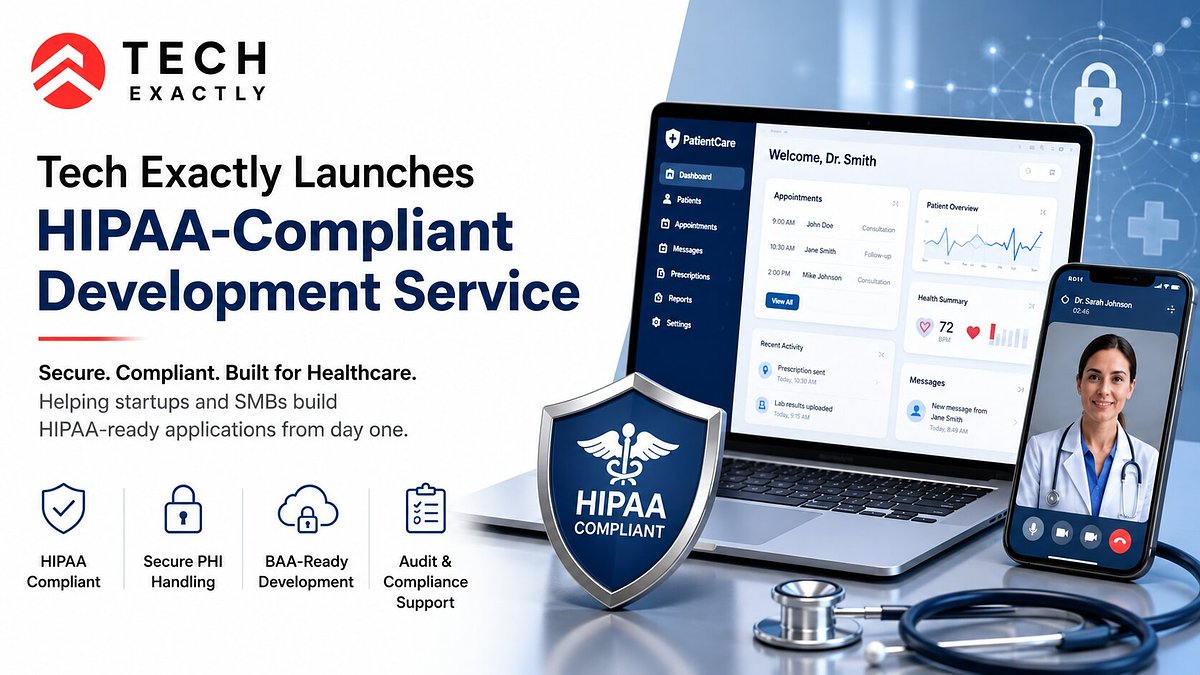
Tech Exactly Launches Service to HIPAA-Proof Healthcare Startups
LAGUNA BEACH, Calif. – May 13, 2026 – As healthcare startups race to innovate, they often collide with the formidable wall of regulatory compliance, a challenge that can cripple a fledgling company before it finds its footing. Addressing this critical pain point, software development firm Tech Exactly today announced the launch of its dedicated HIPAA-Compliant Development Service, an end-to-end offering designed to embed security and compliance into digital health applications from their very inception.
The new service formalizes the company's experience from over 15 HIPAA-compliant projects into a structured program for healthcare startups and small-to-midsize businesses. It aims to bridge the perilous gap between the need for speed-to-market and the absolute necessity of regulatory readiness in the high-stakes world of healthcare technology.
The High Cost of a Compliance Misstep
For digital health ventures, the stakes have never been higher. For the 13th consecutive year, the healthcare industry has earned the grim distinction of having the highest average cost of a data breach, a figure that reached nearly $11 million in 2023, according to IBM's annual report. This represents a staggering 53% increase since 2020, underscoring a trend of escalating risk.
These costs are not merely abstract numbers for large hospital systems. For a startup, a single data breach or a significant HIPAA violation can be an extinction-level event. Fines from the U.S. Department of Health and Human Services (HHS) Office for Civil Rights (OCR) can run into the millions. In 2023 alone, the OCR settled 13 enforcement actions for over $4.1 million. Penalties are tiered based on negligence, but even a single violation can cost tens of thousands of dollars, while intentional non-compliance can lead to criminal charges.
Beyond direct financial penalties, the fallout includes the cost of breach investigation, mandatory notifications, credit monitoring for affected patients, and, most damagingly, a catastrophic loss of patient and investor trust. Many startups fall into the trap of treating compliance as a final hurdle to clear before launch, only to discover that fundamental architectural changes are needed, leading to expensive rework and crippling delays.
Shifting from Afterthought to Architecture
Tech Exactly's new service is part of a broader industry shift away from treating compliance as a 'bolt-on' feature and toward a 'compliance-by-design' philosophy. The service integrates HIPAA-readiness into every phase of the application lifecycle, from initial scoping and architecture through development, testing, and even post-launch audit support.
The offering promises to address the core technical requirements of HIPAA, including implementing AES-256 encryption for data at rest, TLS 1.3 for data in transit, stringent role-based access controls, and comprehensive audit trails necessary for any regulatory review. The goal is to build systems that are ready to support Business Associate Agreements (BAAs) from the ground up, a crucial step for any company handling protected health information (PHI).
"Many healthcare startups we work with discover compliance gaps late in the development cycle, which leads to costly rework and delayed launches," said Hitesh Agarwal, Founder of Tech Exactly, in the press announcement. "We built this to make HIPAA compliance the starting point, not something teams scramble to add before an audit. We've done this across 15+ projects — now it's a defined, repeatable service that founders can plug into from day one."
A Crowded Field with Rising Stakes
Tech Exactly enters a competitive but rapidly expanding market. Firms like Chetu, ScienceSoft, and Arkenea have also established themselves as specialists in healthcare software, each offering a suite of services aimed at navigating the complex regulatory landscape. However, the key differentiator in this market is proving to be the depth of compliance integration.
Industry observers note a growing demand for partners who do more than just check boxes. A recent online discussion among developers praised firms that treat HIPAA as an "architectural constraint, not a compliance checkbox bolted on at the end." This approach involves a deeper level of engagement, including threat modeling at the device level, proactive BAA strategy, and designing audit logs specifically for the scrutiny of an OCR audit. It is this level of embedded expertise that digital health companies are increasingly seeking to ensure their products are not just compliant on paper, but genuinely secure in practice.
Tech Exactly points to its portfolio, which includes a therapy platform in New York City and an IEC 62304-compliant mobile application for medical test interpretation, as evidence of its capability. The company's expertise also extends to related standards such as HL7/FHIR for data interoperability, SOC 2, and FDA documentation support for regulated software as a medical device (SaMD).
Fueling Innovation by Removing Hurdles
Perhaps counterintuitively, proponents argue that this intense focus on early-stage compliance can actually accelerate innovation. By addressing the most significant risks and complexities upfront, development teams are freed to concentrate on core product features, user experience, and market fit. This proactive stance transforms compliance from a roadblock into a strategic advantage.
This approach is gaining traction not only with founders but also with investors and enterprise partners. Venture capital firms are increasingly scrutinizing a startup’s compliance posture as a key indicator of its viability and risk profile. A solid, 'compliance-first' foundation can unlock enterprise pilot programs, shorten security reviews with hospital systems, and build the foundational trust necessary for long-term partnerships.
The trend is even receiving a nod from federal regulators. Initiatives like the FDA's "Regulatory Accelerator" program are designed to help digital health innovators understand and meet requirements more efficiently from the outset, encouraging a culture where safety and compliance are built in, not bolted on. As the digital health landscape matures, this integrated approach is becoming the new standard for building trust in the digital age of medicine.