
- 82.3% sensitivity and 82.5% specificity in detecting moderate-to-severe hyperkalemia (≥6.5 mmol/L) in clinical validation studies.
- 67% mortality rate for severe, untreated hyperkalemia.
- 37 million U.S. patients with chronic kidney disease (CKD) are at high risk for hyperkalemia.
Experts view AK+ Guard™ as a transformative advancement in remote patient monitoring, offering a non-invasive, AI-driven solution for early hyperkalemia detection that could significantly improve outcomes for high-risk patients, though regulatory approval and clinical integration remain critical next steps.
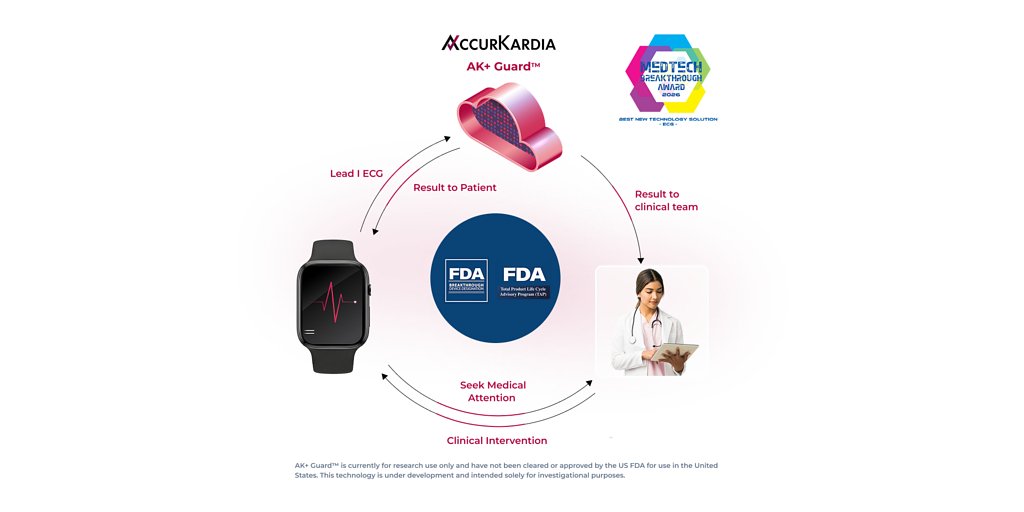
AI ECG Wins Award for Detecting a Silent Killer Via Smartwatch
NEW YORK, NY – May 07, 2026 – A groundbreaking technology that transforms a simple smartwatch ECG into a life-saving diagnostic tool has been recognized as a major innovation in medical technology. AccurKardia's AK+ Guard™, an AI-powered software designed to detect dangerously high potassium levels, has won the “Best New ECG Technology Solution” award in the 10th annual MedTech Breakthrough Awards.
The award highlights a significant shift in patient care, moving from invasive, episodic hospital tests to continuous, non-invasive monitoring that can happen anywhere, anytime. By analyzing the electrical signal from a single-lead ECG—the type available on many popular consumer wearables—AK+ Guard™ promises to provide an early warning for hyperkalemia, a condition that can lead to sudden cardiac arrest.
“AccurKardia’s AK+ Guard represents a fundamental leap forward in patient care,” said Steve Johansson, managing director of MedTech Breakthrough. “By replacing a blood draw with an AI-processed signal, AK+ Guard empowers patients to monitor themselves at home or anywhere, non-invasively and frequently. AccurKardia has not just automated a manual task; they are enabling a life-saving physiological measurement that was previously impossible to obtain outside of a laboratory.”
The Silent Threat of Hyperkalemia
Hyperkalemia, or high potassium in the blood, is a common but often asymptomatic condition that poses a severe risk, particularly to individuals with chronic kidney disease (CKD) and heart failure. While potassium is essential for nerve and muscle function, levels above 5.5 mmol/L can disrupt the heart's electrical activity, leading to life-threatening arrhythmias and cardiac arrest. The mortality rate for severe, untreated hyperkalemia can be as high as 67%.
An estimated 37 million people in the U.S. suffer from CKD, a group highly susceptible to this electrolyte imbalance. For these patients, and for those with heart failure, managing potassium is a delicate balancing act. Many of the most effective cardiorenal protective therapies, such as ACE inhibitors, can raise potassium levels, forcing doctors to reduce or discontinue these life-saving medications.
The current standard for diagnosing hyperkalemia is a blood test, an invasive procedure that provides only a single snapshot in time. This makes frequent monitoring impractical and leaves high-risk patients vulnerable to sudden spikes between lab visits. AK+ Guard™ aims to fill this critical gap by providing a readily accessible tool for risk assessment.
Transforming a Watch into a Biosensor
At the heart of AccurKardia's innovation is a sophisticated deep-learning model. The AI was trained on a vast dataset of paired ECG recordings and corresponding blood-serum potassium values. By analyzing thousands of these examples, the algorithm learned to identify the subtle, often invisible-to-the-human-eye electrical signatures in an ECG waveform that correlate with high potassium levels.
AK+ Guard™ is designed to work with the Lead I ECG data captured by a wide range of clinical and consumer devices, including smartwatches. This effectively transforms a common wearable into what the company calls a “non-invasive metabolic biosensor.”
“We saw that the current standard of care for hyperkalemia detection and monitoring had been underserving patients,” said Moin Hussaini, chief product officer of AccurKardia. “Our solution delivers a speedier, more accessible pathway to detection and risk management, making a meaningful impact on patient care. AK+ Guard detects hyperkalemia in the ECG when it begins to pose a cardiac risk, and enables monitoring between lab visits.”
Clinical Validation and the Path to Market
AccurKardia’s technology is backed by promising clinical data. A recent independent validation study conducted across the Sharp HealthCare system tested the software's ability to detect moderate-to-severe hyperkalemia (≥6.5 mmol/L). The results, presented at the 2025 American Heart Association Scientific Sessions, showed the model achieved high performance with an Area Under the Receiver Operating Characteristic (AUROC) curve of 0.903, demonstrating excellent diagnostic ability. The study reported 82.3% sensitivity (correctly identifying patients with the condition) and 82.5% specificity (correctly identifying patients without the condition).
This robust performance has earned the technology significant regulatory attention. AK+ Guard™ received Breakthrough Device Designation from the U.S. Food and Drug Administration (FDA) and was accepted into the FDA's Total Product Lifecycle Advisory Program (TAP) in January 2025. These programs are designed to expedite the development and review of novel medical devices that address life-threatening conditions.
It is important to note, however, that the technology is still investigational. AccurKardia clearly states that AK+ Guard™ has not yet been cleared or approved by the FDA for clinical use in the United States. The designations fast-track its journey, but full regulatory clearance is a necessary final step before it can be prescribed by doctors or used for diagnosis.
A New Paradigm for Remote Patient Care
The potential impact of a non-invasive, remote hyperkalemia monitoring tool is vast. For patients with CKD and heart failure, it could enable safer, more optimized use of essential medications. Clinicians could monitor at-risk individuals more closely, intervening earlier to prevent acute events and costly hospitalizations. This proactive approach aligns with the broader healthcare shift towards remote patient monitoring and preventative care.
Furthermore, the accessibility of the technology, leveraging devices many people already own, could help address health equity. In his statement, Hussaini emphasized the company's pride in delivering “equitable, high-performance diagnostics across diverse populations, a critical differentiator in medical AI.” Ensuring that AI models are trained on diverse datasets is crucial to avoid perpetuating biases and to make sure the technology works for everyone, regardless of their demographic background.
As AI-driven tools like AK+ Guard™ move from the laboratory to the clinic, they face challenges beyond regulatory approval, including seamless integration into clinical workflows and gaining the trust of physicians. However, the promise of transforming reactive medical treatment into proactive, personalized health management is a powerful driver of innovation. This focus on equitable performance will be a critical factor in determining whether such groundbreaking technologies can fulfill their promise of improving health outcomes for everyone.
Topics & Related
Medical Devices
Health IT
Software & SaaS
Artificial Intelligence
Machine Learning
ESG
Cloud Migration
Precision Medicine
Corporate Finance
Revenue
Related Company Pulse