
- 1,000,000 AI-powered remote support sessions completed by TeamViewer customers
- 300,000 sessions in March 2026 alone, showing rapid adoption
- 80% of employees lose time monthly due to IT problems, averaging 1.3 lost workdays per employee (TeamViewer 2025 Digital Friction Report)
Experts view TeamViewer's milestone as validation of AI-driven Autonomous Endpoint Management (AEM), positioning the company as a leader in the shift toward proactive, autonomous IT operations.
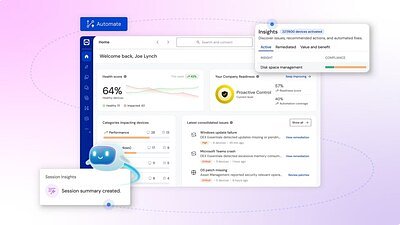
TeamViewer's AI Milestone Signals a New Era for Autonomous IT
GÖPPINGEN, Germany – March 31, 2026 – TeamViewer, a long-standing leader in remote connectivity, has announced a landmark achievement in the enterprise technology space: its customers have completed over one million AI-powered remote support sessions. The milestone is underscored by a dramatic acceleration in adoption, with over 300,000 of those sessions occurring in March alone. This rapid uptake is more than just a number; it serves as a powerful indicator of a fundamental shift in how businesses manage their increasingly complex digital infrastructure, moving from reactive problem-solving towards a future of autonomous IT operations.
For two decades, TeamViewer has been the go-to tool for millions, enabling IT professionals to remotely access and fix computers. Now, the company is leveraging that vast experience to pioneer the category of Autonomous Endpoint Management (AEM). This milestone validates its strategy and demonstrates a significant structural advantage built on a foundation of proprietary data, positioning the German firm as a key player in the next evolution of enterprise IT.
The High Cost of Digital Friction
The push toward autonomous IT is fueled by a pervasive and costly business challenge: digital friction. This term describes the cumulative negative impact of technology-related disruptions—from slow-loading applications and system crashes to network outages—on employee productivity and business performance. While often viewed as minor annoyances, their collective effect is a significant drain on resources.
TeamViewer's own 2025 Digital Friction Report, conducted by Sapio Research, paints a stark picture. The study, which surveyed 4,200 managers and employees across nine major markets, found that 80 percent of staff lose time every month due to IT problems, amounting to an average of 1.3 lost workdays per employee. The consequences extend directly to the bottom line, with 42 percent of organizations reporting a direct impact on revenue from these disruptions.
Independent industry data corroborates these findings, revealing the staggering cost of downtime. Estimates for large enterprises place the cost of a single hour of downtime anywhere from $300,000 to over $1 million, with some analyses suggesting an average cost as high as $9,000 per minute. For employees, these technology hurdles are a constant source of frustration, with other studies showing workers can face over a dozen negative digital events per week, contributing to project delays and even employee turnover. It is this multi-billion-dollar problem that AI-driven IT solutions are designed to solve.
Building the Autonomous IT Flywheel
At the heart of TeamViewer's strategy is a concept the company calls a "closed-loop AEM learning system." This system is designed to create a self-reinforcing flywheel: every AI-assisted support session captures expert knowledge, analyzes deep endpoint data, and feeds it back into the platform. The AI learns from how human experts identify, diagnose, and resolve real-world IT problems, becoming progressively smarter and more capable with each interaction.
More AI sessions lead to better issue detection, which enables faster resolutions and, ultimately, smarter automation. This allows the system to move from simply assisting a human technician to proactively identifying and resolving issues before they can impact an end user's productivity. This continuous learning process is what separates modern AIOps from earlier generations of IT automation.
"By mapping every IT issue and its resolution, we are building a definitive knowledge graph for autonomous IT management," said Mei Dent, TeamViewer's Chief Product and Technology Officer, in the company's announcement. She emphasized that the one-million-session milestone demonstrates not only strong customer adoption but also the company's unique data advantage. "TeamViewer's scale is built on two decades of deep IT ecosystem integration across more than 600,000 customers and one of the largest endpoint footprints globally," Dent added. "This milestone establishes our leadership position in the AEM category, which expands our addressable market meaningfully."
A Data-Fueled Race for Market Leadership
TeamViewer's achievement does not exist in a vacuum. It places the company at the center of the burgeoning Artificial Intelligence for IT Operations (AIOps) market, a sector that has moved from a niche innovation to a strategic necessity for large enterprises. Market projections reflect this urgency, with the global AIOps market size estimated at over $14 billion in 2024 and expected to soar to more than $36 billion by 2030.
The competitive landscape includes technology giants like Microsoft and IBM, as well as specialized observability and management firms such as Splunk and Dynatrace. Even direct competitors in the remote access space, like Splashtop, are integrating AI to enhance performance and automate security functions. However, TeamViewer's primary competitive advantage may lie in the sheer volume and diversity of its historical data. The platform's long history and massive install base across desktops, mobile devices, and even industrial machinery provide a vast, proprietary dataset that is incredibly valuable for training effective and reliable AI models.
This data advantage is crucial. In the world of machine learning, the quality and quantity of training data are often the most significant determinants of an AI's success. By leveraging two decades of real-world problem-solving, TeamViewer is betting that its AI can achieve a level of contextual understanding and predictive accuracy that is difficult for competitors to replicate, solidifying its position in the high-stakes race to automate enterprise IT.
From Reactive Firefighting to Strategic Value
The long-term vision for AEM extends far beyond fixing IT problems faster. The rise of these autonomous systems promises a fundamental redefinition of the corporate IT department's role. For years, IT teams have been caught in a cycle of reactive firefighting, constantly responding to a never-ending queue of support tickets and system alerts. This leaves little time for the strategic work that drives business innovation, such as improving digital workflows, strengthening cybersecurity posture, and leveraging technology for competitive advantage.
Autonomous platforms like TeamViewer's AEM aim to break this cycle. By automating the detection, diagnosis, and resolution of routine issues, these systems free up skilled IT professionals to focus on higher-value initiatives. The shift is from a cost center focused on maintenance to a strategic enabler of business growth. As agentic AI matures, these platforms are expected to become even more sophisticated, capable of making complex decisions with minimal human oversight.
For businesses, the benefits are clear: increased operational resilience, reduced machine downtime, enhanced employee and customer satisfaction, and the unlocking of productivity previously lost to digital friction. As TeamViewer's one million sessions demonstrate, the adoption of this technology is accelerating, heralding a future where IT operations become increasingly intelligent, proactive, and ultimately, autonomous.