
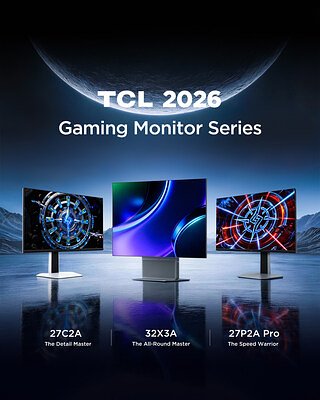
- 2026 Lineup: TCL unveiled its first OLED+ flagship (32X3A) and advanced QD-Mini LED displays, targeting gamers and professionals.
- Dual-Mode Refresh Rates: 32X3A offers 4K at 240Hz and FHD at 480Hz, with 0.03ms response time.
- Vertical Integration: TCL controls panel design to final assembly, leveraging its CSOT engineering arm and 2012-established monitor factory.
Experts would likely conclude that TCL's aggressive vertical integration and premium display technology position it as a formidable challenger in Europe's competitive monitor market, though success will depend on execution and consumer adoption.
TCL's Display Gambit: Can Vertical Integration Conquer Europe's Monitor Market?
PARIS, FRANCE – June 04, 2026 – In a move that signals a seismic shift in its European strategy, consumer electronics giant TCL has thrown down the gauntlet in the fiercely competitive premium monitor market. At its first-ever dedicated monitor event in Paris, the company unveiled a formidable 2026 lineup, spearheaded by its inaugural OLED+ flagship and a suite of advanced QD-Mini LED displays. This isn't just another product launch; it's a calculated offensive, leveraging decades of deep-seated manufacturing expertise to challenge the long-standing dominance of rivals like Samsung, LG, and Asus.
The message from TCL's NXTHOME in Paris was clear: the company is no longer content to be known primarily for its televisions. It is aggressively repositioning itself as a full-range technology provider, and the monitor segment is a key battleground. By placing cutting-edge technology and user-centric design at the forefront, TCL is making a compelling case for why consumers, from hardcore gamers to creative professionals, should pay close attention.
The OLED+ Centerpiece: A Masterclass in Design and Performance
At the heart of the new lineup is the TCL 32X3A, the brand’s first flagship OLED+ monitor. This isn't merely an entry into the OLED space; it's a statement piece. Having already been decorated with both the 2026 iF Design and Red Dot Design Awards, the monitor’s premium ambitions are evident before it’s even powered on. Its minimalist, “Stargate-inspired” aesthetic, ultra-thin 6.4mm profile, and four-sided near-borderless display are engineered for immersion.
But the real story lies in the technology. TCL is branding its panel as 'OLED+', a distinction it claims offers tangible benefits over traditional OLED. The technology features a Matrix-Pure Pixel arrangement designed to eliminate the color fringing on text that can plague some OLED types, a crucial detail for users who split time between gaming and productivity. Furthermore, a 2% circularly polarized low-reflection layer promises to maintain black purity and image clarity even in brightly lit rooms—a common challenge for glossy OLED screens.
Performance specifications are equally aggressive. The 32-inch display offers a dual-mode refresh rate that is the epitome of versatility: a crisp UHD 4K resolution at a blistering 240Hz for stunning visual fidelity, which can be switched to a hyper-fast FHD resolution at an incredible 480Hz for esports-level competitive play. Paired with a near-instantaneous 0.03ms GtG response time, the 32X3A is built to eliminate motion blur entirely. To complete the premium package, TCL co-engineered an audio solution with the venerable Bang & Olufsen, integrating a professional-grade DSP chip for precise in-game audio positioning and immersive entertainment sound—a feature that sets it apart in a market where built-in audio is often an afterthought.
A Multi-Pronged Attack with QD-Mini LED
While the OLED+ flagship grabs headlines, the depth of TCL's strategy is revealed in its comprehensive QD-Mini LED lineup. Here, the company is playing to its established strengths. Having pioneered Mini LED technology in the television space, TCL is now deploying that expertise to saturate the monitor market with options tailored to specific user needs.
For the user who refuses to compromise, the TCL 27C2A “Detail Master” combines a UHD 4K panel with 1196 precise dimming zones and 1200 nits of peak brightness. This allows for exceptional contrast and HDR performance. Like its OLED+ sibling, it features a dual-mode refresh rate (UHD 160Hz / FHD 320Hz), offering a similar blend of high-resolution beauty and high-speed performance.
For the pure competitor, the TCL 27P2A Pro “Speed Warrior” prioritizes raw speed. It offers a QHD resolution with a staggering 320Hz refresh rate and a 1ms GtG response time, ensuring that on-screen action is rendered with absolute fluidity and minimal latency. By backing this speed with Mini LED backlighting, TCL ensures that image quality doesn't suffer, providing the clarity needed to spot opponents in fast-paced scenarios.
Rounding out the high end is the TCL 57R94, an ultra-wide behemoth designed for ultimate immersion and multitasking. This 57-inch curved display boasts a Dual 4K resolution and leverages QD-Mini LED technology to maintain detail and contrast across its vast screen real estate. It’s a direct answer to the ultra-wide flagships from competitors, aimed squarely at simulation gamers and power users managing complex workflows.
The 'Why': A Strategy Built on Vertical Integration
This ambitious product rollout is underpinned by a crucial strategic advantage: TCL's vertically integrated supply chain. The company’s expertise is not superficial; it’s built on the foundation of its own panel engineering arm, CSOT, and over a decade of experience from its dedicated monitor factory established in 2012. This allows TCL to control everything from panel design to final assembly, fostering rapid innovation and potentially offering a more competitive price-to-performance ratio than competitors who rely on third-party panel suppliers.
“As screens become central to how people work, play, and connect, the expectations placed on a single display have fundamentally evolved,” said Stefan Streit, CMO at TCL Europe. “Our new product lineup builds on over 40 years of display expertise and a proven leadership position in Mini LED innovation. With these products, we are delivering consistent, high-quality performance for everyone, without compromise.”
This long-term vision is further evidenced by TCL's investment in future technologies, including an 8.6-generation plant set to begin producing its own inkjet-printed OLED panels in 2027. This move signals a clear intent to achieve self-sufficiency and become a leader in the next generation of display manufacturing. By combining this manufacturing prowess with a deep understanding of the gaming community, evidenced by its partnerships with esports teams like Gentle Mates and Eyeballers, TCL is building a powerful ecosystem. The 2026 lineup is not just a collection of new products; it is the visible manifestation of a long-term plan to reshape the display landscape.