
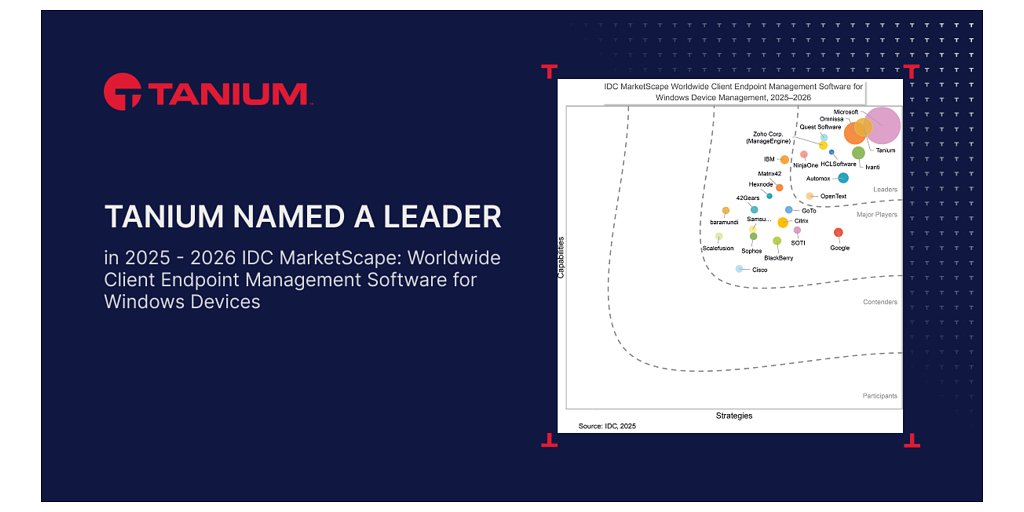
- Tanium named a Leader in the IDC MarketScape: Worldwide Client Endpoint Management Software for Windows Device Management 2025–2026 Vendor Assessment for the second consecutive time. - Tanium’s platform can query and receive data from millions of endpoints in near real-time. - The platform’s Tanium Confidence Score aggregates dozens of data points into a single metric of an endpoint's overall health and risk.
Experts agree that Tanium’s AI-driven platform sets the standard for autonomous IT, offering unparalleled real-time visibility and automation to enhance Windows device management and security.
Tanium Cements Leadership in AI-Driven Windows Device Management
EMERYVILLE, CA – January 15, 2026 – By Linda Coleman
Tanium, a company championing the concept of “Autonomous IT,” has once again been named a Leader in a key industry assessment, solidifying its position in the highly competitive endpoint management market. The firm announced its recognition in the IDC MarketScape: Worldwide Client Endpoint Management Software for Windows Device Management 2025–2026 Vendor Assessment, marking the second consecutive time it has achieved this status. This repeat acknowledgment underscores a significant industry trend: the growing reliance on artificial intelligence and real-time data to manage and secure the sprawling, complex digital estates of modern enterprises.
Windows remains the backbone of corporate computing, but managing these environments—from PCs and servers to a growing number of IoT devices—has become an immense challenge. The IDC MarketScape report highlights this complexity and the need for advanced solutions.
“Windows continues to dominate as the leading operating system across global enterprises despite ever-increasing device diversity. In turn, secure endpoint management with speed and scale for Windows environments is crucial, especially as they increase in complexity,” said Phil Hochmuth, research vice president for Endpoint Device Management and Enterprise Mobility at IDC. “Tanium’s unified platform continues to set the pace for innovation in the market, delivering advanced automation and deep integration with Microsoft’s ecosystem – based on real-time endpoint intelligence.”
The Shift Towards an Autonomous Framework
The recognition arrives as organizations grapple with tool sprawl, persistent visibility gaps between IT and security teams, and the relentless pace of cyber threats. In response, the market is pivoting towards what Tanium and other industry analysts call “Autonomous IT”—an operational model where systems are designed to be self-managing, self-healing, and self-optimizing, driven by AI and machine learning.
This concept extends beyond simple automation. It represents a strategic move towards intelligent systems that can predict issues, recommend actions, and execute remediation workflows with minimal human intervention. This approach is closely aligned with the broader trend of AIOps (AI for IT Operations), which leverages big data and machine learning to enhance IT functions like monitoring, automation, and service management. For chief information and security officers, the promise of an autonomous framework is profound: reduced operational costs, a dramatically improved security posture, and the ability to free up skilled personnel to focus on strategic initiatives rather than reactive firefighting.
Tanium has built its entire platform around this vision, converging endpoint management, security operations, and exposure management into a single, unified solution. This consolidation directly addresses the inefficiencies and risks created when organizations rely on a patchwork of disparate tools that often fail to communicate, leaving dangerous blind spots for attackers to exploit.
Beyond Native Tools: Bridging Critical Gaps
Many organizations are heavily invested in the Microsoft ecosystem, relying on tools like Microsoft Intune and Configuration Manager for device management. However, as environments scale and security demands intensify, gaps can emerge. Tanium has strategically positioned its platform not as a wholesale replacement, but as a powerful complement that enhances these native capabilities.
The IDC MarketScape report validates this approach, noting, “Tanium’s platform complements Windows ecosystems by bridging gaps in endpoint performance monitoring, compliance reporting and automation that are not fully addressed by native Microsoft tools.”
One of the most significant differentiators is the platform’s real-time visibility and control. Leveraging a patented linear-chain architecture, Tanium can query and receive data from millions of endpoints in near real-time—a capability crucial for rapid incident response and threat hunting. Where traditional tools might operate on data that is hours or even days old, Tanium provides an immediate, live snapshot of an organization’s entire IT estate. This speed is critical for everything from deploying an urgent security patch to investigating a potential breach.
Furthermore, the platform offers deeper insights into endpoint performance and compliance. It enables administrators to continuously monitor for configuration drift, enforce complex compliance policies across diverse regulatory frameworks, and proactively identify performance bottlenecks that impact the digital employee experience. This level of granular, real-time reporting and automated remediation goes beyond the foundational capabilities of many native toolsets.
Innovation in Action: AI for Real-Time Control
Driving Tanium’s autonomous vision are several key AI-powered innovations designed to democratize data and automate action at scale.
Tanium Ask: This feature provides a natural language interface, allowing IT and security personnel to ask complex questions about their environment in plain English—such as “Show me all servers missing the latest critical patch” or “Which machines are running unauthorized software?”—and receive immediate, actionable answers. This capability dramatically lowers the barrier to entry for deep-dive investigations, empowering a wider range of team members to access critical endpoint intelligence without needing to write complex scripts.
Tanium Confidence Score: To help prioritize action, the platform generates a dynamic Confidence Score for endpoints. This score aggregates dozens of data points—including patch status, security agent health, vulnerability exposure, and configuration integrity—into a single, quantifiable metric of an endpoint's overall health and risk. This allows teams to move away from endless checklists and instead focus their efforts on the devices that pose the greatest risk to the organization.
Adaptive Actions: This is where the “autonomous” aspect truly comes to life. Adaptive Actions automate remediation workflows based on real-time data and predefined policies. For example, if an endpoint’s Confidence Score drops below a certain threshold due to a newly discovered vulnerability, an Adaptive Action can be triggered to automatically isolate the device, deploy the necessary patch, and verify that the remediation was successful. This creates a self-healing environment that continuously enforces security and operational policies at machine speed.
“With the unprecedented pace and intensity of cyber risk, managing and securing Windows environments at speed and scale has never been more critical,” said Matt Quinn, chief technology officer at Tanium. He emphasized that the IDC MarketScape recognition highlights the importance of bringing IT and security together on a single platform with AI to reduce complexity and strengthen resilience.
Independent customer reviews on platforms like G2 and Gartner Peer Insights echo these strengths, frequently praising the platform’s unparalleled visibility and speed. Users in large enterprises particularly value its ability to consolidate multiple point solutions into a single agent, thereby reducing costs and simplifying management. While some note a steep learning curve due to its powerful feature set, the consensus points to a robust solution for organizations that require deep, real-time control over their complex IT landscapes.
Topics & Related
Generative AI
Machine Learning
Automation
Industry 4.0
Threat Landscape
Data Breaches
Software & SaaS
AI & Machine Learning
Related Company Pulse