
- ₹1,000 crore ($100M) investment: Indian government's funding for Annam.AI's national agricultural ecosystem.
- 150 million farming households: Targeted by Annam.AI for AI-powered advisories.
- 7-9% reduction in crop losses: Projected impact of the system on agricultural efficiency.
Experts would likely conclude that Syngenta's partnership with Annam.AI is a strategic move to influence India's digital agriculture landscape, balancing public-private collaboration with long-term market positioning.
Syngenta’s Gambit: Seeding Influence in India’s AI Farm Revolution
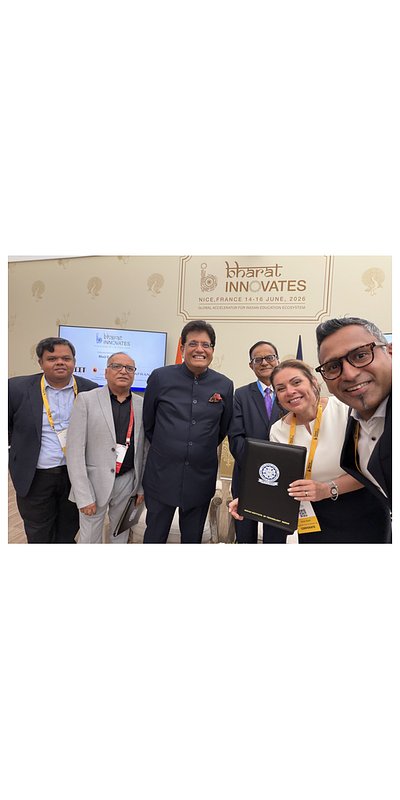
BASEL, Switzerland – June 15, 2026 – In the rarefied air of a diplomatic event in Nice, France, flanked by the leaders of India and France, a significant corporate maneuver took place. Syngenta Group, a global titan of agricultural science, signed a Memorandum of Understanding to become a strategic partner in Annam.AI, India’s audacious plan to build a national, open-data agricultural ecosystem. On the surface, this is a story of public-private partnership, of technology serving the smallholder farmer. But reading the underlying signals, this move is far more than a simple CSR initiative. It’s a calculated, strategic play for influence at the heart of one of the world’s largest and most critical agricultural economies. This is Syngenta planting a flag not just in India’s fertile soil, but in its digital future.
A Digital Backbone for the Green Revolution 2.0
To understand Syngenta’s move, one must first grasp the sheer ambition of Annam.AI. Driven by the prestigious Indian Institute of Technology (IIT) Ropar and backed by the Indian government with a war chest of nearly ₹1,000 crore (over $100 million), Annam.AI is not just another farm-tech app. It aims to be a foundational Digital Public Infrastructure (DPI)—a national intelligence backbone for a sector that supports over 600 million people. The vision is to deliver free, hyperlocal, AI-powered advisories to India's 150 million farming households, over 80% of whom are smallholders operating on less than two hectares.
The system is a sophisticated three-layer architecture. At the base is the 'Swan' network, a planned deployment of advanced, hyperlocal weather stations capturing real-time climate data with pinpoint accuracy. This data feeds the 'Krishi AI' intelligence layer, the system's brain, which uses machine learning and partner models to analyze everything from pest infestations identified via a farmer's photo to complex yield predictions. The final layer, the 'Annam Chat Engine (ACE),' is a multilingual AI chatbot designed to translate this complex data into simple, actionable advice for farmers in their local language. The promise is transformative: a 7-9% reduction in crop losses and a 20-30% saving in precious irrigation water.
Reading the Tea Leaves: Syngenta’s Strategic Play
This is the ecosystem Syngenta is now embedding itself within. The press release notes the company will leverage its deep R&D and agronomic expertise to build critical models for crop health, pest forecasting, and heat stress. This is no small contribution; it is the specialized knowledge that turns raw data into valuable, field-specific intelligence. For Syngenta, the partnership is a masterstroke of strategic alignment.
Jeff Rowe, Syngenta Group’s CEO, stated, “Annam.AI presents a unique opportunity to contribute to a transformative, digital foundation for Indian agriculture.” While the sentiment is laudable, the strategic intent runs deeper. By integrating its proprietary knowledge into a national DPI, Syngenta achieves several long-term goals. Firstly, it positions itself as an indispensable partner to the Indian government in modernizing agriculture. Secondly, it gains an unparalleled platform to test, refine, and showcase its advanced agronomic models at a massive scale. The insights gleaned from a nationwide, real-time data network are an R&D goldmine, informing future product development from seeds to crop protection.
This isn't about selling products directly through the app. It's about shaping the very standards and practices of digital farming in India. When a national system's pest forecasting model is built on Syngenta's logic, it subtly aligns the entire ecosystem with the company’s scientific worldview. It is a powerful, long-term play for market influence that transcends traditional sales and marketing.
The Open-Data Paradox
Herein lies the central tension of the Annam.AI project. It is branded as an “open-data” ecosystem, a public good. Yet, its key partners are corporate behemoths—Syngenta in agriculture and Google in technology. This raises critical questions about data governance, a challenge that will define the initiative's ultimate legacy. Who truly owns the vast lake of data generated by millions of farmers and a national network of sensors? How will India's Digital Personal Data Protection Act be applied to this complex data web?
While the advisories for farmers are free, the aggregated, anonymized data is immensely valuable. It can predict commodity flows, reveal regional vulnerabilities, and guide investment from insurance to finance to food processing. A policy expert specializing in agricultural technology noted, “The term 'open-data' can be a double-edged sword. Open for whom? If it's open for startups and public researchers, it fosters innovation. If it primarily benefits the large corporate partners who have the resources to analyze the data, it risks creating a new form of digital feudalism.”
Ensuring that the value generated from this public data flows back to the farmers and the public, rather than being captured solely by corporate partners, will be the single greatest governance challenge for IIT Ropar and the Indian government. The structure of data-sharing agreements and the transparency of the platform’s operations will be under intense scrutiny.
The Last Mile: Bridging the Gap from AI to Acre
Beyond the strategic and ethical questions lies the immense practical challenge of implementation. The most sophisticated AI model is useless if it cannot reach the farmer in a timely, trusted, and understandable way. India’s agricultural landscape is littered with pilot projects that failed to scale precisely because they couldn't conquer this “last-mile” problem.
Fewer than 20% of Indian farmers currently use digital technologies, a figure constrained by low incomes, variable digital literacy, and inconsistent rural connectivity. Annam.AI's architects are clearly aware of these hurdles. The multilingual chat interface and the plan to train 10,000 local youth and professionals are direct attempts to address the literacy and trust gaps. The creation of human-AI hybrid call centers is a crucial recognition that technology alone is not enough; a human touch remains essential.
However, deploying and maintaining a physical network of 100 weather stations, ensuring farmers have the necessary smartphones and data plans, and building trust in AI-generated advice over generations of traditional knowledge are monumental tasks. The success of Syngenta's strategic partnership and India’s digital dream hinges not on the elegance of the code in a lab, but on the gritty reality of its adoption, acre by difficult acre.