
- 93% reduction in cabling compared to traditional 1U rackmount servers
- 50% reduction in physical space for equivalent compute power
- Up to 100 servers per rack with direct liquid cooling (DLC) configuration
Experts agree that Supermicro's new SuperBlade represents a significant advancement in data center density and efficiency, particularly for AI and HPC workloads, offering a compelling solution for space-constrained and energy-conscious enterprises.
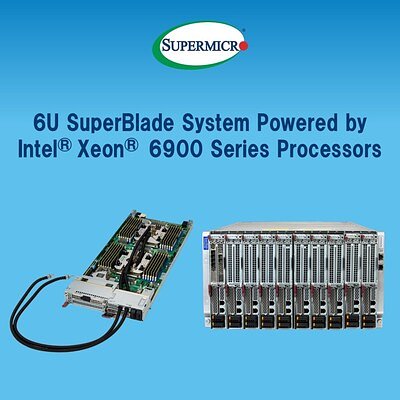
Supermicro's New SuperBlade Redefines Data Center Density for AI Era
SAN JOSE, CA – December 31, 2025 – As the demands of artificial intelligence and high-performance computing (HPC) push data center infrastructure to its limits, Supermicro has unveiled a powerful new solution designed to maximize compute power in a minimal footprint. The company today announced its latest 6U SuperBlade, a high-density server platform powered by dual Intel Xeon 6900 series processors, featuring advanced liquid-cooling technology to tame the immense heat generated by next-generation workloads.
The new system, model SBI-622BA-1NE12-LCC, represents a significant step forward in blade architecture, promising to dramatically increase compute density, energy efficiency, and performance for industries ranging from scientific research and financial services to advanced manufacturing.
The Density Revolution: More Compute, Less Space
At the core of Supermicro's announcement is a radical rethinking of data center real estate. The 6U SuperBlade's innovative architecture consolidates compute, networking, and power into a single enclosure, achieving what the company claims is up to a 93% reduction in cabling and a 50% reduction in physical space compared to an equivalent deployment of traditional 1U rackmount servers. This consolidation is a critical advantage for enterprises facing space constraints or seeking to scale their operations without costly data center expansions.
A single 6U chassis, which fits into a standard 19-inch rack with its 32-inch depth, can house up to ten dual-processor blades when using the direct liquid cooling (DLC) option. This configuration enables a density of up to 100 servers per rack, packing an unprecedented amount of processing power into a standard footprint. For data centers not yet equipped for liquid cooling, an air-cooled version supporting five nodes per enclosure is also available.
This approach not only saves space but also simplifies management and maintenance. By leveraging shared, hot-swappable power supplies, cooling fans, and integrated chassis management, the SuperBlade system reduces the complexity and potential points of failure associated with managing hundreds of individual servers. System administrators can remotely control power, access BIOS settings, and monitor the health of each blade through a central Chassis Management Module (CMM), streamlining operations and lowering the Total Cost of Ownership (TCO).
Powering the Next Wave of AI and HPC
The new SuperBlade is engineered to tackle the most demanding computational tasks. Each blade supports dual Intel Xeon 6900 series processors, which are part of Intel's latest generation of P-core focused server CPUs. With configurations offering up to 256 high-performance cores per blade, the system is capable of delivering up to 25,600 cores per rack, providing the raw horsepower needed for complex AI model training, large-scale simulations, and data-intensive analytics.
To handle the thermal output of these powerful processors—which can have a Thermal Design Power (TDP) of up to 500W each—Supermicro has implemented a robust direct liquid cooling system. The DLC solution features cold plates that make direct contact with the CPUs, and options are available to extend cooling to memory DIMMs and voltage regulators (VRMs). Industry analysis shows that liquid cooling is not just a luxury but a necessity for maintaining optimal performance and longevity in high-density environments, often reducing data center energy costs by 30-40% compared to traditional air cooling.
This performance is backed by immense memory and storage flexibility. Each blade accommodates up to 24 DIMM slots, supporting a massive 3TB of 6400MT/s DDR5 memory or 1.5TB of ultra-fast 8800MT/s DDR5 MRDIMM, making it ideal for in-memory databases and other memory-hungry applications. For storage, the system offers multiple options, including four PCIe 5.0 NVMe SSDs for high-speed data access, along with flexible PCIe expansion slots that can house up to three 400G InfiniBand/Ethernet cards or a combination of networking and GPU accelerators.
The Economic and Sustainable Imperative
Beyond raw performance, the new SuperBlade makes a compelling economic and environmental case. The shift toward liquid cooling and high-density designs is a direct response to the escalating energy consumption of data centers worldwide. The global market for data center liquid cooling is projected to surge from approximately $3.6 billion in 2024 to over $20 billion by the early 2030s, a trend driven by the need for greater efficiency and sustainability.
By moving heat more effectively, Supermicro's liquid-cooled SuperBlade significantly reduces the reliance on energy-intensive computer room air conditioning (CRAC) units, directly lowering a data center's Power Usage Effectiveness (PUE) and overall carbon footprint. This aligns with Supermicro's long-standing 'Green Computing' initiative and provides a clear path for companies to meet increasingly stringent environmental, social, and governance (ESG) targets.
"Supermicro's SuperBlade architecture delivers industry-leading server density and energy efficiency, forming the foundational infrastructure for many of the world's largest and most powerful high-performance computing systems," said Charles Liang, president and CEO of Supermicro, in the official announcement. "This new iteration is the most core-dense SuperBlade we've ever created, providing customers with a scalable, efficient platform that leverages shared resources and direct liquid cooling to achieve maximum performance per watt and per square foot in modern data centers."
Navigating a Competitive High-Density Landscape
Supermicro's launch enters a fiercely competitive market where major players like HPE, Dell, and Lenovo are also aggressively pushing high-density, liquid-cooled solutions. Competitors are leveraging their own proprietary cooling technologies, such as Lenovo's Neptune and HPE's expanded direct liquid cooling for its ProLiant servers, to address the same thermal challenges posed by next-generation CPUs and GPUs.
This industry-wide pivot confirms that advanced thermal management is no longer a niche requirement but a mainstream necessity for modern computing. The common goal across the industry is to enable customers to deploy the most powerful hardware for AI and HPC without being throttled by thermal constraints or crippled by exorbitant energy bills.
In this landscape, Supermicro's SuperBlade stands out with its highly modular 'Server Building Block Solutions' philosophy, offering a granular level of customization in compute, memory, storage, and networking. This flexibility, combined with its impressive density and efficiency claims, positions the new SuperBlade as a formidable platform for organizations building the next generation of supercomputing clusters and AI factories. The platform's ability to integrate seamlessly into existing rack infrastructure while delivering a leap in performance and efficiency will be a key factor for IT leaders planning their next phase of infrastructure modernization.