
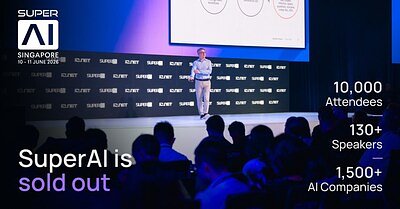
- 10,000 attendees from 150+ countries at SuperAI 2026, Asia's largest AI event.
- US$2.3 million in prize capital for AI startups at the Genesis Competition.
- 200 builders competing in the NEXT Hackathon for over US$200,000 in prizes.
Experts would likely conclude that Singapore has strategically positioned itself as the world's neutral ground for AI collaboration, fostering global innovation and real-world deployment amid geopolitical fragmentation.
SuperAI 2026: How Singapore Became the World's AI Crossroads
SINGAPORE – June 09, 2026 – The Marina Bay Sands convention center is buzzing with a new kind of energy this week as SuperAI 2026, Asia's largest artificial intelligence event, opens its doors to a sold-out crowd of 10,000 attendees. This gathering is more than just a conference; it's a powerful statement on the state of global technology. With over 1,500 AI companies from more than 150 countries converging, the event marks a pivotal moment, showcasing AI's definitive shift from a theoretical research frontier to a globally deployed industrial force. More significantly, it cements Singapore's strategic position as the world's essential neutral ground for AI collaboration.
A Global Nexus in a Fragmenting World
In an era defined by geopolitical friction, tightening export controls, and a global race for sovereign AI capabilities, the window for open, international collaboration is perceived to be narrowing. Yet, SuperAI 2026 stands as a testament to the contrary. The event deliberately bridges the 'East meets West' divide, creating a unique forum where leaders from the US, China, Europe, and across Asia can engage. The exhibition floors feature US-based Snowflake and Cerebras Systems alongside France's frontier model provider Mistral AI and Chinese tech giant Alibaba Cloud, all under one roof.
This convergence is no accident. Singapore has meticulously cultivated an environment of political neutrality, robust infrastructure, and supportive AI regulation that makes it an ideal convener. "Singapore's strategic position makes it one of the only places in the world where the full spectrum of global AI comes together," noted one of the event's co-founders. This sentiment is echoed by the diverse roster of attendees and speakers, from futurist Balaji Srinivasan and MIT's Max Tegmark to leaders from OpenAI, Google DeepMind, and Chinese lab MiniMax. The city-state acts as a trusted platform where competitive ecosystems can meet, share, and shape the future of a technology that is becoming increasingly multipolar.
From Code to Capital: Forging the Next AI Generation
The true measure of SuperAI's impact lies not just in the high-level discussions but in its role as a catalyst for tangible innovation. The event showcases the entire AI development lifecycle, from raw code to venture capital and final deployment. At its heart is the 36-hour NEXT Hackathon, where 200 builders are currently competing for over US$200,000 in prizes, backed by industry giants like AWS, Vercel, and Razer. This intense competition provides a raw, unfiltered look at emerging talent and grassroots problem-solving.
Simultaneously, the Genesis Startup Competition puts the spotlight on the commercial future of AI. Powered by Microsoft for Startups and OpenAI, the competition offers an astounding US$2.3 million in prize capital to the next wave of AI entrepreneurs. Fifty promising startups are being showcased, with ten finalists set to pitch their ventures live to a panel of esteemed investors. These initiatives are not mere side events; they are the engine room of the conference, designed to identify and nurture the ideas and talent that will define the next decade of AI applications, providing a direct pipeline from prototype to market-ready product.
Beyond the Hype: AI's March into Real-World Industries
This year’s conference agenda makes one thing clear: the conversation around AI has decisively moved beyond abstract potential to concrete application. The thematic tracks—spanning Robotics & Embodied AI, Frontier Models, BioTech & HealthTech, and AI in Finance—are all geared towards real-world deployment. Visionaries like Benedict Evans are set to deliver their annual briefings on tangible industry trends, while sessions on AI infrastructure will tackle the critical challenges of energy consumption, compute scaling, and the sovereign infrastructure race.
This focus on application is already transforming industries. In finance, for example, discussions will explore how agentic AI is not just detecting fraud but also augmenting the capabilities of bankers, increasing productivity in software development and turning more professionals into 'builders'. Singapore itself serves as a living case study. The city's regulators are actively embracing this shift, with the Infocomm Media Development Authority (IMDA) launching its Model AI Governance Framework for Agentic AI earlier this year, and the Monetary Authority of Singapore (MAS) announcing an AI risk management toolkit for the financial sector. These policy moves demonstrate a commitment to integrating cutting-edge AI responsibly and effectively into the economic fabric.
The Ripple Effect: A City Transformed by AI Week
The influence of SuperAI extends far beyond the walls of Marina Bay Sands. The conference is the anchor event for Singapore AI Week, a city-wide festival of innovation featuring over 100 satellite events. From founder dinners and investor roundtables hosted by Lightspeed and SparkLabs to workshops by OpenAI, Notion, and HSBC, the entire city-state is animated by the energy of AI development. This broader ecosystem of events ensures that the benefits of this global convergence—knowledge sharing, networking, and investment—permeate the local tech community and beyond.
This week-long immersion solidifies Singapore’s reputation as a natural launchpad into the burgeoning Asian market for AI companies worldwide. As the thousands of attendees disperse after days of intense dialogue and deal-making, they will leave behind a city further entrenched as a global hub for technology and a clear signal of what's to come. For those looking to see where the future of AI is being built, deployed, and capitalized, all eyes are on Singapore this week. SuperAI is scheduled to return to Marina Bay Sands on September 8-9, 2027, promising an even deeper look into the technology reshaping our world.