
- 737 passengers will receive $20 gift cards for sitting in middle seats on January 27, 2026.
- January 27, 2026 marks the end of Southwest Airlines' open seating policy, transitioning to assigned seating.
- $20 gift cards are the promotional reward for participants in Subway's 'Sandwich Seat' giveaway.
Experts view Subway's promotion as a clever, reactive marketing strategy that leverages a widespread travel frustration to create positive brand engagement and goodwill.
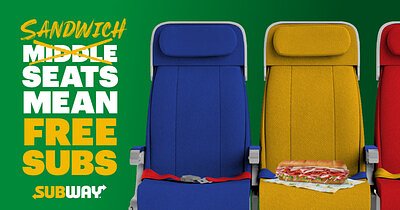
Subway Turns Middle Seat Misery into Free Footlongs
MIAMI, FL – January 22, 2026 – For air travelers, the middle seat has long been the undisputed symbol of a bad travel day—a cramped purgatory of shared armrests and limited personal space. Now, sandwich giant Subway is turning that dreaded assignment into a winning ticket, launching a timely promotion that cleverly intersects with a major shift in the airline industry.
Next Tuesday, January 27, as millions of travelers adjust to the end of an era in air travel, Subway will offer a tasty consolation prize. The company announced it will give away $20 gift cards to 737 passengers who find themselves "sandwiched" in a middle seat. The promotion, dubbed the "Sandwich Seat" giveaway, is a direct and savvy response to Southwest Airlines' decision to end its iconic open seating policy on the very same day.
The End of an Open Seating "Air-a"
For over 50 years, Southwest Airlines built a loyal following around its unique, first-come, first-served boarding process. The open seating policy was a hallmark of its brand, offering a sense of egalitarianism and eliminating fees for pre-assigned seats. However, that tradition comes to an end on January 27, 2026, as the carrier transitions to an assigned seating model, aligning itself with the rest of the major U.S. airlines.
The change means that for the first time, Southwest passengers will be assigned a specific seat, with the airline introducing tiered fare options that include Standard, Preferred, and Extra Legroom seats. While some travelers have expressed relief, welcoming the end of the so-called "cattle call" boarding process and the anxiety it can produce, many long-time customers are mourning the loss of a key differentiator. Online travel forums and social media are filled with mixed reactions, with some critics viewing it as the "homogenization of US airlines" and another step toward nickel-and-diming passengers.
This policy shift guarantees that on Tuesday, a significant number of flyers on the popular carrier will find themselves in the one spot they actively try to avoid. It is this specific, predictable moment of collective passenger displeasure that Subway has seized upon for its latest marketing campaign.
From Bad Sandwich to Great Sandwich
Subway's promotion is simple and directly targeted. Any traveler in the U.S. flying in an assigned middle seat on January 27 can participate by taking a selfie in their seat and uploading it to the promotional website, SubwayMiddleSeat.com. The first 737 entrants—a clever nod to the Boeing 737 aircraft that is a workhorse of the Southwest fleet—will receive a $20 gift card.
"Getting sandwiched in a middle seat no matter how early you check in is not something many travelers will love," said Dave Skena, Chief Marketing Officer for Subway North America, in a press release. "So, on Tuesday, we're going to turn a bad 'sandwich' into a great sandwich by reassigning 737 middle-seaters a $20 Subway® gift card."
The campaign is a textbook example of agile, reactive marketing, where a brand leverages a current event or cultural moment to create a relevant and engaging connection with consumers. By identifying a widespread consumer pain point—the misery of the middle seat—and linking it to a specific, newsworthy event, Subway positions itself as an empathetic brand offering a moment of unexpected delight. Analysts have already noted the cleverness of the approach, labeling it an exercise in the "gamification of discomfort," turning a travel tribulation into a potential reward.
A Broader Trend of Airline Ancillary Fees
Subway's promotion shines a spotlight not just on a single airline's policy change, but on the broader economic trends shaping the modern air travel experience. Southwest's move to assigned seating and tiered pricing is indicative of a larger industry-wide shift toward maximizing ancillary revenue. These are the fees charged for services that were once included in the ticket price, such as seat selection, checked baggage, and extra legroom.
For airlines, this strategy has proven incredibly lucrative. The industry has seen a significant push towards "premiumization," with data showing that the number of scheduled premium seats in the domestic U.S. market has grown at more than three times the rate of economy seats since 2019. This suggests a growing segment of travelers is willing to pay more for comfort, and airlines are eager to capitalize on that demand. Southwest's decision, driven by customer survey data and a desire to boost revenue, falls squarely within this trend.
While most airlines focus on what they can charge for, some are exploring other ways to enhance the passenger experience through seating policies. For example, India's IndiGo has a feature that shows seats occupied by female passengers, and Japan Airlines has a system to help travelers avoid sitting near infants. These initiatives, however, remain exceptions in an industry that is increasingly focused on unbundling its services to drive profit, often at the expense of baseline passenger comfort.
The New Playbook for Brand Engagement
In an era of constant advertising noise, brands are increasingly looking for authentic ways to cut through the clutter. Subway's "Middle Seat" campaign demonstrates a modern playbook for achieving this: tap into a shared human experience, respond to it with empathy and humor, and offer a tangible reward. This form of experiential marketing creates a direct, memorable interaction that traditional advertising often struggles to achieve.
By inserting itself into the conversation around airline travel frustrations, the sandwich chain generates positive public relations and brand goodwill. It's a strategy that builds on the company's recent guest-centric marketing approach, which actively seeks insights from real consumers. Instead of just broadcasting a message about fresh ingredients or value, Subway is participating in its customers' lives, acknowledging their daily hassles and offering a small solution.
This approach is not just about giving away free food; it is about creating a narrative where the brand is the hero in a small, everyday story. As airlines continue to find new ways to charge for comfort, it creates an opening for other consumer-facing companies to step in and provide it, even if it just comes in the form of a free footlong sandwich.