
- 30-40%: Tax credits can represent 30-40% of the total cost of BESS projects, making FEOC compliance critical for financial viability.
- 10% bonus tax credit: The Inflation Reduction Act (IRA) offers a 10% bonus tax credit for clean energy projects meeting domestic content thresholds.
- 2008: Nuvation Energy has been developing its BMS technology in North America since 2008.
Experts would likely conclude that this partnership provides a credible, domestically engineered solution to navigate federal incentives and restrictions, ensuring compliance and enhancing the security and efficiency of North American energy storage systems.
Stem and Nuvation Forge North American Energy Storage Alliance
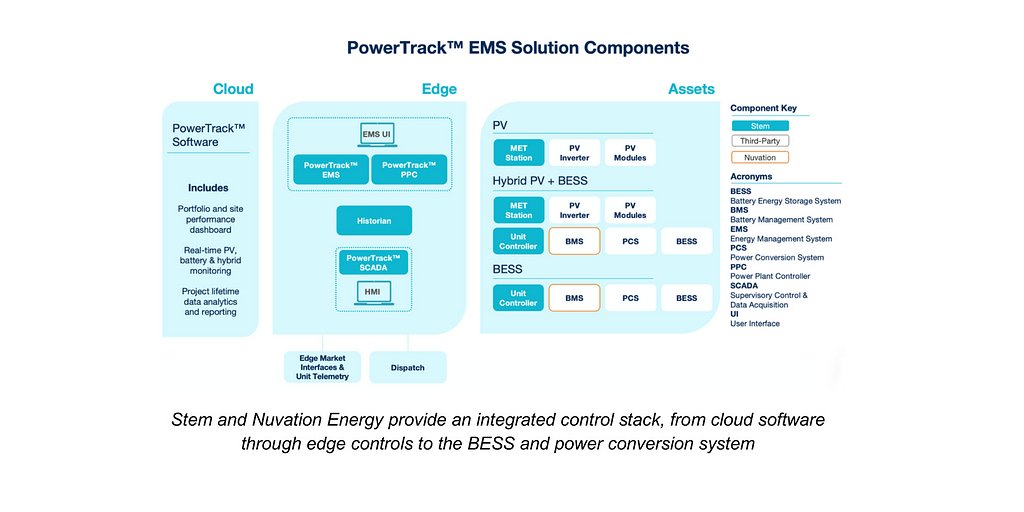
HOUSTON, TX – April 30, 2026 – In a strategic move to secure the domestic clean energy supply chain, AI-enabled software leader Stem, Inc. and energy control provider Nuvation Energy have announced a co-marketing agreement to deliver a fully North American-made control system for battery energy storage systems (BESS). The collaboration integrates Stem’s PowerTrack Energy Management System (EMS) with Nuvation’s Battery Management System (BMS), creating a unified solution designed to meet escalating demand for secure and regulation-compliant energy infrastructure.
The partnership arrives at a critical juncture for the U.S. energy sector, which is grappling with a complex web of new federal incentives and restrictions. This collaboration directly addresses the pressing need for developers, utilities, and asset owners to navigate this new landscape by providing a credible, domestically engineered alternative to control systems reliant on foreign components.
The Regulatory Gauntlet: Navigating FEOC and IRA
The demand for a North American BESS control stack is not merely a preference; it's rapidly becoming a financial and operational necessity. The landscape has been reshaped by two key pieces of federal policy: the Inflation Reduction Act (IRA) and its stringent Foreign Entity of Concern (FEOC) provisions. The IRA offers a lucrative 10% bonus tax credit for clean energy projects that meet specific domestic content thresholds, directly incentivizing the use of American-made components.
More critically, the FEOC rules carry a significant penalty. These regulations aim to reduce reliance on supply chains linked to foreign adversaries like China and Russia by making projects with components from these nations ineligible for federal tax credits. For a BESS project, where tax credits can represent 30-40% or more of the total cost, FEOC compliance has shifted from a background concern to a core issue of bankability. Developers now face the arduous task of performing deep due diligence on their entire supply chain, from the battery cell level up to the software that manages the asset.
This intense regulatory pressure has created a market ripe for shortcuts. Some manufacturers may attempt to meet compliance thresholds through superficial measures, such as rebranding foreign-made products or performing minimal final assembly in the U.S. while the core technology remains sourced from abroad. However, recent guidance from the Treasury and IRS indicates that such tactics will not suffice, as regulators now require a granular breakdown of component costs and origins, effectively treating system integrators as transparent entities rather than black boxes.
A Genuinely Domestic Control Stack
It is within this high-stakes environment that the Stem and Nuvation alliance offers a clear path forward. Their integrated solution is not a reaction to the rules but a purpose-built answer. It combines Stem’s high-level PowerTrack EMS, which manages site-level scheduling and grid coordination, with Nuvation’s granular BMS, which monitors and protects the battery at the individual cell level.
The key differentiator is the system's origin story. Nuvation Energy has been developing its BMS technology since 2008, with all design, engineering, and manufacturing conducted in the United States and Canada by a North American-based team. This provides project developers with a powerful and verifiable tool for meeting domestic content requirements and, crucially, avoiding the pitfalls of FEOC restrictions for the system's critical control layer.
“For developers, utilities, and project owners who need to get ahead of tightening compliance requirements, this solution is built to meet both the letter and the spirit of the law,” said Michael Worry, CEO and CTO of Nuvation Energy. “By combining Nuvation's battery management system with Stem's energy management platform, we are delivering a solution where the critical control electronics are North American designed and manufactured, a clear and credible alternative that is technically robust and commercially relevant.”
This commitment to authentic domestic engineering stands in stark contrast to the market's superficial compliance strategies, offering customers confidence that their assets are built on a secure and transparent foundation.
Beyond Compliance: The Technical and Security Edge
While regulatory compliance is the immediate catalyst, the technical advantages of this integrated system offer long-term value. A tightly coupled EMS and BMS can achieve a level of performance and reliability that is difficult to replicate with disparate components. Stem’s AI-driven PowerTrack software can make more intelligent decisions about when to charge and discharge the battery because it receives precise, real-time data on battery health and state-of-charge directly from Nuvation’s cell-level monitoring system.
This synergy enhances operational efficiency and extends the lifespan of the battery asset, maximizing the return on investment. The detailed data stream also enables predictive maintenance, allowing operators to address potential issues before they lead to costly downtime.
“Customers are asking for greater transparency, control and confidence in the technologies deployed across their energy assets,” noted Matt Tappin, President of Software at Stem. “This collaboration will allow us to deliver a more integrated solution that directly addresses those priorities, while enhancing system performance, reliability of the system, and long-term value for our customers.”
Furthermore, the partnership directly confronts the growing cybersecurity concerns surrounding critical energy infrastructure. By sourcing the entire control stack—both hardware and software—from a trusted North American ecosystem, the solution significantly reduces the risk of vulnerabilities that could be introduced through foreign-sourced components. This provides an essential layer of security for the nation’s power grid as it becomes increasingly reliant on distributed energy resources.
Under the agreement, the two companies will pursue a coordinated go-to-market strategy, including joint thought leadership and aligned sales efforts. The integrated solution will undergo rigorous joint performance validation and testing before being deployed to customers, ensuring a seamless and reliable experience from day one. This collaboration represents a significant step toward building a more resilient, secure, and self-sufficient clean energy future in North America.
Topics & Related
Software & SaaS
Artificial Intelligence
Generative AI
Tax Policy
Antitrust
Data Breaches
Private Placement
AI & Software Platforms
Revenue
Related Company Pulse