
- 50kWh: High-capacity lithium-ion batteries starting at 50kWh for energy storage.
- 12 to 72 months: Flexible financing terms offered for the Spark MCT.
- $1 billion: Financial backing from Soneil Investments, the parent company.
Experts would likely conclude that Soneil Spark's mobile EV charging solution addresses critical gaps in remote and off-grid commercial electrification, combining technological versatility with accessible financing to accelerate EV adoption in industries like mining, construction, and emergency services.
Soneil Spark Rolls Out Mobile EV Chargers to Power Remote Industries
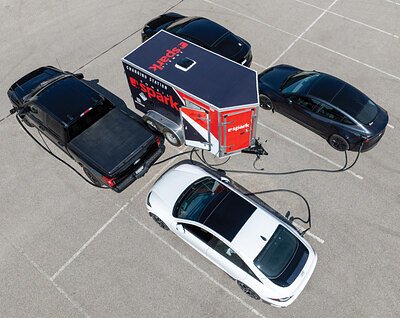
BRAMPTON, ON – January 06, 2026 – Soneil Spark, a company specializing in AI-driven power systems, has unveiled a new solution aimed at electrifying the most challenging commercial environments. The company today announced the launch of its Spark Mobile EV Charging Station (MCT), a trailer-mounted microgrid designed to deliver on-demand power to remote, off-grid, and underpowered locations. The launch is coupled with an aggressive financing program intended to lower the barrier to entry for commercial fleet operators across Canada and the United States.
This dual-pronged strategy addresses two of the most significant hurdles slowing widespread electric vehicle adoption in the commercial sector: the lack of charging infrastructure in remote industrial settings and the high upfront capital cost of acquiring such equipment. By offering a technologically versatile product backed by accessible financing, Soneil Spark is positioning itself to serve industries that have so far remained on the sidelines of the EV transition, such as mining, construction, and emergency services.
A Microgrid on Wheels for a Grid-Constrained World
The core innovation of the Spark MCT is its function as a self-contained, mobile microgrid. Unlike fixed charging stations that depend on a stable grid connection, the MCT is engineered for energy independence. Equipped with high-capacity lithium-ion batteries starting at 50kWh, the unit can be charged from and operate using a variety of energy sources, including solar, wind, natural gas, or propane generators. This multi-source capability makes it a resilient power hub for virtually any scenario.
Soneil Spark states that its "intelligent power management software" is the key to this versatility. While the company has not released the specific details of its proprietary algorithms, the system aligns with broader industry trends leveraging artificial intelligence to optimize energy flow. In practice, this AI-driven software balances the energy drawn from its internal battery storage with real-time input from connected sources, ensuring a stable and efficient power output for either AC or DC fast charging. According to the company, this approach overcomes the limitations of simpler hybrid systems, which are often capped by the maximum power of their inverters.
The real-world applications for such a system are extensive and address critical market gaps. Demand is growing for deployable charging in sectors where grid access is either non-existent or impractical.
- Construction and Mining: These industries often operate in rugged, remote terrains. Competitors like ABB with its eMine™ FastCharge and Dimaag with its megawatt mobile systems have already identified this market, validating the need for robust, high-power mobile charging for heavy electric machinery.
- Events and Festivals: Temporary large-scale gatherings require flexible power infrastructure. Mobile DC fast chargers are increasingly sought after to support vendor operations and provide convenience charging for attendees, aligning with the sustainability goals of many modern events.
- Emergency and Disaster Response: In the aftermath of natural disasters when the electrical grid is often compromised, mobile microgrids can be indispensable. They ensure that critical EV fleets—including police, fire, and medical services—remain operational for rescue and logistical support.
The Spark MCT's modular and customizable design allows it to be configured for these specific use cases, from providing convenience charging at a trade show to acting as a primary power source for a remote utility project.
Dismantling the Financial Barriers to Fleet Electrification
Beyond the hardware, Soneil Spark is making a strategic push to solve the financial equation for its customers. The company's announcement of "industry-leading financing" is more than just marketing; it points to a structured effort to de-risk the investment for commercial buyers. Through a partnership with RCAP Leasing, Soneil Spark offers flexible financing terms from 12 to 72 months.
The program's most notable feature is its use of "pre-established asset valuations" for the Spark MCT. This seemingly technical detail is crucial, as it streamlines the underwriting process and allows for faster loan approvals—a common pain point for businesses seeking to finance new types of equipment. By establishing the trailer's value upfront, the company and its financing partner reduce uncertainty and expedite the path to ownership.
This model directly confronts the high upfront costs that fleet managers consistently cite as a primary obstacle to electrification. Instead of a large capital expenditure, businesses can opt for fixed monthly payments, which simplifies budgeting and conserves working capital for other operational needs. This structure is similar to the popular "Charging as a Service" (CaaS) model but is applied to a mobile asset, giving businesses ownership or leasing options over a deployable resource.
Underpinning this entire initiative is the financial heft of Soneil Investments, Soneil Spark's parent company, which boasts over $1 billion in property holdings. This substantial backing provides the financial credibility necessary to secure favorable partnership terms and assures customers of the program's long-term stability. It's a strategic use of corporate strength to make a new technology product more attainable and to accelerate market penetration.
Navigating a Competitive and Innovative Market
Soneil Spark enters a dynamic and increasingly crowded field. Several companies are already active in the mobile and off-grid charging space. SparkCharge offers a high-output DC fast charging hub, while companies like Ampernext and Sunnoo focus on renewable-powered off-grid solutions. In the events space, Charge Rigs and Bee Charge provide portable chargers, and for heavy industry, players like ABB and Kempower offer ruggedized mobile units.
Where the Spark MCT aims to differentiate itself is in its comprehensive, all-in-one approach. It combines a highly customizable, multi-source microgrid with sophisticated AI-driven energy management and, crucially, an integrated and accessible financing package backed by a major investment firm. This trifecta of technological versatility, intelligent operation, and financial accessibility creates a compelling value proposition.
By framing the Spark MCT not just as an EV charger but as a versatile power hub, Soneil Spark is tapping into the broader trend of distributed energy and grid resilience. As industries and municipalities seek greater energy independence and operational continuity, solutions that can function both with and without the grid will become increasingly vital. The ability to deploy reliable power anywhere it's needed represents a significant step forward in enabling a more flexible and robust energy transition for all commercial sectors.