
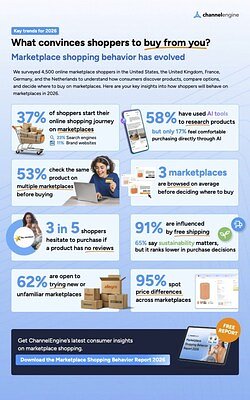
- 58% of shoppers use AI for product research
- 17% feel comfortable letting AI complete a transaction
- 95% of consumers notice price differences across online stores
Experts conclude that while AI is widely adopted for product discovery, consumer trust remains a critical barrier to AI-driven transactions, emphasizing the need for transparency and reliability in e-commerce.
The AI Paradox: Shoppers Browse with Bots, But Won't Let Them Buy
NEW YORK, NY – January 07, 2026 – A significant gap is emerging in the world of e-commerce: while a majority of consumers now use artificial intelligence to discover and research products, very few trust it enough to handle the final purchase. A new global study reveals that despite AI’s growing influence in the shopping journey, the decision to buy still hinges on old-fashioned principles of trust, transparency, and reliability.
The findings come from the Marketplace Shopping Behavior Report 2026, released today by e-commerce platform ChannelEngine. Based on a survey of 4,500 consumers across the United States, UK, and key European markets, the report paints a picture of a shopper who is technologically savvy but pragmatically cautious. While 58% of shoppers have used AI tools for product research and 37% have initiated a purchase journey via an AI assistant, a mere 17% feel comfortable letting an AI complete the transaction.
The Great AI Divide: A Tool for Discovery, Not Decision
The report highlights that AI has successfully integrated itself into the chaotic initial stages of online shopping, acting as a powerful filter in an increasingly fragmented digital marketplace. However, its role appears to stop abruptly at the checkout button. This hesitation reflects a broader behavioral shift where consumers are becoming more diligent and less loyal to a single platform.
According to the study, comparison shopping is now the default behavior for more than half of consumers (53%), who "always or often" compare the same product across an average of three different marketplaces before committing to a purchase. This multi-platform browsing habit means that AI, like search engines and social media, has become another stop on the journey, rather than the final destination.
This "AI paradox" is further supported by other industry analyses, which show that while AI-powered tools like Amazon's "Rufus" are already influencing a substantial portion of purchase considerations, the technology has not yet earned the transactional trust of the average consumer. The lack of human oversight, potential for algorithmic bias, and fear of errors in an automated checkout process create a psychological barrier that most shoppers are not yet willing to cross.
Winning in the 'Confidence Economy'
ChannelEngine frames this new landscape as the "Confidence Economy," a marketplace where consumers explore widely but ultimately give their money to the seller that provides the greatest sense of certainty. The data suggests that this confidence is built not on cutting-edge technology, but on fundamental retail principles.
The report finds that three in five shoppers will hesitate to buy an item if it has no reviews, even on a marketplace they know and use regularly. Furthermore, an overwhelming 95% of consumers notice price differences for identical products across various online stores, making inconsistent pricing an immediate source of doubt and a likely deal-breaker.
This demand for clarity and value is starkly illustrated by shopper priorities. While a majority of consumers (65%) state that sustainability is an important factor in their purchasing decisions, a staggering 91% confirm that the availability of free shipping directly influences whether they complete a purchase. This underscores a pragmatic mindset where, at the moment of truth, tangible benefits like cost savings and delivery reliability outweigh more abstract values. This trend is echoed in broader market research, which indicates consumers increasingly value dependable delivery timelines and transparent return policies over sheer speed, reinforcing that reliability is a key currency of trust.
A Blueprint for Brands in a Skeptical Market
For brands and retailers, the implications of the 'Confidence Economy' are clear: operational excellence is no longer a competitive advantage but a baseline requirement for survival. As shoppers navigate a sea of options, the brands that win are those that can eliminate uncertainty at every touchpoint.
This means ensuring that product information—from detailed specifications and high-resolution images to use-case examples—is rich, accurate, and, most importantly, consistent across every channel, from a brand's own website to the dozens of marketplaces they may sell on. As Jorrit Steinz, CEO of ChannelEngine, noted in the release, "Success on marketplaces now depends on unified operations and consistent product information. AI surfaces gaps instantly, so if your content or infrastructure is weak, you lose visibility and trust."
The challenge for modern retailers is managing this consistency at scale. The proliferation of online channels requires a centralized approach to managing product data, synchronizing inventory in real-time to prevent overselling, and implementing dynamic pricing strategies that remain competitive yet transparent. Platforms designed to automate and unify these functions across hundreds of global marketplaces are becoming critical infrastructure for brands aiming to build and maintain the consumer confidence that the report highlights as essential.
The Enduring Value of Human-Centric Trust
As e-commerce continues its rapid evolution, the dynamic between technological advancement and fundamental consumer psychology will define the next era of online retail. The report suggests that for the foreseeable future, AI's primary role will be to enhance the discovery and personalization phases of shopping, making it easier for consumers to find what they are looking for amidst a vast digital shelf.
However, the final, crucial step of converting a browser into a buyer will remain dependent on a brand's ability to project reliability and transparency. This involves more than just flawless logistics; it requires creating AI-ready product content that is structured for conversational search, actively managing customer reviews to build social proof, and being upfront about all costs, including shipping and potential returns.
Ultimately, the study serves as a critical reminder for the industry: while technology can open the door and invite a customer in, it is the bedrock of confidence that convinces them to stay and make a purchase. In an age of algorithms and automation, the most powerful tool for driving sales remains unwavering trust.