
- 13% stock price surge in premarket trading following the announcement.
- 385+ patents in Solidion's intellectual property portfolio.
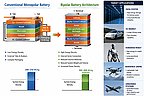
- BEEP technology claims to reduce weight, size, and manufacturing complexity by eliminating redundant components.
Experts would likely conclude that Solidion’s BEEP technology represents a significant innovation in solid-state battery design, but its commercial success hinges on overcoming manufacturing and financial challenges in a highly competitive market.
Solidion’s BEEP: A Radical Redesign in the Solid-State Battery Race
DALLAS, TX – June 16, 2026 – In the relentless and capital-intensive race to build a better battery, the industry has been fixated on a holy grail: the solid-state battery. Today, Dallas-based Solidion Technology (NASDAQ: STI) threw down a new gauntlet, unveiling a patented technology that doesn't just tweak the chemistry but fundamentally rethinks the entire battery structure. Their Bipolar Electrode-to-Pack (BEEP) technology, designed with the aid of AI, promises to leapfrog the persistent challenges of cost, weight, and manufacturing complexity that have kept solid-state batteries largely confined to the lab.
Solid-state technology has long been heralded as the successor to the ubiquitous lithium-ion battery, promising a safer, more energy-dense power source. By replacing the flammable liquid electrolyte with a solid material, these batteries could theoretically eliminate fire risk while packing more power into a smaller space. Yet, the path to commercialization has been fraught with difficulty. Manufacturing has proven stubbornly complex and expensive, and a significant portion of a battery pack's weight and volume comes not from the energy-storing cells themselves, but from the casings, wiring, and safety systems required to package them.
Solidion claims its BEEP architecture directly confronts this problem. Instead of producing hundreds of individual cells that are then painstakingly assembled into modules and packs, BEEP technology involves directly stacking large bipolar electrodes and solid electrolyte layers. The entire assembly is then housed in a single casing with minimal connectors. It’s a shift from a modular, piece-by-piece approach to an integrated, holistic design.
A Fundamental Rethink in Battery Design
The elegance of the BEEP concept lies in its simplicity. Conventional 'monopolar' battery packs are a complex web of individual cells, each in its own housing, connected by a tangle of wires and busbars. This adds significant 'dead weight' and 'dead volume'—components that contribute to the pack's size and mass but not its energy capacity. Solidion’s bipolar design, by contrast, connects the cells internally within a single stack, eliminating the need for most of this extraneous hardware.
“BEEP represents a fundamental rethinking of how battery packs are built,” said Jaymes Winters, Chief Executive Officer of Solidion Technology, in the company's announcement. “By eliminating the redundant housings, connectors, and fire mitigation systems that burden conventional designs, we've created a pathway to batteries that are lighter, smaller, safer, and less expensive to manufacture.”
This electrode-to-pack approach, optimized through AI-driven design processes, could yield significant gains in both gravimetric (by weight) and volumetric (by size) energy density. For industries where every gram and cubic centimeter counts, this is a game-changer. The company also asserts that the stacking procedure is “intrinsically simpler and easier” than conventional cell manufacturing, potentially lowering one of the highest barriers to entry for solid-state technology: manufacturability at scale.
Powering the Next Frontier
While the solid-state conversation has been dominated by the electric vehicle market, Solidion is aiming its BEEP technology at an even more demanding set of emerging industries. The press release specifically targets electric vertical take-off and landing (eVTOL) aircraft, drones, robotics, AI data centers, and space infrastructure. These are sectors where the limitations of current battery technology are not just an inconvenience, but a fundamental bottleneck to progress.
For the burgeoning eVTOL or 'flying taxi' market, battery weight is a critical limiting factor that directly impacts flight range and passenger capacity. A lighter, denser battery pack could be the difference between a commercially viable air taxi service and a technologically impressive but economically unfeasible prototype. Similarly, for space applications—from satellites in low-Earth orbit to future lunar bases—launch costs are directly proportional to mass. A battery that offers more power for less weight is enormously valuable.
Even on the ground, the impact could be profound. The explosive growth of AI has created an insatiable demand for data centers, which in turn require massive, reliable uninterruptible power supplies (UPS). Denser, safer batteries could provide more robust backup power in a smaller footprint. This focus on high-value, performance-driven markets could provide Solidion with a strategic entry point, proving its technology in applications where customers are willing to pay a premium for superior performance before tackling the more cost-sensitive automotive market.
Navigating a Crowded and Costly Race
Solidion's announcement, however promising, enters a fiercely competitive arena. The solid-state battery space is crowded with well-funded players, from startups like QuantumScape and Solid Power to established industrial giants like Toyota, all racing to solve the same puzzle. While Solidion's pack-level innovation is a compelling differentiator, the company still faces the same underlying material science and high-volume manufacturing challenges as its rivals.
The road from a pilot facility in Dayton, Ohio, to mass production is long and expensive. The industry as a whole is still grappling with creating stable, high-performance solid electrolytes and ensuring the perfect, durable interface between solid layers—a critical factor for a battery's longevity. While Solidion's strong intellectual property portfolio of over 385 patents provides a formidable moat, a patent is not a product.
Furthermore, a look at the company's financial health reveals a more complex picture. Despite a more than 13% surge in its stock price in premarket trading following the news, recent financial assessments have been less than stellar. Auditors have raised 'going-concern' warnings, signaling doubt about the company's ability to continue operations without securing additional funding. This financial pressure exists alongside recent moves to raise capital through a private placement and a deal to monetize its valuable patent portfolio, suggesting a company leveraging its key assets to fuel its ambitious technology roadmap.
The juxtaposition of groundbreaking technological potential against significant business and financial headwinds is the central drama of the innovation economy. Solidion’s BEEP technology is a genuinely exciting development that offers a clear, intelligent solution to a major industry bottleneck. Whether the company can navigate the treacherous path to commercialization and convince the market its financial footing is as solid as its battery technology will determine if this is a footnote or a turning point in the energy storage revolution.