
- 100% employee-owned company
- 30 employees now own the company through an Employee-Owned Trust (EOT)
- B Impact Score of 119.5 (exceeds certification threshold of 80)
Experts in business succession and employee ownership would likely conclude that Softstar Shoes' transition to a 100% employee-owned model through an EOT is a forward-thinking strategy that ensures long-term mission alignment, local economic stability, and enhanced employee engagement.
Softstar Shoes Charts a New Path with 100% Employee Ownership
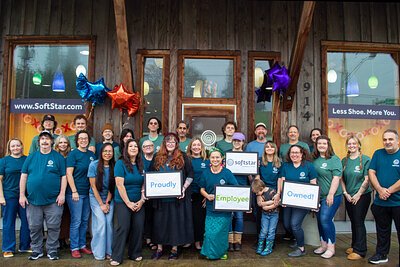
PHILOMATH, OR – February 02, 2026 – After four decades of handcrafting minimal leather footwear, Softstar Shoes has announced a landmark transition, becoming a 100% employee-owned company. The move ensures the 40-year-old manufacturer, a staple in Oregon's central valley, will remain locally rooted and mission-driven for generations to come, placing its future directly in the hands of its thirty employees.
The transition was achieved using an innovative model known as an Employee-Owned Trust (EOT), a structure designed to safeguard a company's purpose in perpetuity. For Softstar, this means cementing its commitment to sustainability, quality craftsmanship, and employee well-being.
"Softstar is a special place, and we wanted to make sure it would live on in the future," said Tricia Salcido, who, along with her husband Sal, led the company for the past 20 years. "Employee ownership keeps Softstar's mission intact and provides wealth-building opportunities for employees."
A New Blueprint for Business Succession
The decision to pursue an EOT places Softstar at the forefront of an emerging trend in American business succession. While common in the United Kingdom, the EOT model is relatively new in the United States. Unlike a traditional sale to a competitor or private equity firm, which often prioritizes short-term profits and can lead to restructuring or relocation, an EOT is designed for legacy preservation. It also differs from the more common Employee Stock Ownership Plan (ESOP), which allocates individual shares to employees. Instead, the EOT holds all company shares in a trust that operates for the collective benefit of all current and future employees.
This structure creates a legal fortress around the company's core mission. The trust's founding documents legally bind it to operate in a way that benefits its employee-owners and upholds the company's values. Crucially, the EOT ensures that Softstar can never be sold. All profits are mandated to be reinvested back into the company and its workforce, funding everything from employee compensation and bonuses to future innovation and capital improvements.
The Salcidos' journey to this decision was deeply personal. Having witnessed other family-owned businesses get sold, broken up, and moved out of their communities, they were determined to find a different path for the company they had nurtured. They partnered with Project Equity, a national non-profit that specializes in helping companies transition to employee ownership. Over the course of more than a year, Project Equity guided them through the complex legal and financial process, helping establish the trust and secure financing to facilitate the owners' exit.
Preserving Craft and Community in Oregon
For the Philomath community, Softstar's transition is more than just a change in corporate structure; it's a commitment to local economic stability. By anchoring the company permanently in the region, the EOT model secures 30 skilled manufacturing jobs and ensures that the economic benefits generated by the business continue to circulate locally.
This commitment to community and ethical practice is already part of Softstar’s DNA. As a certified B Corporation since 2015, the company has long been held to high standards of social and environmental performance. It boasts an impressive B Impact Score of 119.5, far exceeding the 80-point threshold for certification. This reflects a deep-seated dedication to practices like sourcing sustainable materials, minimizing waste, and fostering a positive work environment—values that the EOT structure is now set to protect indefinitely.
Former owners Sal and Tricia Salcido cultivated a unique culture where employees were seen as creative makers and family. They believed deeply in connecting customers to the people who crafted their products. Choosing the EOT model was the ultimate expression of this belief, entrusting the company's legacy to the very people who helped build it.
From Employee to Owner: A New Competitive Edge
The shift to an employee-owned model is poised to create significant advantages for Softstar, both internally and in the marketplace. For employees, the benefits are tangible. Beyond improved job security, the structure promises direct financial rewards through profit-sharing mechanisms, transforming every worker into a stakeholder with a vested interest in the company's success. Research from the National Center for Employee Ownership consistently shows that employees at owner-led firms have greater retirement savings and overall wealth.
Furthermore, the EOT empowers employees with a democratic voice in the company's governance. A peer-elected Trust Stewardship Committee will give employees a rotating opportunity to participate in high-level oversight, developing their business acumen and ensuring that management remains aligned with the workforce's interests. This level of engagement is a proven driver of morale, productivity, and innovation.
In the competitive minimalist footwear market, this authentic story of employee empowerment serves as a powerful differentiator. Softstar competes against larger brands in a niche where consumers are increasingly savvy about corporate ethics and sustainability. The company's transparent, employee-centric model reinforces its brand narrative, building deeper trust with customers who want to support businesses that align with their values. By investing in its people, Softstar is ultimately investing in the quality of its product and the strength of its brand, creating a sustainable model for success that is built to last.