
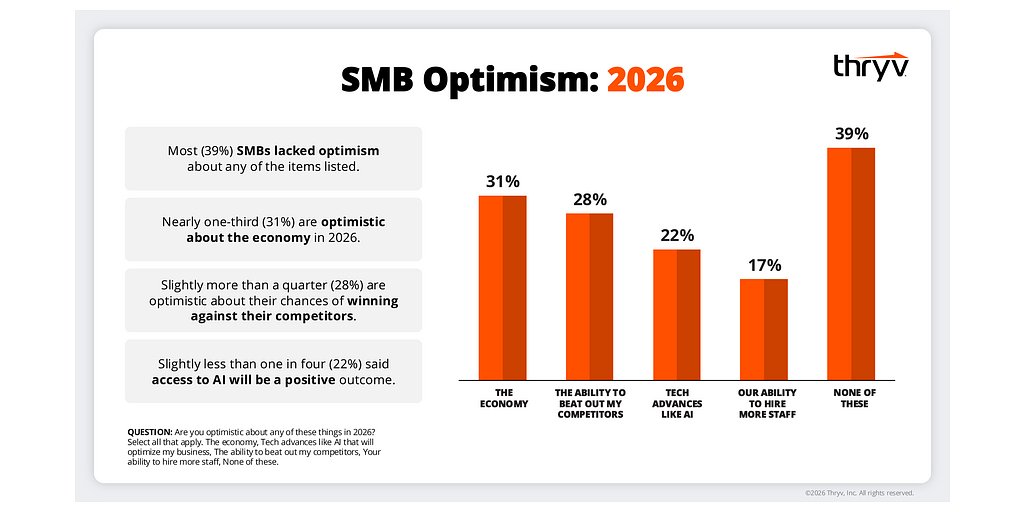
- 39% of small business owners report feeling optimistic about no factors for 2026 (economy, technology, etc.)
- 67% of small business owners believe AI will not impact their business in 2026
- 49% of business owners cite growth in the current economy as their single greatest concern
Experts agree that small businesses face a challenging 2026, with significant uncertainty about growth and AI adoption, but those that embrace technology will have a competitive advantage.
Small Businesses Face 2026 With Caution and a Critical AI Blind Spot
DALLAS, TX – January 22, 2026
Small business owners across the nation are stepping into 2026 on shaky ground, armed with a sentiment best described as “cautious optimism.” Despite a majority reporting a solid performance in 2025, a pervasive sense of uncertainty about the year ahead is tempering expectations and stalling confidence. New survey data reveals that while some see glimmers of hope, a significant portion of entrepreneurs are bracing for challenges, with many overlooking the very technological advancements that could prove essential for survival and growth.
A mid-December 2025 survey from small business software provider Thryv paints a complex picture of the American entrepreneurial mindset. When asked what business factors they felt optimistic about for 2026—from the economy to technology—the most common response, chosen by 39 percent of owners, was starkly telling: “none of the above.” This widespread apprehension points to a challenging psychological landscape for a sector that serves as the backbone of the U.S. economy.
A Climate of Uncertainty
The survey, which gathered responses from over 130 small and medium-sized businesses (SMBs), highlights a clear disconnect between past performance and future outlook. In 2025, a combined 63 percent of respondents said their revenue and business health either met (50 percent) or exceeded (13 percent) their expectations. This resilience came despite a year where nearly half of business owners cited economic turmoil (48 percent) and inflation (45 percent) as significant negative impacts.
Yet, looking forward, the mood darkens. The ability to grow in the current economy is the single greatest concern, cited by 49 percent of business owners. Close behind is the pressure of keeping up with rising employment costs, a worry for 44 percent. These fears reflect broader anxieties about navigating a volatile market where labor and operational expenses continue to climb.
“Small businesses are entering 2026 with a mix of hope and hesitation,” noted Grant Freeman, president of Thryv, in the company's press release. “While many expect growth, nearly a third remain unsure. That uncertainty can stall progress.”
Economic forecasts for 2026 offer a mixed bag that helps explain this cautious stance. While institutions like the IMF and Goldman Sachs project stable GDP growth for the U.S. and economists see inflation normalizing between 2-3 percent, the labor market remains a significant variable. Projections of a softening labor market, coupled with the disruptive potential of automation, validate SMB concerns over employment costs and talent management.
The Great AI Disconnect
Perhaps the most striking finding from the Thryv data is the profound skepticism surrounding artificial intelligence. An overwhelming two-thirds (67 percent) of small business owners believe AI will not impact their business in 2026. Furthermore, the sector is deeply divided on its own readiness, with only 38 percent feeling they have the necessary tools, including AI, to grow. A full third confessed they simply “don’t know.”
This sentiment stands in stark contrast to a tidal wave of industry data indicating that AI is not just coming for small business—it’s already here. A recent Salesforce report found that three out of four SMBs are already investing in AI, and 71 percent plan to increase that investment. Another report from the U.S. Chamber of Commerce declared AI adoption “nearly ubiquitous” among small businesses. This creates a tale of two SMB sectors: one rapidly embracing AI for a competitive edge, and another, as captured in the Thryv survey, remaining on the sidelines, unconvinced of its relevance.
Freeman commented on this gap, stating, “This survey demonstrates that not all small businesses see the transformative power of AI. Those who are already leveraging AI to streamline operations and uplevel their marketing have a clear competitive edge.”
Research into the barriers for AI adoption suggests this isn't just stubbornness, but a knowledge and resource gap. A lack of understanding of AI's benefits, concerns over cost, and a shortage of technical expertise are the primary hurdles preventing wider implementation. For the businesses that have crossed this chasm, the benefits are significant, with reports of enhanced operational efficiency, improved competitiveness, and a tangible return on investment.
Navigating the Path Forward
For the large contingent of business owners feeling uncertain, the path forward involves bridging the gap between their current operations and the tools available to address their primary concerns. The anxieties over growth and employment costs are precisely the areas where modern technology platforms, including AI-powered systems, promise the most impact. All-in-one software suites, like the one offered by Thryv, are designed to consolidate functions like customer relationship management (CRM), marketing automation, scheduling, and invoicing into a single, manageable interface.
These platforms aim to automate repetitive tasks, freeing up owners and employees to focus on core business activities and customer service. AI-driven features can optimize marketing campaigns, score leads to prioritize sales efforts, and provide data insights that were once the exclusive domain of large corporations with dedicated analytics departments. By increasing efficiency, these tools can directly mitigate the pressure of rising labor costs and unlock new avenues for growth.
However, the adoption of any new technology is not without friction. The ultimate success for a small business often hinges on the quality of the software, the responsiveness of customer support, and a realistic alignment of expectations. As entrepreneurs weigh their options, the decision to invest in technology becomes a critical strategic choice.
The businesses that thrive in the uncertain climate of 2026 will likely be those that proactively seek to understand and implement new technologies. Overcoming the initial hesitation and knowledge gaps to leverage tools like AI could be the deciding factor that, as Freeman suggests, turns cautious optimism into concrete success.
Topics & Related
Artificial Intelligence
Generative AI
Labor Market
Machine Learning
Automation
Revenue
Economic Indicators
Software & SaaS
AI & Machine Learning
Cloud & Infrastructure
Fintech
Consumer & Retail
Related Company Pulse