
- 74% of job seekers and 71% of hiring managers now view skills learned through informal online platforms as credible.
- 47% of job seekers add self-acquired skills to their resumes, creating a 'verification headache' for employers.
- 92% of hiring managers say demonstrating how skills are applied is more effective than reviewing a resume.
Experts agree that the rise of self-taught skills among Gen Z is reshaping hiring practices, but employers struggle to verify these skills, highlighting the need for practical assessment methods over traditional credentials.
Skills Over Diplomas: Gen Z's Learning Revolution Creates Hiring Puzzle
OKLAHOMA CITY, Feb. 25, 2026 – From YouTube crash courses in data analytics to TikTok tutorials promising graphic design mastery in minutes, a quiet revolution is reshaping the American workforce. A massive surge in self-taught skills, led by a digitally native Gen Z, is forcing a nationwide reckoning over what it means to be qualified for a job, creating what many are calling a significant 'verification headache' for employers.
A new survey from Express Employment Professionals and The Harris Poll reveals the staggering scale of this shift. While a majority of both job seekers (74%) and hiring managers (71%) now view skills learned through informal online platforms as credible, the practical application of this belief is proving complex. Nearly half of all job seekers (47%) are adding these self-acquired skills to their resumes, leaving companies struggling to separate genuine expertise from inflated claims.
The Self-Taught Generation Rewrites the Rules
This trend is overwhelmingly driven by the youngest members of the workforce. A remarkable 66% of Gen Z report teaching themselves professional skills online, a figure that dramatically outpaces the 50% of millennials, 35% of Gen X, and just 20% of baby boomers who do the same. This generation, having grown up with instant access to information, sees little distinction between learning in a lecture hall and learning from a curated YouTube playlist.
This proactive approach to career development is challenging the long-held supremacy of traditional education. The data suggests a growing acceptance of these non-traditional learning paths, yet hiring practices have been slow to catch up. The survey found that while 53% of hiring managers still prefer candidates with formal education, a combined 47% now value self-taught skills equally or even favor them. This near-even split highlights a fundamental tension in the modern labor market: the skills are in demand, but the credentials are in question.
This shift isn't just generational; it also reveals a gender divide. According to the poll, men (53%) are notably more likely than women (40%) to include self-taught skills on their resumes, suggesting different levels of confidence or strategy in how they present their qualifications to potential employers.
Beyond the Resume: The Employer's Verification Dilemma
The core of the problem for businesses lies in validation. A line item on a resume stating 'Proficient in Python' or 'Expert in SEO' offers little insight into how that skill was acquired or how effectively the candidate can apply it. Consequently, a striking 92% of hiring managers say demonstrating how skills were used or would be applied in a role is far more effective than simply reviewing a resume.
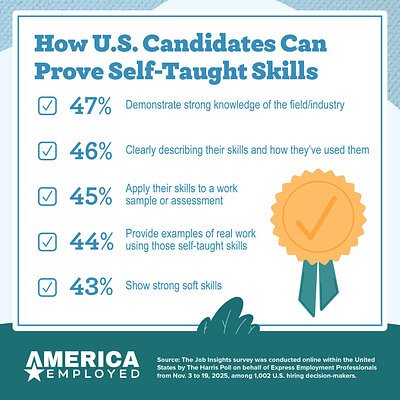
This has placed a new burden on both job seekers and employers. Candidates must now be prepared not just to list their skills, but to prove them. For employers, the 'verification headache' requires a move beyond credentialism and toward practical evaluation. According to the survey, confidence in a candidate's self-taught skills is boosted by:
- Demonstrated industry knowledge (47%)
- Clear explanations of how skills were applied (46%)
- Completion of a work sample or assessment (45%)
In response, the HR technology market is booming with solutions designed to bridge this verification gap. Companies are increasingly turning to skill assessment platforms like TestGorilla and HackerRank to administer standardized tests for technical roles. Digital credentialing services such as Credly are allowing learners to display verified micro-credentials and badges for completed online courses. For creative and technical professionals, portfolio platforms like Behance and GitHub have become essential tools for showcasing tangible proof of their abilities.
Adapting the Playbook in a Skill-Based Economy
Faced with this new reality, companies are beginning to overhaul their hiring playbooks. The Express-Harris Poll shows that half of all hiring managers say their company has already updated its processes to better recognize and verify self-taught skills, while another 35% have more updates planned. Larger employers, who encounter a higher volume of candidates with diverse educational backgrounds, are leading this charge.
This evolution marks a significant pivot toward a skill-based economy, where proven ability is becoming the primary currency, not the pedigree of one's degree. The focus is shifting from where a person learned to what they can do.
"Self‑learning is opening doors for workers everywhere, but it also raises the bar," said Bob Funk Jr., CEO of Express Employment International, in the press release. "Job seekers must be ready to demonstrate their abilities right away, and employers should update their hiring practices to evaluate the skills people gain on their own. As self-taught learning becomes more common, refining how to assess these skills will help employers make better, more confident decisions about the talent they bring on board."
AI's Dual Role: Fueling Learning and Complicating Hiring
Accelerating this entire trend is the rapid advancement of artificial intelligence. AI is acting as both a catalyst for self-directed learning and a new complication for hiring managers. The survey found that 75% of job seekers say AI makes them more likely to pursue additional training, and 76% believe it is appropriate to learn professional skills using AI tools.
AI-powered platforms can create personalized learning paths, act as virtual tutors, and curate vast amounts of information, making it easier than ever for individuals to upskill on their own terms. However, this same technology presents a double-edged sword. Other recent polling indicates that a vast majority of hiring managers (86%) believe AI makes it too easy for candidates to exaggerate or fabricate skills on their resumes, adding another layer to the verification challenge.
This paradox reinforces the urgent need for robust, practical assessment methods. As AI reshapes the world of work by automating tasks and creating new job functions, it is simultaneously reshaping how people prepare for it. The companies that succeed will be those that can effectively identify and harness demonstrable talent, regardless of its origin, in an environment where the lines between human ability and AI assistance are increasingly blurred.
Topics & Related
Artificial Intelligence
Generative AI
Automation
Machine Learning
Remote & Hybrid Work
Upskilling & Reskilling
Software & SaaS
AI & Machine Learning
Related Company Pulse