
- 450+ materials: The foundry can work with over 450 different materials, including metals, complex oxides, and semiconductors.
- $100B market by 2035: The advanced semiconductor packaging market is projected to reach nearly $100 billion by 2035.
- Hours vs. months: The DALP® technology reduces prototyping time from months to hours.
Experts view this collaboration as a transformative step in materials science, leveraging AI and atomic-scale manufacturing to accelerate innovation and secure Singapore's leadership in deep-tech research and commercialization.
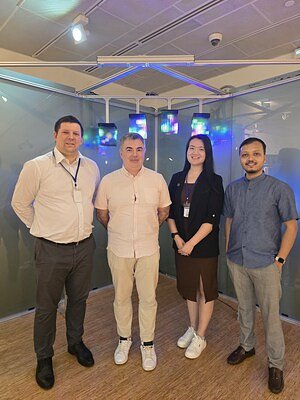
Singapore's AI Foundry to Build Future Materials Atom by Atom
SINGAPORE – April 16, 2026 – In a move set to redefine the future of materials science, Danish deep-tech firm ATLANT 3D and the National University of Singapore's (NUS) Institute for Functional Intelligent Materials (I-FIM) have announced a landmark collaboration. The two organizations have signed a Memorandum of Understanding (MOU) to establish a shared, AI-driven materials discovery foundry, aiming to merge atomic-scale manufacturing with advanced robotics and artificial intelligence.
The new foundry will be housed within NUS I-FIM's robotic laboratory at the Campus for Research Excellence and Technological Enterprise (CREATE). It represents a significant step towards creating "self-driving laboratories" that can invent and test novel materials at a speed previously unimaginable, promising to accelerate innovation across a swath of high-tech industries, from semiconductors to quantum computing.
The Dawn of Self-Driving Science
At the heart of this collaboration is ATLANT 3D's groundbreaking Direct Atomic Layer Processing (DALP®) technology. DALP® is a revolutionary manufacturing technique that allows scientists and engineers to build materials and devices literally atom by atom. Unlike conventional methods that rely on complex, multi-step processes involving masks and chemical etching, DALP® uses a patented micronozzle system to precisely deposit material only where it is needed. This "direct writing" approach operates at atmospheric pressure, dramatically simplifying and accelerating the prototyping phase from months to mere hours.
This technology will be integrated into the NANOFABRICATOR® platform, which will serve as the core synthesis engine within NUS I-FIM's highly automated robotic hub. The system will support AI-driven workflows where intelligent algorithms can design a new material, direct the robotic platform to synthesize it using the DALP® process, and then automatically conduct experiments to test its properties. The resulting data is then fed back into the AI, creating a closed-loop system of rapid learning and discovery. This paradigm shift promises to compress years of traditional trial-and-error research into a highly efficient, automated process.
The platform's versatility is a key advantage, with the capability to work with over 450 different materials, including the metals, complex oxides, and semiconductors crucial for next-generation electronics. This will enable researchers to explore a vast and complex design space for new material combinations.
"We are excited to partner with ATLANT 3D in harnessing new capabilities in atomic-scale fabrication," said Professor Sir Kostya S. Novoselov of the Institute for Functional Intelligent Materials at NUS. "The ability to fabricate and test novel material combinations with atomic precision, while producing device-relevant structures, would accelerate experimental studies and open new lines of inquiry. I look forward to integrating advanced fabrication platforms into our AI-driven workflows at NUS I-FIM."
Singapore's Strategic Deep-Tech Gambit
The new foundry is far more than an isolated academic project; it is a cornerstone of Singapore's ambitious national strategy to secure a leading position in the global deep-tech landscape. The initiative is explicitly designed to support the "AI for Science" programme under the National Research Foundation, Singapore (NRF), a well-funded effort to embed artificial intelligence at the core of scientific discovery.
This collaboration aligns perfectly with Singapore's broader Research, Innovation and Enterprise (RIE2025) plan, a multi-billion dollar state commitment to fostering a vibrant ecosystem where cutting-edge research is translated into commercial success. By establishing this world-class facility, Singapore is not only attracting top-tier global talent and technology but also creating a powerful nexus for collaboration between academia, industry, and government.
The vision is to create a reference model for self-driving laboratories that can be replicated and scaled, solidifying the nation's reputation as a hub for advanced manufacturing and AI-powered innovation. This strategic investment aims to build sovereign capabilities in critical technologies and ensure Singapore remains competitive in a rapidly evolving technological world.
"An AI-driven materials discovery foundry in Singapore represents our vision for what becomes possible when atomic-scale manufacturing and AI are deeply integrated," stated Dr. Maksym Plakhotnyuk, CEO and Founder of ATLANT 3D. "Singapore is one of the world's most forward-thinking environments for deep-tech and AI-for-science materials discovery, and we are excited to pursue this with NUS."
Fueling Next-Generation Industries
The practical implications of this AI-driven foundry are vast, with the potential to catalyze breakthroughs in some of the world's most critical and fastest-growing industries. The collaboration is specifically targeting application areas poised for disruption, including 2D materials, advanced semiconductor packaging, quantum materials, and photonics.
In the semiconductor sector, for instance, the industry is grappling with the physical limits of Moore's Law. Advanced packaging—the art of combining multiple chips (or "chiplets") into a single, powerful package—has become a key frontier for innovation. The global market for this technology is projected to soar, potentially reaching nearly $100 billion by 2035, driven by the insatiable demands of AI, high-performance computing, and 5G. The ability of the new foundry to rapidly prototype complex, multi-material structures at the atomic level could provide a decisive edge in designing the next generation of powerful and efficient AI accelerators.
Similarly, the market for 2D materials like graphene is expanding rapidly, with applications in everything from ultra-efficient electronics to advanced energy storage. The foundry's ability to automate the synthesis and testing of these novel materials will dramatically shorten the typically long and arduous path from lab discovery to commercial viability. By accelerating the development of these foundational technologies, the partnership between ATLANT 3D and NUS I-FIM aims to directly fuel the engines of future industrial growth.
From Lab to Fab: A New Manufacturing Paradigm
The long-term vision extends beyond a single research facility. ATLANT 3D’s "lab-to-fab" philosophy aims to create a seamless pipeline from initial discovery to scalable manufacturing. The NANOFABRICATOR® platform is designed not just for R&D but also for eventual production, democratizing access to atomic-scale fabrication. This allows universities, startups, and corporate R&D centers to bring once-exclusive manufacturing capabilities in-house, fostering a more decentralized and dynamic innovation ecosystem.
This model is particularly well-suited to Singapore's robust framework for commercializing deep-tech research. The government provides substantial support through funding schemes like Startup SG Equity and venture-building partnerships that help translate intellectual property from institutions like NUS into thriving businesses. The establishment of SG Growth Capital in 2025 is set to further streamline this process, providing sustained financing for capital-intensive deep-tech ventures.
By combining cutting-edge technology, a world-class research institution, and a supportive national strategy, the AI-driven materials discovery foundry is poised to become more than just a laboratory. It represents a new paradigm for innovation, where the digital design of a material can be transformed into a physical reality with unprecedented speed and precision, paving the way for the technologies that will shape the 21st century.