
- Global IoT device management market: Valued at $8.8 billion in 2025, projected to exceed $52 billion by 2033
- IoT-related breaches: 60% tied to outdated software
- IoT cyberattacks: Increasing by over 80% year-over-year
Experts agree that AI-driven automation is becoming essential for managing the complexity and security risks of enterprise IoT ecosystems, though centralized orchestration introduces new challenges that must be carefully addressed.
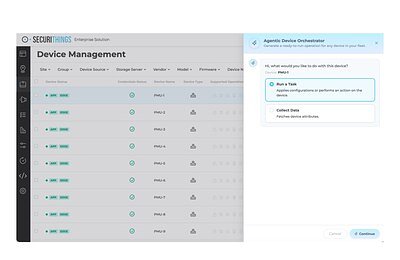
SecuriThings' AI Agents Aim to Tame Enterprise IoT Chaos
TEL AVIV, Israel – March 19, 2026 – Physical security specialist SecuriThings today announced a significant strategic pivot with the launch of its Agentic Device Orchestrator, an AI-powered platform designed to manage and control the sprawling, often chaotic, world of enterprise Internet of Things (IoT) devices. The new offering extends the company's reach far beyond its traditional domain of security cameras and access control systems, aiming to provide unified, automated command over everything from office printers to specialized clinical engineering equipment.
The move signals a direct response to a market grappling with the explosive growth of connected devices. By leveraging what it calls "agentic AI," SecuriThings aims to replace complex manual oversight with intelligent, autonomous agents, empowering even non-technical staff to manage and secure vast device fleets.
The Mounting Challenge of a Connected World
The promise of IoT—smarter buildings, efficient operations, and data-driven insights—has been accompanied by immense management and security headaches for enterprises. The scale is staggering. Market research indicates the global IoT device management market, valued at nearly $8.8 billion in 2025, is on a steep growth trajectory, with some projections forecasting it to exceed $52 billion by 2033. This explosion in connected endpoints has created a highly fragmented and complex ecosystem.
Organizations now manage thousands, sometimes millions, of devices from a multitude of vendors, each with its own protocols, software, and security vulnerabilities. This diversity creates significant operational friction and security gaps. A lack of centralized visibility is a common complaint, leaving IT and security teams unable to maintain a complete inventory, apply consistent policies, or effectively monitor for threats.
Traditional IT management tools have proven ill-equipped for this new paradigm. The sheer volume and heterogeneity of devices make manual tasks like firmware updates and configuration changes logistically impractical and prone to error. This operational inefficiency drives up costs and, more critically, leaves organizations exposed to significant risk.
AI Agents Enter the Fray
SecuriThings is betting that a new class of artificial intelligence is the key to solving this complexity. The Agentic Device Orchestrator is built on the concept of "agentic AI," a step beyond simple automation. Instead of following rigid, pre-programmed rules, these intelligent software agents are designed to be autonomous, goal-oriented, and adaptive. They can independently analyze situations, make decisions, and take proactive steps to achieve objectives without constant human intervention.
At the core of the new platform is a set of these intelligent agents designed to make device control accessible to all users. For operators without deep technical knowledge, the system offers a natural language interface. A user can simply state a goal—such as "check the remaining storage on all security cameras in the west wing" or "reboot all printers that are offline"—and the AI agent automatically constructs and executes the necessary workflow. This eliminates the need for specialized scripting skills or knowledge of complex device-specific APIs.
"Our customers rely on our platform for unmatched depth of operational control and automation of their critical physical security device fleet," said Roy Dagan, CEO and co-founder of SecuriThings, in the announcement. "With Agentic Device Orchestrator, they can now exert the same granular control over a far wider and more diverse set of devices across the enterprise. Leveraging AI eliminates technical skills as a blocker—operators no longer need deep expertise in device-specific configuration commands to execute complex remediation and maintenance at scale."
Bridging the Gap from Detection to Remediation
For years, the cybersecurity industry has focused on visibility—detecting problems within a network. However, as threats multiply, the focus is shifting decisively toward remediation. Knowing about a problem is no longer enough; organizations need the ability to fix it quickly and at scale. A recent Gartner forecast underscores this trend, predicting that by 2027, 45% of organizations will prioritize remediation capabilities as a key selection criterion for cyber-physical security platforms.
SecuriThings' new platform is engineered to address this "last mile" problem in IoT security. It moves beyond passive monitoring to enable direct, automated intervention down to the individual device. This is particularly critical in addressing one of the most persistent and dangerous IoT vulnerabilities: unpatched firmware. According to the IoT Security Foundation, a staggering 60% of IoT-related breaches are tied to outdated software, a vulnerability that attackers frequently exploit. The average cost of an IoT breach can run into the millions, making proactive management a financial and operational imperative.
By automating tasks like vulnerability scanning, patch deployment, and password rotation across an entire fleet, the Agentic Device Orchestrator aims to transform security from a reactive, manual process into a continuous, proactive function. This allows organizations to close security gaps before they can be exploited, significantly reducing their attack surface in an environment where IoT cyberattacks have been increasing by over 80% year-over-year.
A Strategic Expansion into a Competitive Market
The launch marks a bold strategic expansion for SecuriThings, moving it from a specialized player in physical security to a contender in the broader, highly competitive enterprise IoT platform market. This space is currently dominated by tech giants like Microsoft with its Azure IoT platform and Amazon with AWS IoT Core, both of which offer robust tools for device provisioning, management, and security integrated into their vast cloud ecosystems.
SecuriThings aims to differentiate itself with its laser focus on agent-driven, device-level remediation and its device-agnostic approach. While major cloud providers offer powerful toolkits, they often require significant development effort to build custom solutions. SecuriThings is offering a more out-of-the-box solution specifically for the remediation lifecycle, promising to integrate with any IP-enabled device, regardless of the vendor. This unification of control—spanning security cameras, building automation systems, printers, and even medical devices—addresses a major pain point for enterprises struggling with siloed management tools.
However, such a powerful, centralized orchestration layer is not without potential risks. Critics of this model point to the creation of a single point of failure; a compromise of the orchestrator could give an attacker control over an entire IoT fleet. The complexity of the AI itself could also introduce unforeseen vulnerabilities. Securing the orchestrator is therefore paramount to the platform's success.
As enterprises increasingly merge their physical and digital operations, the line between IT and Operational Technology (OT) continues to blur. Research from Deloitte shows that 58% of organizations are already combining AI with IoT sensors to shift from reactive monitoring to autonomous interaction with the physical world. SecuriThings is positioning its platform to be the central nervous system for this new, converged reality, offering a unified way to manage and secure the devices that underpin modern business operations. To further explain its new platform, the company is hosting a webinar on April 28, 2026, titled "AI-Powered Control for Enterprise IoT."