
- 25% reduction in workplace injuries with human-robot collaboration in warehouses
- Global warehouse automation market projected to double from nearly $30 billion in 2026 to almost $60 billion by 2030
- Training time for robots reduced from weeks to hours using demonstration-based learning
Experts view this deployment as a significant milestone in logistics automation, demonstrating that AI-powered robots can adapt to dynamic warehouse environments, enhance efficiency, and transform human roles by taking over repetitive tasks while enabling workers to focus on higher-value activities.
SAP's AI Robots Learn on the Job in Live Warehouse Deployment
WALLDORF, Germany – May 11, 2026 – By Matthew Richardson
In a move that transitions advanced artificial intelligence from a research concept into a tangible operational reality, enterprise software giant SAP and AI robotics firm Cyberwave have successfully deployed fully autonomous robots in a live SAP logistics warehouse. The initiative, unveiled today at SAP’s facility in St. Leon-Rot, Germany, marks a pivotal moment for the logistics industry, as AI-powered machines are now performing complex, variable tasks like box folding, packaging, and shipping fulfillment alongside human counterparts.
This deployment is the first major operationalization of SAP's strategic push into Physical AI, a field focused on intelligent robots that can perceive, reason, and act in the physical world. By using its own warehouse as a proving ground, SAP is demonstrating that the era of adaptable, intelligent automation is not a distant vision but a present-day solution delivering measurable gains in efficiency and resilience.
The Dawn of the Learning Robot
Logistics has long been considered one of the final frontiers for robotic automation due to its inherent unpredictability. Unlike the controlled environment of a traditional assembly line, a warehouse is a dynamic space where object sizes, shapes, and weights constantly change. Traditional robots, which rely on rigid, hand-coded programming, falter in such conditions, often requiring weeks of engineering for each new task and breaking down when faced with unexpected variations.
Cyberwave’s technology directly confronts this challenge. The company has developed a platform that bypasses painstaking programming in favor of rapid, demonstration-based learning. Instead of writing complex code, non-expert operators can now teach robots new tasks by simply showing them. This data is then used to fine-tune sophisticated Vision-Language-Action (VLA) and Reinforcement Learning (RL) models. VLA models allow the robot to interpret its surroundings and instructions, while RL enables it to learn and improve through trial and error. The result is a robot that doesn't just memorize scripted motions but generalizes its learning to handle the endless variability of a real warehouse.
This approach slashes training time from weeks to mere hours. The robots at the St. Leon-Rot facility are not just executing pre-defined commands; they are adapting to different box sizes, product orientations, and workflow changes in real time.
"Partnering with SAP on a live warehouse deployment is a defining moment—not just for Cyberwave, but for what AI-powered robotics can actually deliver in enterprise logistics today," said Simone Di Somma, Co-Founder and CEO of Cyberwave. "Robots no longer need to be painstakingly programmed for every object or scenario—they learn, adapt, and keep improving. That's the shift we've been building toward."
SAP’s Blueprint for the Intelligent Enterprise
For SAP, this initiative is more than a technological showcase; it is a core part of its business strategy. By deploying Cyberwave’s robots within its own operations—a practice often called 'eating your own dog food'—SAP is creating a powerful reference implementation for its global customer base. This move validates its own technology stack and demonstrates a clear path for other enterprises to follow.
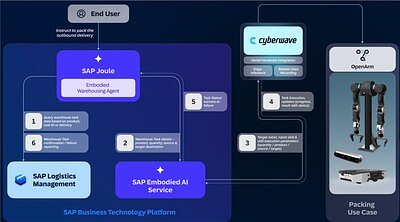
The entire integration hinges on SAP's own cloud-native solutions. The SAP Logistics Management (LGM) system, which gained significant attention at the LogiMAT 2026 trade fair for its rapid implementation architecture, serves as the digital backbone. Tasks from the LGM are translated into precise robot commands via the SAP Embodied AI Service, with the SAP Business Technology Platform (BTP) managing the end-to-end data flow. This seamless integration proves that sophisticated robotics can be deployed quickly and reliably within existing enterprise frameworks.
"By integrating AI-powered robotics directly into our live warehouse operations, we are proving that Physical AI is no longer a concept—it's delivering real value today," stated Tim Kuebler, Head of Warehouse & Shipping at SAP. "At our St. Leon-Rot warehouse, SAP LGM provides the digital backbone that allows robots to be deployed quickly, operate reliably, and scale with our processes. This is a decisive step toward more resilient and efficient logistics operations."
This strategy aligns with SAP’s strong financial performance and stated focus on becoming a leader in Business AI, having reported significant growth in its cloud revenue and making AI a central pillar of its customer offerings.
Redefining the Warehouse Workforce
The introduction of autonomous robots invariably raises questions about the impact on human workers. The announcement emphasizes that the robots are freeing employees from "repetitive, physically demanding tasks." This reflects a broader industry trend where automation is not simply replacing jobs but transforming them. As robots take over monotonous and strenuous activities, human workers can be redeployed to higher-value roles that require problem-solving, critical thinking, and customer interaction.
Industry data supports this vision of human-robot collaboration. Studies have shown that warehouses adopting automation can see a 25% reduction in workplace injuries, as robots handle the physically taxing labor. Furthermore, human-machine teams are projected to be significantly more productive than either working alone. The key to realizing these benefits lies in workforce development, with a growing emphasis on reskilling and upskilling employees to manage, maintain, and work alongside these new intelligent systems.
This shift is also a pragmatic response to persistent labor shortages in the logistics sector. With the global warehouse automation market projected to more than double from nearly $30 billion in 2026 to almost $60 billion by 2030, robots are increasingly seen as essential for filling workforce gaps and enabling companies to meet the relentless demand driven by e-commerce.
A New Era for Logistics Automation
The SAP and Cyberwave deployment is a landmark event in a fiercely competitive and rapidly evolving market. While companies like Locus Robotics and KUKA have made significant strides in warehouse AMRs, Cyberwave's focus on rapid, demonstration-based learning for complex manipulation tasks presents a distinct and powerful advantage. It addresses the core challenge of adaptability that has long held back more advanced robotic applications.
With the global logistics robot market projected to quadruple to over $65 billion by 2034, the potential for this technology is immense. For SAP, the St. Leon-Rot facility is just the beginning. The success of this reference implementation paves the way for scaling the solution across its own global operations and, more importantly, offering it as a proven, integrated solution to its vast network of customers.
The capabilities honed in the warehouse—adaptive manipulation, rapid learning, and intelligent decision-making—are highly transferable. The same core technology could soon find applications in flexible manufacturing, infrastructure inspection, and retail fulfillment, heralding a new wave of automation where intelligent machines become integral, adaptable partners in the physical world.